Law that prohibits the digital dollar controlled by the Fed advances in Congress
Key facts:
-
The bill was approved by 216 votes and will now go to the Senate.
-
According to Emmer, “this is what the digital economy of the future needs.”
The Lower House of the United States approved this Thursday the bill that prevents the country’s Federal Reserve (Fed) from issuing a central bank digital currency (CBDC) without first obtaining the approval of the US Congress.
This is the State Law Against CBDC Surveillance, initially presented by Republican Congressman Tom Emmer, an assiduous defender of the bitcoin (BTC) ecosystem, cryptocurrencies, as well as privacy.
The proposed law It was approved by 216 votes in favor and 192 against. The majority of voters in favor of the project were from the Republican Party, while those who opposed the proposal were from the Democrats.
This regulation, which now passes to the US Senate, explicitly blocks the creation of a CBDC that is issued by the US Executive.
“It prevents unelected bureaucrats from issuing a CBDC, which would threaten Americans’ right to financial privacy, without explicit authorization from Congress,” says a press release from the Financial Services Committee of the United States House of Representatives.
A CBDC that reflects “American values”
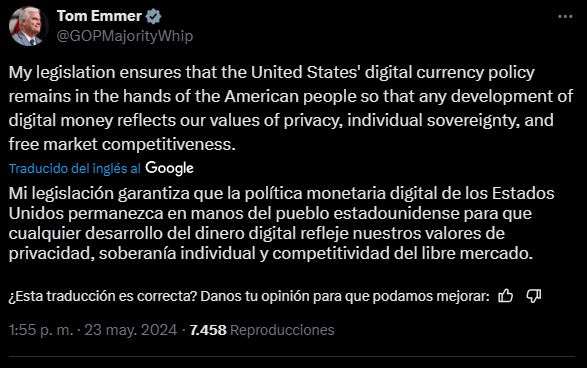
Tom Emmer, promoter of the regulations approved in the Lower House, asserted that the project guarantees that the digital monetary policy of the United States “remains in the hands of the American people.”
This will allow, in his words, that any development of digital money “reflects values of privacy, individual sovereignty and free market competitiveness.”
“This is what the future global digital economy needs,” said Emmer, after recalling that for more than two years they have worked to educate, increase support and pass legislation, “that prevents bureaucrats from issuing a financial surveillance tool to undermine fundamentally our American values.”
It must be remembered that, in accordance with the provisions of the bill, the creation of the American CBDC, the digital dollar, It would not depend solely on the Federal Reservean entity equivalent to the US central bank and whose authority is usually promoted by the president of the country.
Instead, it is proposed that the creation of this asset have the approval and approval of the entire US Congress. This, preventing the CBDC from becoming “a weapon against its own citizens.” This is according to Patrick McHenry, Republican leader of the House Financial Services Committee.
In the session, McHenry, who has also publicly defended the bitcoin and cryptocurrency ecosystem, stated that this bill will prevent the US from being like the Chinese Communist Party (CCP), which “uses its CBDC to track the spending habits of its citizens.”
This data is being used to “create a social credit system that rewards or punishes people based on their behavior,” McHenry warned.
In the congressman’s opinion, this type of financial surveillance “has no place in the United States.” And he expressed concern that the Democratic administration “does not agree” with that. This, when remembering that the White House has shown interest in this type of digital currency.
“That is why the State Law Against Surveillance of CBDCs is necessary. “This requires Congress to authorize legislation for the issuance of any CBDC, ensuring that it must reflect American values,” he stated. “If not open, permissionless and private, a CBDC is nothing more than a CCP-style surveillance tool waiting to be weaponized,” he added.
Combo of laws in favor of the Bitcoin ecosystem
With the approval of this regulation, the United States takes a step in favor of the privacy of American users. This, remembering that CBDCs can be vehicles to increase financial control over the population.
There are even studies that determine that governments, in this case the Brazilian one, will have the capacity to monitor the finances of your CBDC users, the so-called Drex. Thus, the Rio monetary authorities will be able to block, open, close, confiscate and regulate the expenses of users of the central bank digital currency.
Now, this is the second project related to digital assets that receives the approval of the Lower House of the United States this week. On May 22, the body approved the FIT21 Law, aimed at regulating the bitcoin (BTC) ecosystem and cryptocurrencies.
The proposal will now go to the United States Senate for consideration. If it is approved there, it will be sent to the Oval Office of the White House, where President Joe Biden will place his signature on the document, promulgating it into law. A 180° turn in his policy on the cryptocurrency market.
The White House clarified in a statement that He would not veto the regulations if they were approved by the Senate. They say that, although they do not agree with the regulation, they want to promote regulation for the emerging and disruptive bitcoin sector.