BlackRock now has the world’s largest bitcoin ETF
In just five months, the bitcoin (BTC) spot ETF issued by asset manager BlackRock, iShares Bitcoin Trust (IBIT), has managed to become the largest in the world.
This milestone was achieved yesterday, May 29, when the ETF had inflows that reached $103 millionaccording to data from Farside Investors.
IBIT has achieved raise 288,670 BTC, since its launch on January 10. The ETF managed by BlackRock now holds 1.4% of the circulating supply of bitcoin which is 19,705,021 BTC.
In this way, it has surpassed Grayscale’s spot ETF, Grayscale Bitcoin Trust (GBTC), which held first place as the fund with the most bitcoin.
At its launch on the US stock market, GBTC had 619,000 BTC, according to data from Bitcoin Treasuries. From that moment on, capital inflows to the fund began to decline, leaving it with less and less bitcoin, as can be seen in the following graph.
Currently the fund issued by Grayscale has 287,450 BTC, this represents a reduction in digital currency holdings of more than 50%.
In the following graph you can see the path of IBIT (green line) and GBTC (red line) week after week since they were approved and how the fund managed by BlackRock was hot on the heels of Grayscale.
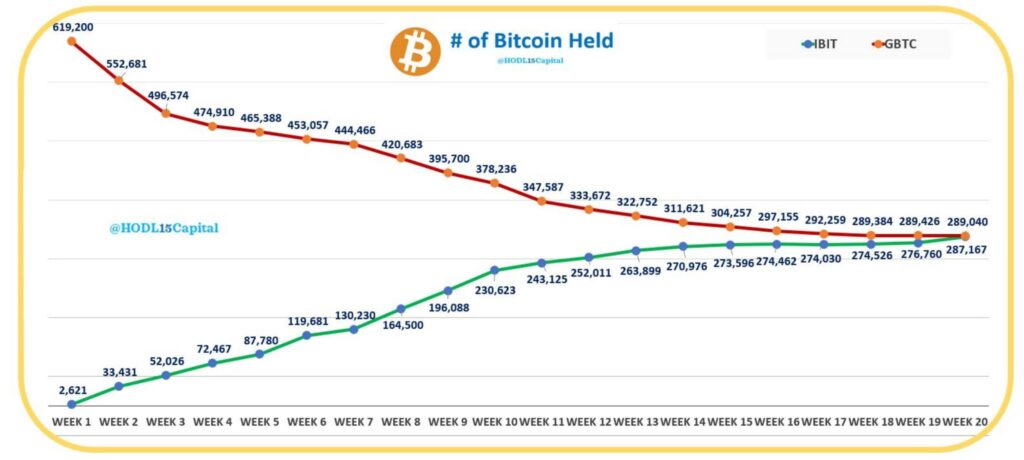
Yesterday GBTC had a net outflow of 105 million dollars, which allowed it to give way to IBIT to the first place of bitcoin ETFs in the United States and the rest of the world.
High management fees were the brakes for GBTC
The fees or commissions charged by ETs are costs associated with the investment in the financial product, which in turn generate profitability for their issuers. These include management fees, brokerage and administrative services.
In the case of GBTC, it is the ETF with the highest fees, 1.50%. In contrast, BlackRock (IBIT) and Fidelity (FBTC) bitcoin ETF fees are 0.25%.
This is something that has worked against GBTC since its launch. For several months, investment companies such as JP Morgan have warned of the significant challenges that Grayscale could face if it insists on its rates and avoids implementing changes to its structure, as reported by CriptoNoticias.
JP Morgan highlighted the need for GBTC to adapt in an increasingly competitive market.
ETF specialist Eric Balchunas commented that “fee and issuer brand are the No. 1 and 2 most important criteria for advisors when choosing an ETF, according to surveys.”
Taking this into account, lTariffs are one of the most important factors that led to GBTC’s poor performance.
Michael Sonnenshein, CEO of Grayscale, commented two months ago that the fund’s fees would decrease in the near future, as the market evolves and matures. But, Sonnenshein himself reported that he was leaving the position of CEO on May 20 and this rate decrease has not occurred yet.
Bitcoin ETF with 11 positive days
Aside from the negative activity of GBTC, The set of bitcoin ETFs achieved 11 days in the green. The longest streak of positive flows since February.
The fund managed by Fidelity, Fidelity Wise Origin Bitcoin Fund (FBTC), had the second largest capital inflow reaching 34 million dollarsFarside Investors also reported.
For their part, other funds such as ARK 21Shares Bitcoin ETF (ARKB), Bitwise Bitcoin ETF (BITB), Invesco Galaxy Bitcoin ETF (BTCO), Valkyrie Bitcoin Fund (BRRR) and WisdomTree Bitcoin Fund (BTCW) recorded gains between 4 million and 1 .2 million dollars.
The Franklin Bitcoin ETF (EZBC) and VanEck Bitcoin Trust (HODL) funds had no inflows or outflows.
Over the past 11 days, spot bitcoin ETFs have seen total net inflows of over $2 billion. This increases cumulative total net inflows to $13.73 billion since January .