House prices face another year on the rise with forecasts for increases above 6%
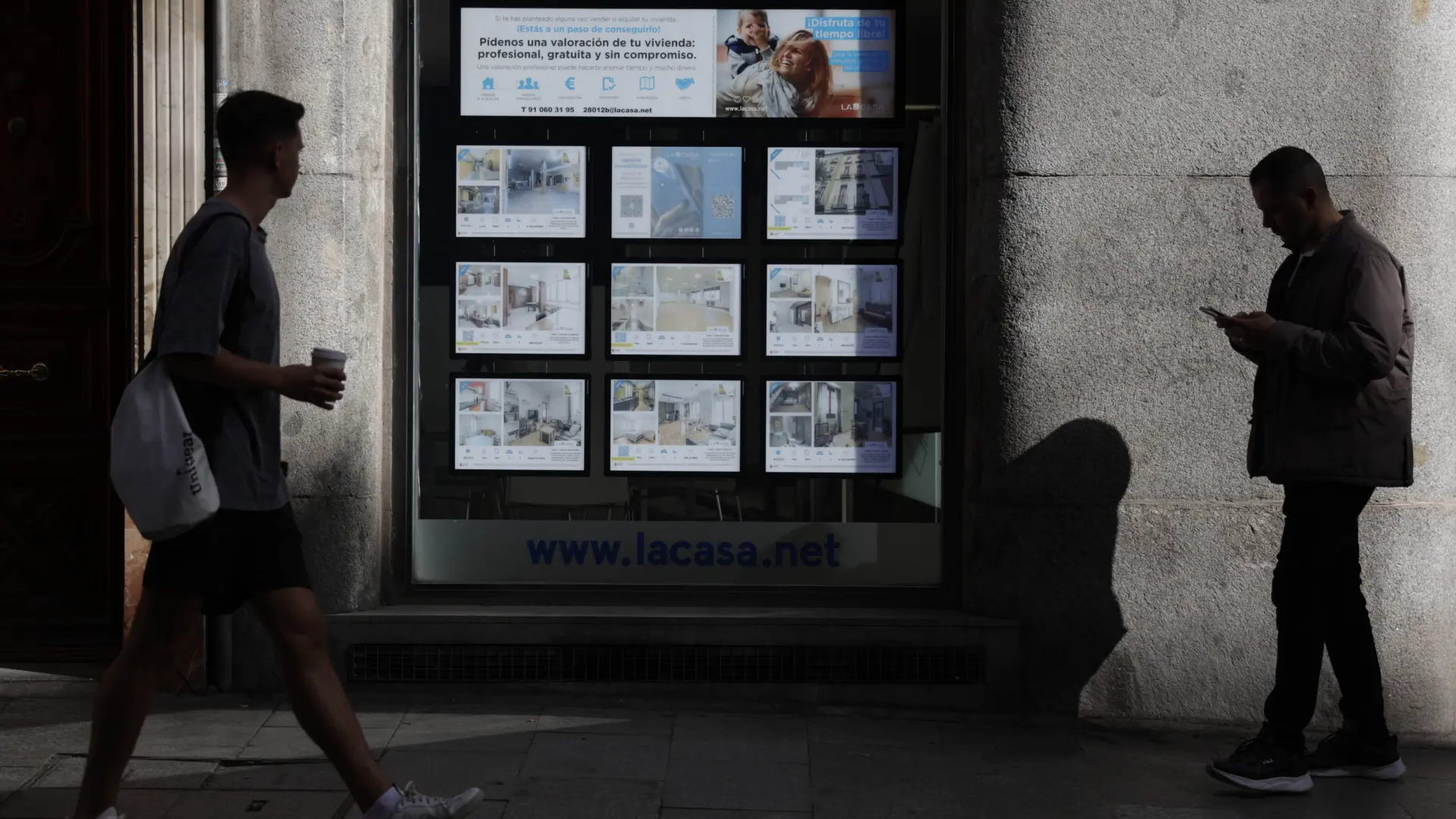
The change of year does not seem to bring a new direction to the real estate market. After closing 2025 with double-digit increases, The price of housing faces a 2026 for which all forecasts continue to point upwardsthis time with increases above 6%. For the year that has just begun, more moderate price increases are expected than those seen in 2025, although still well above inflation forecasts and, predictably, the increase in the income of families, who face increasing difficulties in accessing housing.
According to data from Idealista published this Monday, the price of used housing registered an increase of 16.2% in the last three months of 2025 compared to the same months in 2024. This increase, the largest since the real estate bubble, caused a new historical maximum of 2,639 euros per square meter to be reached, which is equivalent to about 198,000 euros for a 75 square meter apartment. “There is a lack of housing and the numbers are clear. After the 2008 crisis we have not been able to recover our production capacity, so we carry a huge burden of underproduction,” said platform spokesperson Francisco Iñareta based on these figures.
The data from the real estate portal reflects the sales prices at which the apartments are advertised, and may vary with respect to what buyers actually pay. However, in the absence of the most recent data, the latest official statistics from the Ministry of Housing also point to record levels – without taking inflation into account – with an average appraisal price of 2,153 euros per square meter in the third quarter – already above the previous peak of 2,101 euros per square meter at the beginning of 2008 – and a year-on-year increase of 12.1%, the largest since 2005. “I believe that This double-digit increase this year will mark a milestonea maximum that will probably not be repeated in 2026,” he points out to 20 minutes the director of Coyuntura de Funcas, Raymond Torres, who recognizes that “the price of housing is no longer within the reach of the majority of the middle class.”
Above these levels, new increases are expected for 2026. Among the forecasts of the main economic analysis centers and the real estate market, the most optimistic are those of Bankinter and CaixaBank Research, which respectively point to an increase in house prices of 6% and 6.3% for the new year. Along the same lines, BBVA Research predicts an advance of 7%. In all three cases, these are slightly less significant increases than those recorded in 2025, although they continue to triple inflation forecasts – the Bank of Spain expects 2.1%.
The forecasts are somewhat more pessimistic among real estate portals and appraisers. Pisos.com expects second-hand housing to become more expensive on average by 7.8% and rents also rise by 6.8%while Tecnitasa predicts an increase of 8% in the price of used apartments and 10% in new construction, Sociedad de Tasación predicts an increase of 8.9% for the latter and Tinsa is considering a global range of between 5% and 10%.
“Prices are going to continue risingboth in sales and rentals, although we will possibly notice it more in peripheral areas,” summarizes the president of the National Federation of Real Estate Associations (FAI), José María Alfaro, pointing to a shift in demand towards the proximities of large cities due to the rise in prices and warning, at the same time, of the consequences of rising prices. “This drains the citizens’ net disposable income and impoverishes the population,” he remarks. “Housing is going to become the epicenter of inequality social in Spain. The year 2026 will not only be marked by historical figures of activity, but also by historical figures of inaccessibility,” agrees the Director of Studies at Fotocasa, María Matos, who anticipates that this year “will break all records in housing prices.”
Supply shortage
Beyond the specific data, behind these figures there is a consensus that what is pushing prices up is the mismatch between the shortage of supply and the high demand for housing. “The population has grown by three million inhabitants since 2019 and, on the other hand, housing construction has satisfied half of the demand that has occurred each year,” explains Torres. “There is no replacement of the supply. If two properties are sold, barely one enters the market. 2025 has been a bad year for those looking for a home because they need it and 2026 will possibly be worse,” adds Alfaro in the same vein.
According to the latest data from the Ministry of Housing, between January and September 2025, 100,327 construction visas were granted for the construction of new apartments, 5.6% more than in 2024. The forecasts are that the brick sector will continue to regain vigor —CaixaBank estimates 150,000 visas by 2026about 10,000 more than expected for 2025—but at a slow pace and very far from covering the deficit of 600,000 homes that the Bank of Spain estimates currently exists to cover the volume of homes created in recent years.
BBVA Research predicts that This deficit will increase in 2026 and 2027 to 725,000 homesdespite the continued growth of construction. “Until the process of land transformation is accelerated, legal certainty is increased and the lack of labor is resolved, progress will continue to be slow,” says the study center in its latest Real Estate Observatory, in which it warns that the lack of supply is already slowing down the sale of homes, which it predicts will stagnate at around 720,000 operations in 2026 despite the good situation of the labor market and the stabilization of interest rates. interest.
“It is very necessary to build more, but it takes time. In existing housing there is also the opportunity to recover a lot of housing that is closed or destined for other uses, such as temporary or tourist rentals,” points out the president of FAI, adding that for this it would be necessary to “provide the market with legal certainty and tax incentives” and expresses that a common strategy of all administrations is missing. “No one assumes the commitment that is needed, a country commitment to generate stability and decent accessibility to housing,” he laments.