Ibex 35 banks refuse to correct and challenge forecasts for 2026

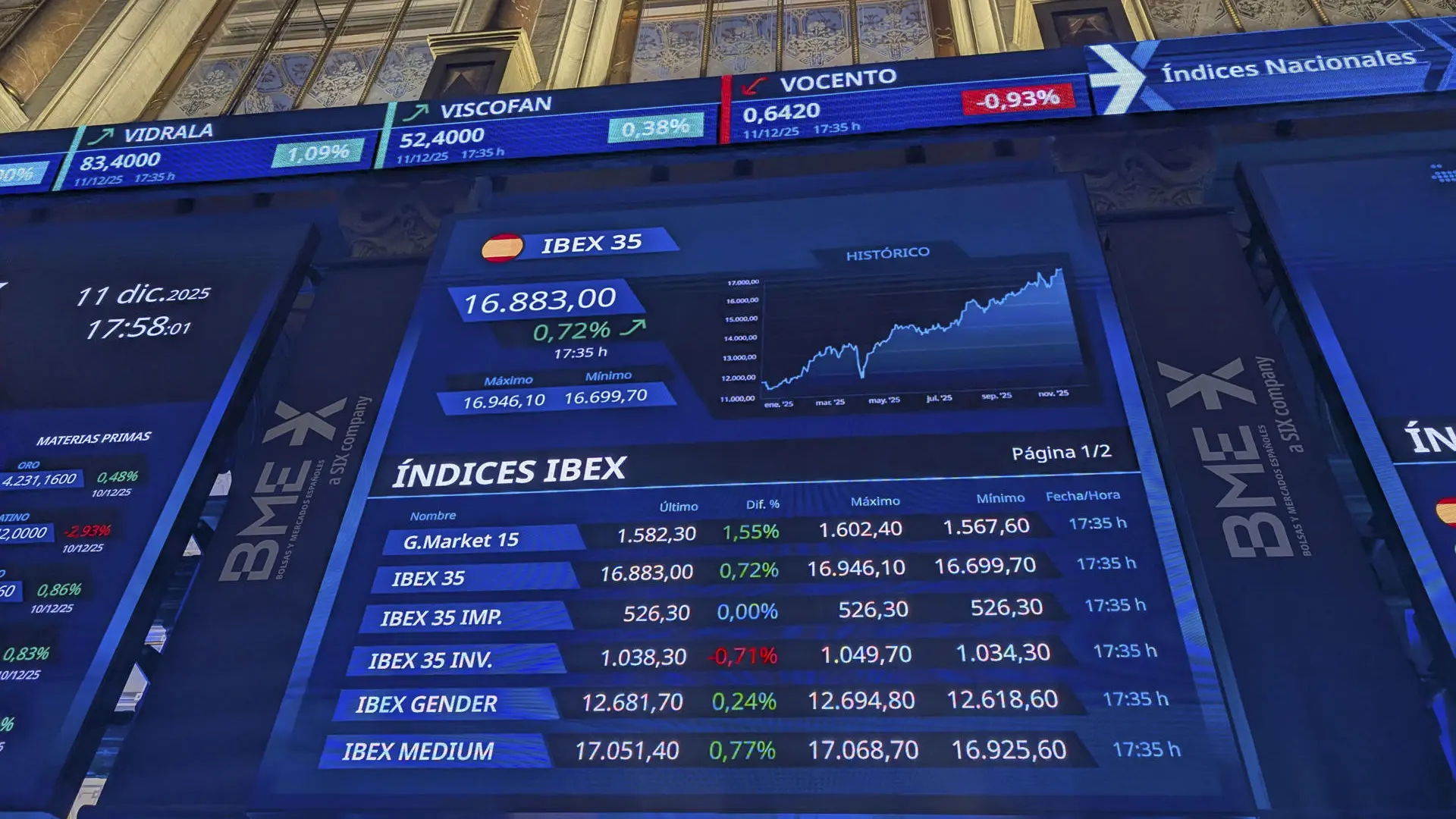
While warnings accumulate about economic developments, rate cuts in Europe, the sustainability of growth and the natural wear and tear of a rally prolonged, The banks continue to pull the Spanish market as if none of that were with them. The Ibex 35 has exceeded 17,000 points for the first time in its history and has done so, once again, with the help of the financial sector.
So far this year, the Ibex has appreciated around 46%, and Santander, BBVA, CaixaBank, Sabadell, Bankinter and Unicaja accumulate double-digit increases and some triple digits if the focus is expanded to the last five years.
A rally prolonged that has not only changed the price of the shares, but also the way in which the market values the sector. For the first time since the financial crisis, All listed Spanish banks are worth more on the stock market than in their books.
Bankinter has doubled its book value, while BBVA and CaixaBank are already moving very close to that psychological reference. Unicaja, the last straggler, crossed that threshold in recent weeks and completed a picture that had not been seen since before 2008.
That change is not just a matter of perception. It responds to very specific figures. Interest margins have soared with the new rate environmentdefaults remain contained and the generation of capital has made it possible to return to dividend and buyback policies that for years seemed impossible.
However, the context does not exactly accompany complacency. The Eurozone is advancing at an anemic pace, Germany remains trapped in structural problems and France is experiencing episodes of political instability. Added to this are geopolitical tensions, the war in Ukraine, the conflict in the Middle East and an increasingly unpredictable US trade policy.
In Spain, furthermore, the debate on the growth model is gaining weight, with an economy that grows more by population than by productivity. But none of this has managed to curb the appetite for banks. Far from punishing the sector for the expectation of rate cuts, many investors seem to interpret the new scenario as an orderly transition and not as a direct threat. However, this collides with the forecasts of international analysis houses that have been adjusting their discourses.
No tour?
With current quotes on the table, The market shows to what extent it has moved ahead of analysts’ forecasts. Five of the six large Ibex banks are already trading in line with or directly above the average consensus target prices, an unusual situation after a rally so long.
BBVA It moves around 19.5 euros when estimates place it slightly below 19, which leaves an already negative potential. CaixaBank It is around 10.1 euros compared to a target close to 9.7 and Santander moves close to 9.8 with reasonable prices that barely reach 9.5. In both cases, the value would be practically exhausted according to the market.
Bankinter and Unicaja They draw the same photograph, although with greater intensity. The former is slightly above its average reference after years of rewarding its defensive profile and operational discipline, while Unicaja is clearly ahead of the consensus script and exceeds the target price by around 10%, after a rally which has led it to complete its stock market recovery.
Far from punishing the sector for the expectation of rate cuts, many investors seem to interpret the new scenario as an orderly transition
The only bank that retains a small cushion is Sabadellwith a residual potential close to 4% despite already accumulating a revaluation of 90% in the year.
In any case, The sector enters the final stretch of 2025 with comfortable capital ratioscontained provisions and moderate but stable credit growth. There are no major catalysts in the short term, analysts acknowledge, but there are also no clear signs of deterioration. In this context, exceeding 17,000 points is not just a round number. The question is whether the Ibex and the banks are discounting too much optimism or simply closing a historical gap.
Meanwhile, 2026 is getting closer. It would be the seventh consecutive year of good performance for banking on the stock marketsomething unusual in a cyclical sector by definition. The closest precedent forces us to look carefully at each new piece of information. Evolution of credit, monetary policy of the ECB, competition in deposits and pace of the real economy. Everything adds up and everything can change the script.