“It’s like selling your organs”
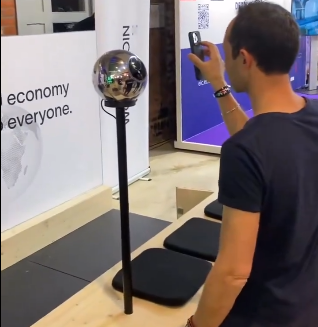
The controversial Worldcoin cryptocurrency project continues to attract criticism in Latin America. Now, in Peru, consumer protection specialists warn that scanning the iris is practically like “selling human organs.”
Jaime Delgado, Peruvian lawyer and consumer advocate, expressed his concern and questioned the practice of giving up that important identification in exchange for economic benefits.
The specialist raised uncertainty about the future security of this information transferred to Worldcoin. Furthermore, he emphasized the risk inherent in exchanging biometric identity for minimal monetary compensationconsidering it extremely dangerous.
“Selling the iris of your eyes for a few cents or the biometric identity is as if you were selling your organs,” warned Delgado, who also questioned that there is no guarantee that in the future that information can be used for other purposessince it was “sold” to Worldcoin.
“For a few coins, you are selling your biometric identity. “It seems extremely risky to me,” Delgado told the local press.
In Peru, the Worldcoin project has had interesting participation. In general, There are at least three places where people go to scan their irises through the so-called Orbs, more precisely in the towns of Miraflores, Surco and Lince, in the Peruvian capital, Lima.
These sites usually register a daily influx of more than 500 people, who agree to scan their irises in exchange for receiving a handful of WLD tokens, valued in Peru at approximately 180 soles.
Along with Peru, there are other nations in the Latin American region where Worldcoin also has a presence. Colombia, Chile, Argentina and Mexico are some of the nations in which there are now several Orbs, which are the devices in which hundreds of people scan their irises daily.
Negative consequences for safety
Now, iris scanning puts privacy at risk, according to systems engineer specializing in artificial intelligence Lennin Cenas. For the Peruvian expert, This action has negative consequences for security of people.
Cenas expressed that cybercriminals can use users’ biometric data to, for example, spoof identities using iris code data.
This, remembering that since 2012 the way in which biometric data scanners can be deceived by recreating images of an eyeball has been studied. using true iris codes taken from a database.
Cenas remembers that in the future it is estimated that with the iris it will be possible to carry out banking transactions, access properties, open doors and other actions. Therefore, his recommendation is categorical: Do not transfer biometric data to any project.
As you see it, the iris code is “unique information”, which accompanies people “all their lives.” And with the advancement of artificial intelligence, “we don’t know what may happen in the future or how much the technology will develop.”
“You will probably no longer have the option to reclaim the rights you gave up to your iris, because you did it a long time ago and there will be no way to reverse that. They have already taken your data and you will not be able to recover it,” the specialist warned.
The managers of the Worldcoin project, launched in 2019, have publicly explained that They do not save the users’ iris code and they only use it to verify that they are real human beings and not created by computer.
They even implemented protocols so that users be the custodians of that private information. And they even committed to erasing all traces of this data on the scanning devices, the Orbs.
However, that has not been enough for Worldcoin, which is a project of the Tools For Humanity company, is in question in more than a dozen countries around the worlddue to privacy concerns emanating from the activity of this initiative.
So far, Chile, Mexico, France, Germany, the United Kingdom, Kenya, Nigeria, Argentina, Spain, South Korea, Hong Kong and Portugal opened investigations against Worldcoin and pointed to that company of putting the privacy of its inhabitants at risk.
There are cases such as Spain, Portugal, Hong Kong or Kenya, in which the authorities They decided to kick that project out due to privacy concerns of people and for the alleged participation of minors in iris scanning.
And there are other cases, such as Chile, in which, despite the criticism and questioning of the Worldcoin project, the authorities plan to begin taking the biometric data of the inhabitants “to verify them.” This, alleging that “the safe thing” is to deliver this delicate information to rulers and States, and not to companies.