Learn about financial education, the desired (and necessary) subject

Content created for a company, brand or organization that has paid for its production and publication and has your approval.
IN COLLABORATION WITH BANCO SANTANDER
It is undeniable that money is essential in our daily lives and that part of our well-being depends on knowing how to manage it. Not having notions of financial education can be a risk factor to fall into difficult situations, which is why it is essential to learn to manage our finances, a discipline still pending for the majority of the population.
This is how the study reflects The value of learning: Global perspectives on financial education that Banco Santander has carried out together with Ipsos as part of its commitment to the financial education of the most vulnerable groups. From 20,000 surveys in 10 countries, data emerge such as: In Spain, 86% of those surveyed never received financial education classes at schoola figure similar to the global average.
The banking entity focuses on this knowledge as a tool for progress to promote well-being and inclusion. This is how the president of Banco Santander, Ana Botín, explained it in the presentation of the results held in London: “Financial education is an essential tool for progress and knowledge is what allows people to make informed decisions, anticipate risks and take advantage of opportunities. For Santander, promoting financial education is not a one-time initiative, but rather a permanent responsibility and shared: Governments, schools, families, companies and banks must collaborate so that knowledge reaches everyone, from childhood to adulthood.”
The desired subject at school: financial education
Although training aimed at economic management is not within the official study curriculum, 91% of Spanish respondents consider that financial education should be taught in schools. In fact, this study shows that Spaniards already value this subject above traditional subjects such as History and Literature.
Such is the importance given to it, that 67% of Spanish respondents confess that they would choose an educational center that included it. Added to this is that three out of four would be willing to participate in a free course to learn about this topicespecially young people between 25 and 34 years old. The areas they considered key in learning in this regard were taxes, savings and investments, followed by mortgages, budgeting and banking.
Spaniards value financial education above traditional subjects such as History and Literature
Why do Spaniards want to educate themselves financially? Mostly The benefit that respondents seek with this training is to make better financial decisions (64%), in addition to better managing money and debt (59%) and acting ethically when choosing financial products (46%).
When asked about their financial goals, 33% of national respondents confessed that they want to save to travel, while 31% wanted to be financially stable enough to not have to worry about money and 19% intended to buy a car. Assuming they received the equivalent of their monthly income, 41% of Spaniards who responded would save it directly compared to 25% who would invest it in financial products.
Learn to avoid taking economic risks
One of the dangers of not having a good base of economic knowledge is that, in many cases, the respondent overestimates what he or she understands about financial management. For example, in the case of Spain, 54% of people asked said they had sufficient financial knowledge, but only 26% were able to correctly answer a basic question about inflation.
The disconnection between what you think you know and what you really know is called the ‘Dunning-Kruger’ effect. Some of its most dangerous consequences are making bad decisionsinadequate risk assessment and even the erroneous perception that more training is not needed, according to the report.
An extra challenge is added to this lack of self-knowledge: the great weight that social networks have taken as a source of training. Despite its unstoppable rise, 61% of Spanish respondents acknowledge feeling less secure when managing their finances online, a figure below the average for the rest of the countries analyzed.
In general, the Spaniards who participated in the study they turn to banking on-line to check your account balance (73%) or make a payment or transfer (70%). However, 48% still prefer to go in person to a branch when contracting or purchasing a new financial product.
In order to make a consultation about financial matters, In Spain, 45% mentioned a financial advisor or specialist as their main source of informationwhile 28% went to a family member to resolve these doubts and 24% trusted companies or organizations that provide financial products.
Banco Santander supports financial education
Although in our country efforts have been made to encourage initiatives to improve the financial culture of the population with proposals such as the Financial Education Plan promoted by the National Securities Market Commission (CNMV), the Bank of Spain and the Ministry of Economy, There is still a long way to go. In fact, these organizations remember that there are still pending gaps related to digital literacy, teacher preparation or the incorporation of the subject on a more massive basis as a transversal competence in the school stage.
There are still pending gaps related to digital literacy, teacher preparation or the incorporation of the subject on a more massive basis.
Santander Bank has demonstrated on numerous occasions its commitment to financial education. To this end, in addition to launching studies such as the one mentioned above, they provide accessible, adapted and aligned training with OECD standards in all the countries where it operates with the aim of helping people make better decisions. In 2024 alone, more than 4 million people around the world accessed its initiatives, workshops and financial education content.
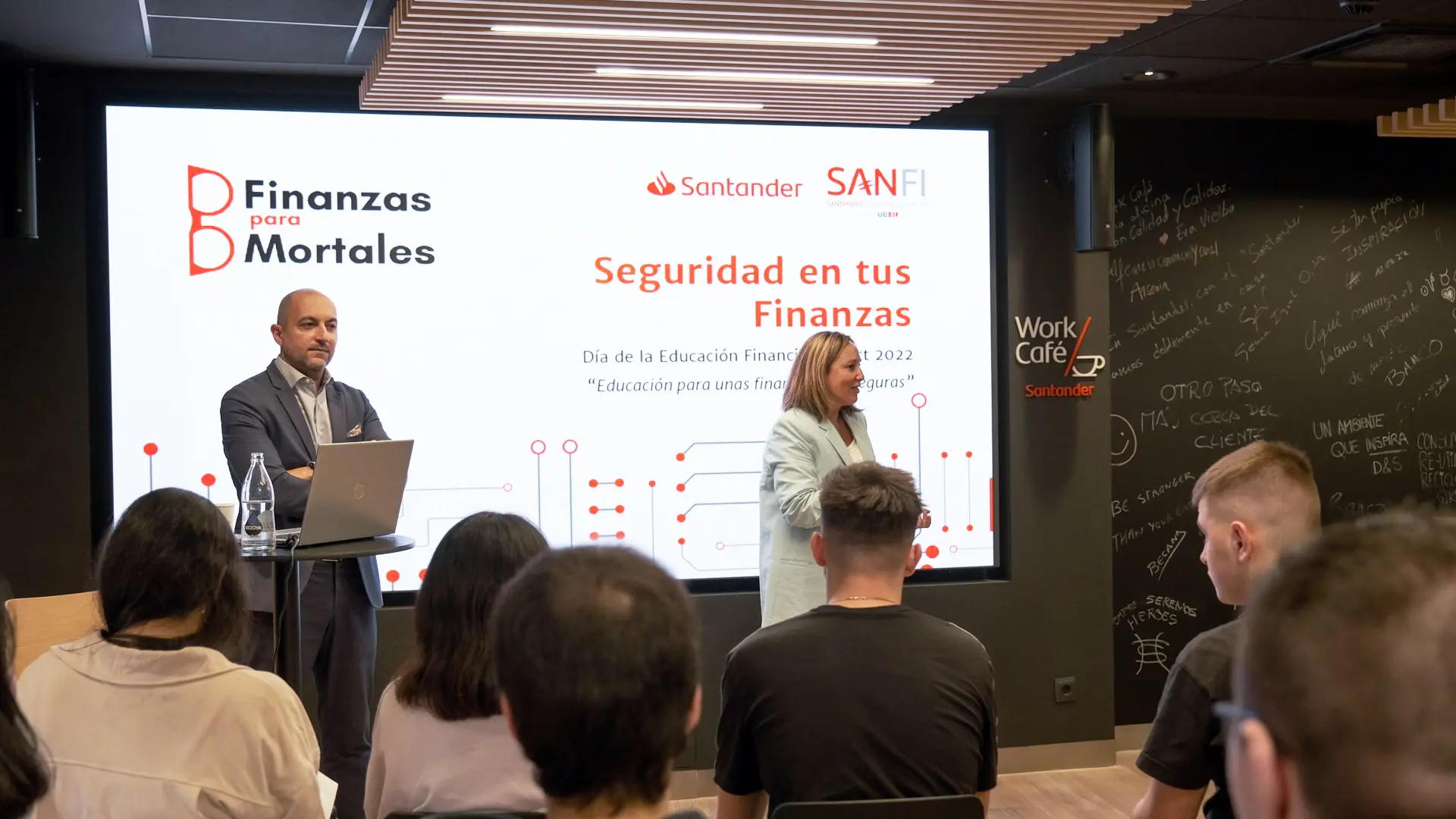
Specifically in Spain they have been managing ‘Finance for Mortals’, a project aimed at financially vulnerable groups to whom notions of economics are explained in a simple and accessible way.
In 2025, the entity has given a new boost to financial education in our country. Closes the year with the record number of 1,831 training sessions given – 10% more than in 2024 – that have helped train almost 45,000 people through its face-to-face classes in schools, institutes or senior centers thanks to hundreds of volunteer professionals from Santander.
Since their inception, they have helped more than 276,000 people with an inclusive and multi-channel approach, obtaining recognition from the Bank of Spain and the National Securities Market Commission (CNMV).