MiCA imposes fines of up to one billion euros on exchanges that fail to comply with its rules
Key facts:
-
So far only Binance, OKX and Kraken have presented the measures they will take to comply with MiCA.
-
USDT, the main stablecoin in dollars, will leave Europe after failing to comply with the regulations.
There are 15 days left until the regulations for stablecoins established within the Regulation for the Cryptoasset Market (MiCA) come into force in the European Union (EU), and so far there are few exchanges in the sector that have announced the measures they will take for the compliance.
Juuso Roinevirta, head of Product and Growth at Membrane Finance, drew attention to this issue in X, pointing out the fines established in the regulations for the platforms. that market stablecoins that are not registered in the region.
It should be noted that for a stablecoin to be considered regulated, it must be issued by an electronic money institution (EMI) or a credit institution (CI), entities from which stablecoin issuers must apply for a permit.
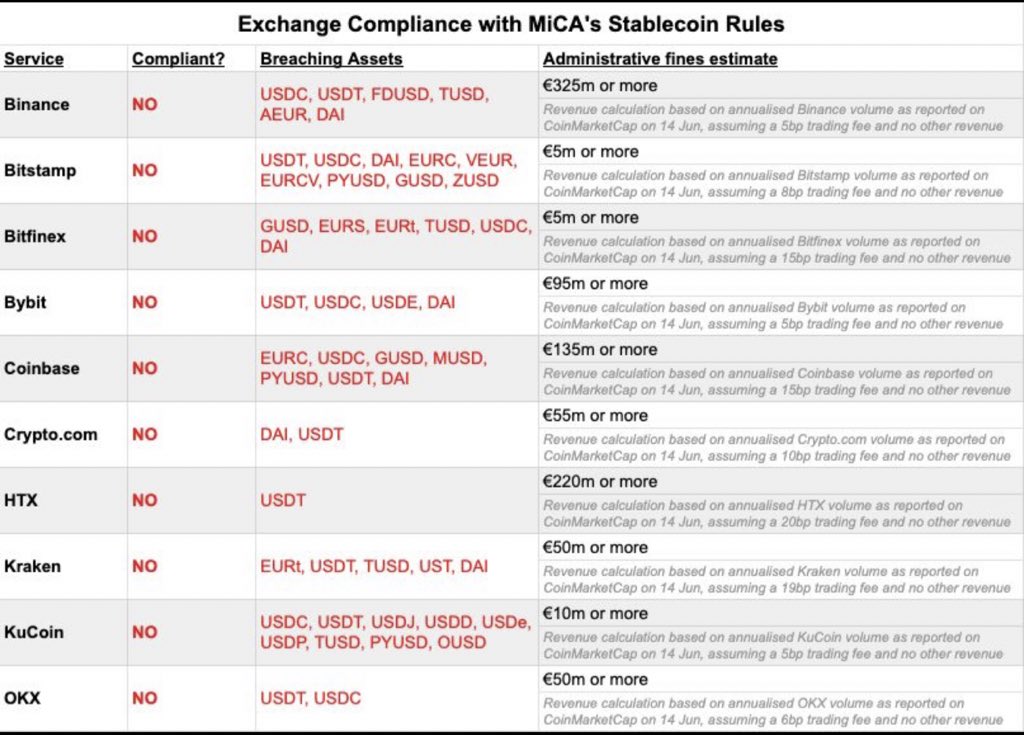
The expert shared a table indicating the fines that exchanges that do not comply with this requirement could receive. His calculations indicate that The fines would total up to one billion eurosand that is only taking into account 10 of the platforms that operate in the eurozone and that currently process transactions with stablecoins anchored to the dollar.
“If all the other VASPs (crypto asset service providers) are added, MiCA could become one of the biggest windfalls for EU Member States in 2024,” says Roinevirta.

As seen in the table that Roinevirta shared on social networks, the amount of the fines increases based on the number of dollar stablecoins traded by the exchange and the volume of transactions carried out with them.
This is how MiCA was stipulated when it states that Fines can reach 12.5% of total annual turnover. In this way, exchanges that include stablecoins such as USDT in their list, which is dominant in Europe and the rest of the world (and which will not be registered in Europe), would be fined a higher amount.
Most exchanges still do not have clear rules
Only the announcements made by exchanges such as OKX, Kraken and Binance are known.
The first has already said that it will stop trading pairs in USDT, the second is evaluating settling dollar-backed currencies in euros. Binance, for its part, reported restrictions on what it classifies as unregulated stablecoins.
For the rest, there is no information on the measures that other platforms will take. In statements to the media, Oliver Linch, CEO of Bittrex Global and former lawyer at Shearman & Sterling, assured that as the critical deadline of June 30 approaches, companies They continue to overcome some ambiguities inherent to the new rules.
As for stablecoin issuers, it is known that USDT will not comply with MiCA regulations and its exit from the European regulated market is expected starting in July. This, while its main competition, USDC, will remain active in Europe due to having a registry in France.
As reported by CriptoNoticias, Tether CEO Paolo Ardoino explained that the liquidity and reserve requirements for stablecoins approved in MiCA prevent the functioning of USDT and other stable currencies.
The executive mainly questioned that 2% of own funds are required of the currency issuers are included in the reserves.
A requirement whose fulfillment it will get even more complicatedconsidering that this week the European Banking Authority (EBA) presented a package of technical guidelines for the application of MiCA that foresees increase demands for stablecoin issuers. There it raises to 3% the percentage of own funds that must be maintained in said reserves.
In that sense, Cristina Carrascosa, a Spanish lawyer specialized in the area of cryptoassets, made several comments on this topic in X. The specialist joins the voices that express skepticism around the new regulations, also questioning the restrictions that arise for stablecoins anchored to the dollar, “as a measure to protect the euro.”
“The over-protectionism that the EU has wanted to make of its ‘financial stability’ has strangled the usual business of the relevant stablecoin issuers, who will have to be creative to be able to maintain the same levels of profitability before and after MiCA,” says the lawyer. .
His message joins that of other European analysts, who think that with these regulations Europe risks being isolated.