More expensive hotels, restaurants and gas, but cheaper flights
Once the year is over, July arrives and the earliest travelers begin their vacations. According to the National Observatory of Outbound Tourism (ObservaTUR), 29% of people who plan to travel this summer will do so in the seventh month of the year. Some are already enjoying the long-awaited summer break, while others are counting the days until their moment arrives. Summer is coming this year with higher prices than in 2023 in hotels, tourist apartments and restaurants… and also more expensive petrol and tolls, compared to cheaper flights abroad and discounts on buses and trains for young people.
Accommodation: hotels, apartments and campsites
An almost insurmountable expense for those who choose to travel this summer is accommodation, an item for which the bill this year will be higher than in 2023. According to the latest data from the INE, the price of hotels in May was already 8.1% more expensive than a year ago, hovering around Average room rate 112 eurosAs usual, the upward trend is expected to continue strongly until August, so those who are late in making their reservations will have to dig deeper into their pockets.
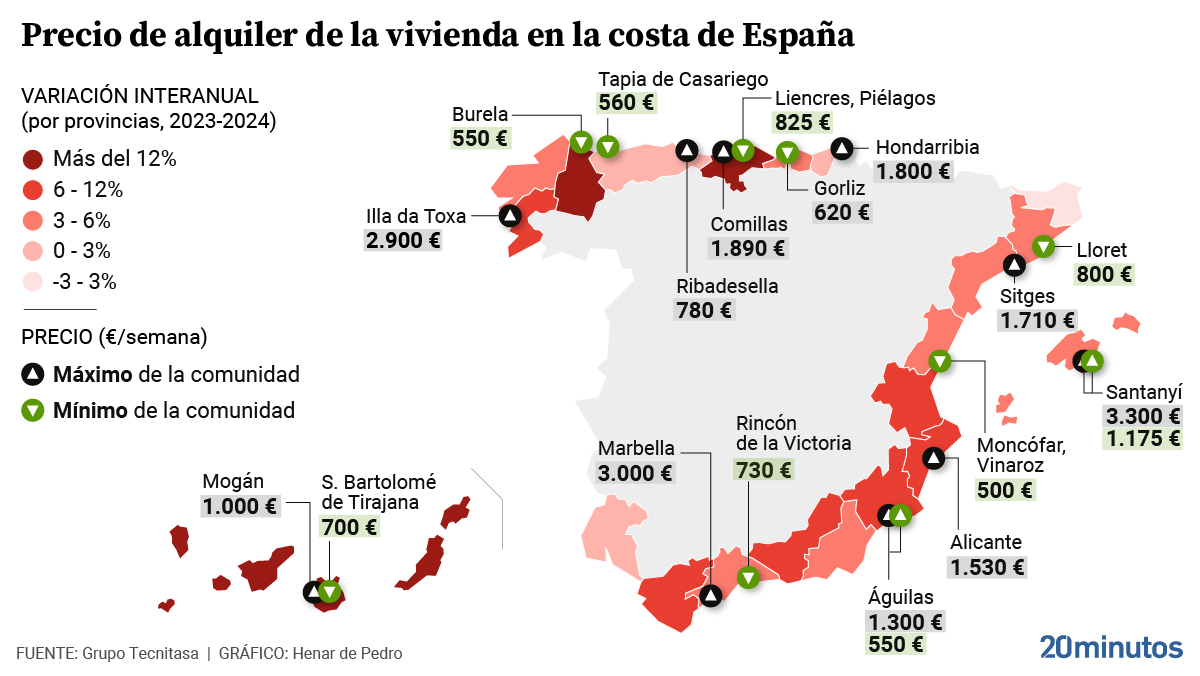
Those who opt for other accommodation options will not escape the price increase either. The campsites and rural accommodations have increased in price by 3.9% and 2.9% respectively in the last year, according to the INE. The rise has been more pronounced in the case of tourist rentals. Since last summer, beachfront apartments have risen by 9.95% to an average of 1,160 euros. The amount reaches 3,000 euros per week in places in the Balearic Islands such as Ibiza or Pollensa and exceeds this figure in Puerto Banús (Marbella), for example. Even in Cantabria, on the beach of Comillas, the rental of a 70 square metre apartment costs an average of 1,900 euros per week, according to a recent study carried out by the appraisal firm Tecnitasa.

Gasoline prices break their streak
Filling up the tank for road trips will also be more expensive this summer than last, it is expected. After two months of continuous falls, diesel and petrol prices have broken their downward trend in the last week, just before the first major Operation Exit of the summer. According to the latest data from the European Union Petroleum Bulletin, A litre of super 95 is currently priced at 1.616 euros, 1.13% higher from the 1,598 euros it cost at the same time of year in 2023. Diesel remains the cheapest option, although it has suffered a greater rise in the last year: its price has gone from 1.441 euros per litre at the end of June last year to 1.47 euros, 2% more expensive.
Updated tolls
In addition to facing rising fuel prices, drivers will also face higher tolls this summer. As usual, The Government revised the rates in January with increases of between 5% and 6.65% for state-owned motorways. Specifically, the roads affected were the AP-46 (Malaga), AP-51 (Avila-Villacastín), AP-53 (Santiago de Compostela-Alto de Santo Domingo), AP-6 (Avila-Madrid), AP-61 (Segovia-San Rafael), AP-66 (Gijon-Seville), AP-68 (Bilbao-Zaragoza), AP-7 (Malaga-Guadiaro), AP-71 (Leon-Astorga), AP-8 (Alicante-Cartagena) and AP-9 (Ferrol-Tui).
Discounts for trains and buses
For younger travellers, using public transport this summer will continue to be a very economical option. For the second year in a row, the Government is maintaining the discounts of the Verano Joven programme for travel between 1 July and 30 September. This plan for Young people between 18 and 30 years old include discounts of between 50% and 90% on the price of bus and train tickets for Media Distancia, Avant, AVE, Avlo, Alvia, Intercity and Euromed trains, as well as for Interrail. As a novelty, the programme has been extended to all young people residing in Spain, regardless of their nationality.

Flying abroad, cheaper
Those who have planned flights abroad for this summer and have bought their tickets in advance have been able to find cheaper prices than in 2023. According to the latest data from the INE – referring to the month of May -, International flights are 7.5% cheaper than a year ago. In fact, they are among the products that have become cheaper. On the other hand, the price of domestic flights has remained more stable, standing at just 0.8% above the price level recorded in May 2023. Airlines expect this year to be a record summer, with a forecast of 240 million seats to or from Spain.
From the beach bar to the supermarket
To grab a snack at a beach bar or go out for dinner, you’ll have to dig deeper into your pocket this summer than last year. Prices in restaurants, cafes and nightclubs have risen by 4.8% from May 2023, compared to the same month this year. The increase is even greater for fast food and takeaway services, which are 5.3% more expensive than in 2023.
Unlike last year, inflation is less noticeable in supermarkets than in restaurants. Food prices have slowed their growth in the last year, after peaking in February 2023. Although the rise is still marked in basic items in the shopping basket – for which the Government has extended the VAT reduction – such as olive oil or fruit – which have become more expensive by 62.8% and 12.1% respectively in the last year – other products in high demand in summer have experienced a more stable evolution. For example, the price of beer and ready meals has risen by 2.7% and 1.9% respectively, while that of Ice cream and soft drinks have barely grown by 0.8% and 0.1%.

The sales are coming
As well as being synonymous with holidays, summer is also synonymous with sales. Although more and more brands are getting ahead of the game, July 1st remains in the collective imagination as the day when summer discounts start. In addition to the offers launched by the various brands, there is also the fact that Clothing and footwear are some of the items that have increased in price the least over the last year. According to INE data, women’s and children’s clothing are respectively 1.2% and 1.7% more expensive than a year ago. The price of men’s clothing has remained stable and that of footwear has risen by just 0.4%.
Use air conditioning
Air conditioning is a great ally to combat the summer heat, but it also a significant burden on the electricity bill. The use of the cooling system significantly increases electricity consumption in the summer months. The good news is that the price of electricity is below the levels it was at a year ago, so the pocket will suffer less foreseeably. Compared to the 93.02 euros that the megawatt hour cost in June 2023, the sixth month of 2024 leaves an average slightly higher than 45 euros/MWh, the threshold established by the Government to determine the electricity tax. The increase above that mark activates the reduction of the VAT on electricity from 21% to 10% in July.
The telephone bill
Summer is a time when mobile data consumption increases, as people spend more time outside their homes and intensify their social relationships during the holidays. However, these expenses will not be a much greater burden this year. INE data indicate that Mobile phone services have only increased by 2.4% in the last year. In fact, a trade war has now broken out between brands low cost to take market share from the Romanian operator Digi, the big beneficiary of the merger of Orange and MásMóvil.

Relief for mortgage holders
Beyond the expenses associated with holidays and the time of year, summer will likely bring relief for those with variable-rate mortgages. The Euribor, which is the benchmark for the vast majority of loans of this type in Spain, has been falling for three consecutive months since April. Although the decline is slow and the indicator has been stuck since the end of 2023 between 3.6% and 3.7%, Current levels are far from the 4% that was exceeded in the second half of last yearThe comparison with that high Euribor predicts a favourable revision for those mortgages with annual updates that have to be revised in the coming months, thus reducing the monthly payments.