Murtra sees Telefónica well positioned in the “process of technological rearmament in Europe”

Telefónica CEO Marc Murtra believes that Europe is heading towards a wave of “technological rearmament” in which telecommunications companies can play an important role, as long as they are efficient and have scale and have the capacity to invest and operate efficiently. Sooner or later this movement will entail a consolidation process for which, he assures, the company he leads is prepared.
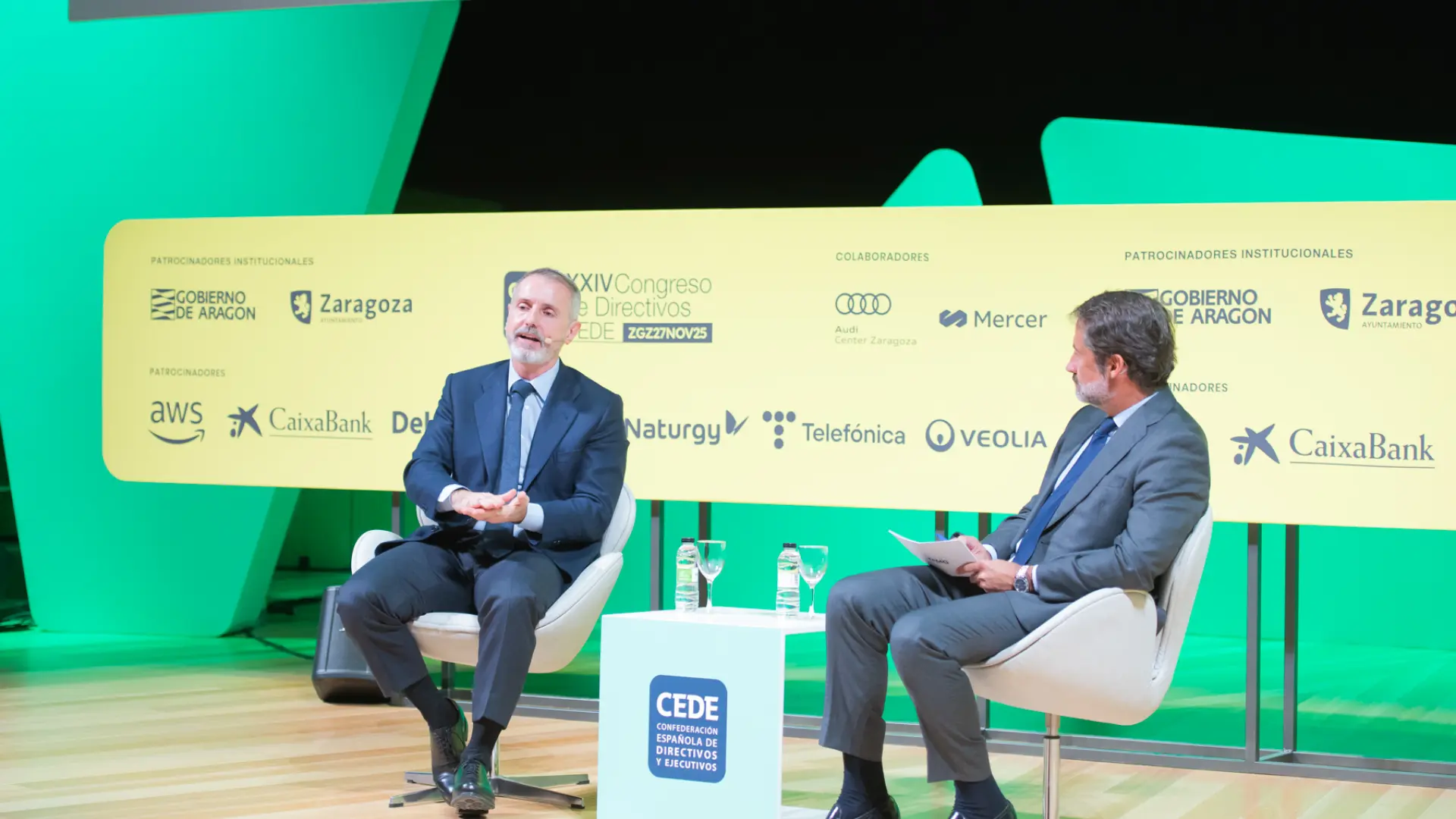
During his speech at the XXIV Congress that the Spanish Confederation of Directors and Executives (CEDE) is holding this Thursday in Zaragoza under the motto Europe: from diagnosis to action, The first sword of the operator has recalled that the Union has to develop digital technologies and products to “ensure productive sovereignty and the autonomy to make its own decisions.”
Murtra has positioned technology and geopolitics as two fundamental vectors of change and has warned, in relation to Artificial Intelligence that, given that in ten or fifteen years it will be important for telecommunications, for banking and for companies, and the technology that develops it is created in the United States or China, “it is difficult to think” that both powers will give Europe access to this latest generation technology. “They will always be giving us access to one or two generations behindbecause it is difficult that in a time where there are tariffs they will give us access to their own technology under equal conditions,” he warned.
Hence, it has opted to promote a technological construction process at the European level to develop hyperscalers, artificial intelligence, and cybersecurity. There are two types of companies positioned for this in Europe: defense companies that, in their opinion, are absorbing the pace of growth very efficiently, but “at almost insufficient speed”and the large telecommunications companies, pending this consolidation process.
In the week in which the telecom company announced that its ERE proposal will amount to more than 6,000 workers, Murtra has made it clear that at a business level one of the big decisions is always to identify the balance between the short and long term. “Many of the most difficult and painful decisions made today They are justified only if the diagnosis is correct, if you have the mandate and the capacity to receive returns in the future,” he noted.
Reynés (Naturgy): security of supply has a cost
Francisco Reynés, executive president of Naturgy, also participated in the Congress organized by CEDE, who in a dialogue with Cristina Lobillo, director of Energy Policy of the European Commission, made it clear that “security of supply has a cost” and in the case of the region this has to do with the costs linked to fuels involved in gas or uranium, in the case of nuclear. From his point of view it is “impossible” to go from 100 to zero without going through “intermediate phases” that allow guaranteeing security of supply.
The top executive of the energy company has also entered into the issue of the cost of the bill for the final consumer. “Energy is an essential and basic cost in the shopping basket of any home, and companies in the sector have the duty to provide a service that is reasonable in price to their customers,” he acknowledged.
However, he wanted to make it clear that, although one cannot expect the cost of energy “to be as low as one would like”, one should not attribute to the energy bill a cost that includes “many other non-energy concepts”. In any case, Reynés has opted not to give up any technology, in order to be able to promote a “balanced energy mix”, while advancing the decarbonization process and guaranteeing that energy is “abundant, affordable and sustainable.”