“Mutual funds, bonds and loans will be tokenized in waves”: McKinsey
The tokenization of real world assets or RWA (real world assets) is a reality and is increasingly gaining ground in the preference of various economic sectors.
According to a report by global consulting firm McKinsey, “mutual funds, bonds and loans will be tokenized in waves.”
The first stage will be driven for these assets that have proven return on investment and existing scale. “We believe that the viability of tokenization is greater for asset classes with lower technical complexities and considerations,” the company details.
Once these first use cases demonstrate success, the door will be opened for tokenization of asset classes whose current markets are smallerwith less obvious benefits or that require solutions to more complex technical challenges.
This progression will allow for greater regulatory clarity, infrastructure maturity, interoperability and accelerated investment, he notes.
It should be remembered that the RWA refers to those tokens that represent traditional assets, be it real estate, precious metals, bonds such as this case, among others.
Growth for tokenized assets is guaranteed
McKinsey estimates that the total capitalization of the tokenized market could reach around $2 trillion by 2030driven mainly by adoption in the aforementioned sectors, as seen in the image below.
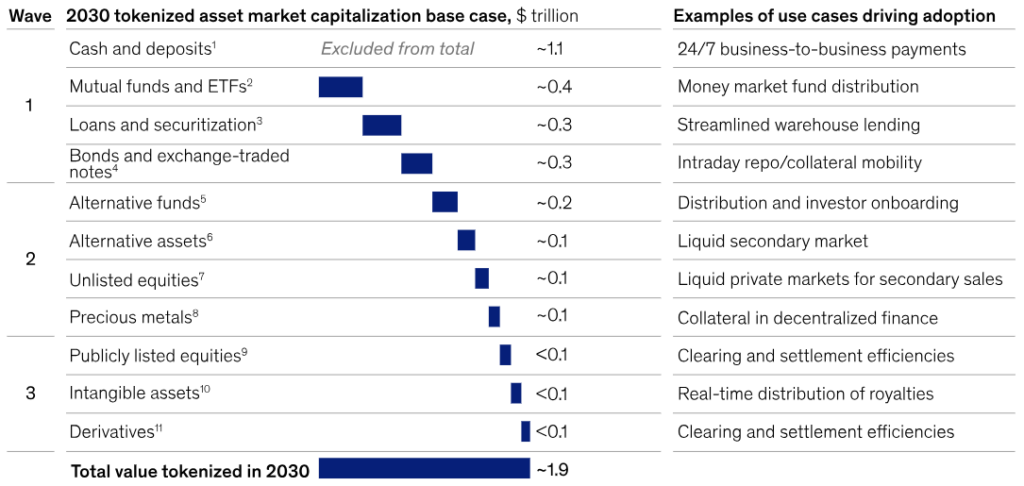
In an optimistic scenario, this value could double to reach $4 trillion, although the consulting firm is less optimistic, suggesting that the realistic range will be between $1 and $2 trillion.
A success story is related to tokens that offer indirect exposure to US Treasury bonds that have gained great traction, going from less than 720 million to 1.5 billion dollars so far in 2024as reported by CriptoNoticias.
In this regard, the consulting firm points out that as the scope and magnitude of tokenized funds grows, additional benefits related to the products will materialize and operations.
However, despite this visible momentum, widespread adoption of tokenization is still some way off, he warns.
BlackRock wins in asset tokenization
In this market niche, the asset manager BlackRock burst in strongly, with the presentation of an investment fund tokenized on the Ethereum network, called BUIDL.
This works in a similar way to a stablecoin because each token is equivalent to one dollar. The difference with a stablecoin is that BUIDL, month after month, pays dividends to the wallets that hold the token. Those dividends come from BlackRock’s investments in US Treasury bills and repurchase agreements. Also, a portion of the portfolio is held as cash.
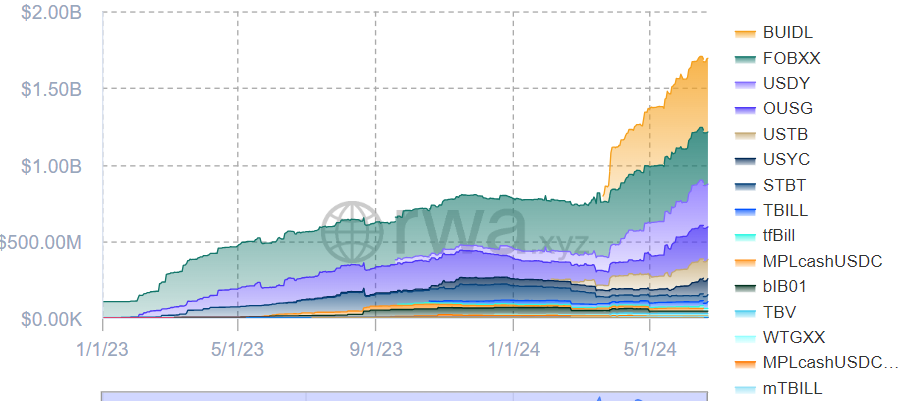
After its issuance last March, the fund BlackRock currently has greater value, hoarding more than 460 million dollarsas seen in the following graph from the Rwa.xyz on-chain data explorer.
The company is also notable for managing a bitcoin (BTC) spot ETF, which since its launch five months ago has become the largest in the world.
The digitization of assets seems even more inevitable now that the technology matures and demonstrates measurable economic benefits, McKinsey explains. As network effects gain momentum, tokenization is expected to accelerate its pace, significantly transforming the global financial landscape.