Spanish banks aim for new record annual profits despite lower interest rates

Spanish banks are heading towards the end of the quarterly results season with a new profit record. The five big banks –Banco Santander, BBVA, CaixaBank, Bankinter and Unicaja– They record a joint result of 24,027 million, 7.23% higher than that recorded in the same period of the previous year, when these entities totaled 22,405 million. The figure does not take into account Sabadellwhich will present its results on November 13, and everything indicates that it will exceed the 1,295 million registered by the end of September 2024.
On the whole, analysts look at the bank with optimism. If the bank led by César González-Bueno is included, in the whole of 2024 they reaped profits of 31,768 millionwith a year-on-year increase of 21%. A figure they have approached at the end of the third quarter.
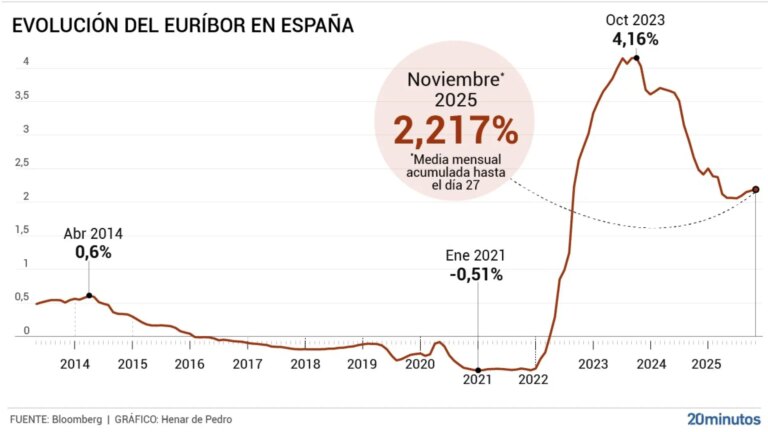
If this dynamism is maintained for the remainder of the year, the sector would be on its way towards what could be its fourth consecutive year of profits record. The entities are going through a golden cycle that started in 2022 with the end of the era of ‘ultra-low’ rates, at levels close to zero and that has continued in the following quarters. All this despite the fact that the Euribor is far from the level of 4% that it reached in this monetary cycle. The mortgage market benchmark has been progressively deflating in a context of restrictive monetary policy.
He European Central Bank (ECB) started with rate cuts of interest in the middle of last year and it was not until July of this year – he declared some pause along the way – when the end of the reductions in the price of money began to take shape. After three consecutive meetings in which has kept the reference rate at 2%the possibility of undertaking another cut in the medium term has cooled.
In this scenario, the general trend has been offset by the lower revaluation of the credit portfolio, with a direct impact on the interest margin, with greater financing volumes, but also in the increase in the commission incomewhich have helped brighten the income statement. Lower costs and improved efficiency, which measures the expenditure necessary to generate income and, therefore, the lower the indicator is better, they have also contributed to breaking new records.
Banco Santander would top this classification with 10,337 million, 11% more, in what has been its sixth consecutive quarter breaking ceilings. They are followed by BBVA with almost 7,978 million (+4.7%); CaixaBank, which has remained on the verge of 4,400 million (+3.5%); Bankinter is further away with 812 million, with Unicaja closing the list with 503 million after rising more than 11.5%. In the case of the entity based in Malaga it is significant, given that it reaches the objective for all of 2025 three months ahead of schedule.
The reduced tariff risk, consumers’ appetite for credit, with double-digit growth, as well as excess capital that entities are allocating to strengthening shareholder remuneration via dividends and share buybacks, are some of the factors that may have served as a catalyst for the sector. Also on the stock market, where they are experiencing significant revaluations. So far this year alone, the six Ibex 35 banks have recorded increases ranging from almost 97% of Banco Santander to 70% of Bankinter.
“If we were looking for a group of companies that could dethrone the ‘magnificent seven,’ it is European banks were probably not the first option. But if we analyze the profitability they have registered in the last twelve months and since the beginning of the year, that is exactly what has happened. They have obtained spectacular results, far surpassing the group of large American technology companies known as the magnificent seven and the S&P 500 index,” they explain from Capital Group.
Solo growth plans
In addition to historical profits, everyone agrees on one element: their short-term growth strategy involves continuing alone. Bankinter is the greatest exponent of organic growth in Spain, as reiterated in the last presentation of results. They also plan to continue along this line from BBVA after the failure of the takeover bid for Sabadell, in which they have barely collected 25% of the support to carry it out.
CaixaBank has expressed its intention not to participate in any merger, statements made after being ruled out in the bid to acquire 75% of Novo Banco in Portugal, which was finally acquired by the French group BPCE. Although Banco Santander becomes the exception with the purchase of the business in the United Kingdom to Banco Sabadellwhose transaction will close in March 2026, the CEO himself, Héctor Grisi, rules out mergers on a national scale. The list is completed with Unicaja, from which they rule out entering into any corporate movement and focus on the execution of their new strategic plan 2025-2027.