Spanish banks use share buybacks as a way out of excess capital

Spanish banks find in share buybacks a comfortable destination to get rid of the excess capital that they accumulate after several years of record profits. What began at the end of 2021 as a trend to encourage listing and retain shareholders after the pandemic has been consolidated and the main entities already consider it normal in their remuneration policy. BBVA was one of the entities that laid the first stone four years ago with a historic program worth 3.5 billion, which ultimately amounted to 3.1 billion.
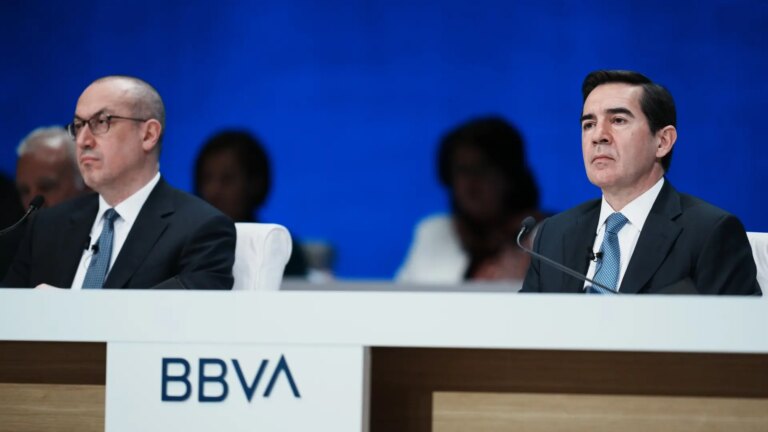
The group chaired by Carlos Torres He found in this formula a place in which to place the excess amount after the first failed attempt to merge with Banco Sabadell. It so happens that yesterday he announced an extraordinary ‘megra-purchase’ of almost 4,000 million, as promised after the takeover bid for the Catalan group did not go ahead last October. Altogether, the entity will have used more than 10.3 billion for this purpose throughout this time through five programs.
At 3,160 million executed between 2021 and 2022another 1,000 million are added in 2023 on an extraordinary basis, while the other three remaining amounts of 422, 781 and 993 million are charged to the results of 2022, 2023 and 2024, respectively. The frustrated plan to become the third largest bank in Europe in market capitalization behind BNP Paribas and Banco Santander It led him to decide that the best way to invest that money was in his shareholders and even attract those who hunt for this type of operations.
Following in its wake was Banco Santander, which was also a pioneer in this regard, although with a smaller volume. It started four years ago with 841 million and, since then, every year it allocates a part of the remuneration for this purpose. From 2021 until the second buyback charged to the 2024 results, Banco Santander has returned approximately 9.5 billion to its shareholders, a movement that has materialized with the acquisition of the around 15% of its shares with the ultimate purpose to amortize capital, which in practice implies a reduction in the number of securities in circulation and increases the participation of investors. At the current time, it is close to completing its latest plan of 1.7 billion.
The president of the group, Ana Botín, has reiterated on several occasions that she is only open to evaluating corporate operations that offer a higher return than share buybacks. The Capital Companies Law imposes limits on the number of shares that a listed company can have in treasury stock, which must not exceed 10% of the outstanding capital. Except for Bankinter, which has openly expressed its reluctance to them under the argument that they prioritize reinvestment in the business, large entities have gradually embraced this tool, which is more standardized in legislation like the North American one. List that also includes CaixaBank, Banco Sabadell and Unicaja.
The position of the sector clashes with the interpretation of the National Securities Market Commission (CNMV), from which they do not see it as “entirely correct” to include them as another element of their policy of retribution, because they can “lead” to errorgiven that its effects are uncertain in relation to the price and direct benefits. Therefore, They recommend that if they are incorporated They are given differentiated treatment, in a clear reference to the banking sector, which is the most active in this sense.
The ECB will give its approval faster
In contrast, the European Central Bank (ECB) has advanced this Friday that will accelerate when approving buybacks. Starting in January, it plans to give its approval in just two weeks instead of the three months it takes now. “Banks will be able to receive a faster response when they request to reduce their capital through buybacks or other instruments, as well as lower their capital requirements after a risk transfer significant,” they explain from the organization headed by Christine Lagarde.
This procedure implies more efficient and effective supervision because it will save time in routine operations and will allow supervisors to focus on more complex analyses. European entities must request approval from the ECB before executing it because they reduce the bank’s ability to absorb losses.