Tether is key to counteracting the defolarization of the BRICs
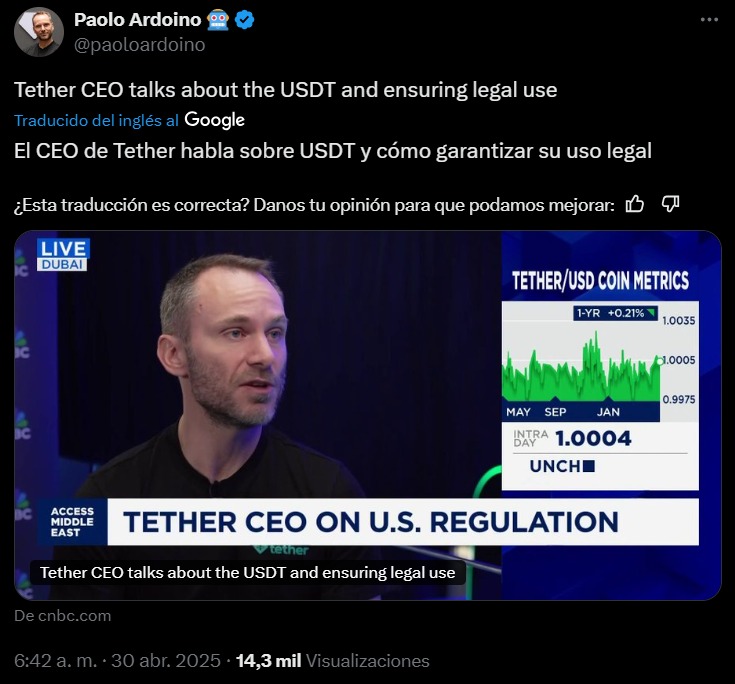
Within the framework of the Token 2049 Dubai event, Paolo Ardoino, CEO of Tether, offered an interview in which he talked about the company’s intention in strengthening the domain of the US dollar, especially in front of initiatives such as the de -drainage agenda promoted by BRICs countries.
Faced with the speculation on Tether’s influence on Washington, derived from his link with Howard Lutnick, CEO of Cantor Fitzgerald and Trump’s ally, Trump’s ally, Ardoino clarified that they do not maintain contact to avoid conflicts of interest. However, he highlighted Tether’s solid relations with multiple figures in the US and his commitment to educate about the role of the stablecoin in strengthening the dollar, especially now that the BRICs are promoting disdain.
During the interview, Ardoino was consulted about the possible connection between Tether’s growth and an eventual success of the Donald Trump government. The CEO replied that, in his opinion, “Tether’s success is really linked to the United States”. Instead of focusing on possible interactions between the company and the current administration, the expert stressed that the true value of the USDT lies in its usefulness for countries with inflationary economies. “If you go from the United States or Europe and ask a thousand people if they prefer their local currency or the dollar, at least 99% will choose the dollar,” he said.
«Tether, as International Stablecoin, is designed for people in small villages in Africa, taxi drivers in South America such as in Buenos Aires, or workers in Istanbul. It is a product for markets with high inflationwhere the dollar is more reliable than local currencies, ”explained the businessman, who was also consulted on whether they are working on a kind of stablecoin focused on the US domestic market.
On the latter, Ardoino replied: «In the US, we need to create a payment product that institutions can use. We are working on that, but it depends on the schedule of the final legislation on Stablecoins. We believe that it could be realized at the end of this year or next ».
Paolo was also questioned about how he guarantees that Tether is useful for those who need it, without becoming a tool for illegal activities. This, in response to an article from the New York Times that described USDT as the preferred stablecoin for criminals. Given this statement, the CEO responded firmly: «The New York Times ignores that Cash dollars are used in extreme amounts for illegal activities, such as drugs, crime and terrorism. Everyone knows that these things happen in the world, so you have to put it in context.
According to Ardoino, Tether is one of the few companies that actively collaborates with order agencies: «We have 66% of the market. Unlike other stablcoins, we work with the Department of Justice and with agencies in more than 50 countries. No company, not even the traditional financial system, has this level of cooperation ». In addition, he was categorical in stating that they act proactively without expecting judicial orders, and that traceability in cryptoactive networks gives him an advantage over the traditional financial system. «We demonstrate it every day [la cooperación]. For example, we work for months with the Department of Justice to freeze the assets of Russian Exchange sanctioned Guarantex. The New York Times should have investigated better, ”he said.
During the conversation, he also asked about certain criticisms that qualify Tether as a “stablecoin without stability.” Far from dodging the comment, the largest representative of the project responded with irony: «Who says that is probably a bank that operates with fractional reserveskeeping only 10% of deposits. In Italy we say: ‘The bull is accusing the donkey of having horns’ (said it is used to point out hypocrisy or lack of self -criticism) ».
Thus, the CEO defended the company’s financial solidity by highlighting that it is supported, in large part, by US Treasury bonds, and that they are close to reaching the USD 120 billion in reserves. In addition, he stressed that in December 2024 they had USD 7 billion in excess capital, an unprecedented figure: “Hopefully financial institutions will copy us to offer better products to consumers”.
Finally, before the question of whether Tether could answer a situation of panic in the market, Ardoino did not hesitate to affirm that each Token is completely supported. He said that in 2022, during an attack coordinated by short vendors, Tether returned USD 7 billion to users in just 48 hours, and more than USD 20 billion in less than a month, which represented more than 25% of their reserves without affecting its operation. «Meanwhile, the banks of Silicon Valley Bank collapsed. No bank can return more than 10% of deposits without breakingso it is ironic to criticize us. We have more liquidity than the total tokens issued, ”he concluded.
Trump, the BRICS and the disdain …
Since Ardoino alluded to the BRICS, it is pertinent to clarify that Donald Trump has been intensifying his rhetoric against the block for months. In fact, a few weeks after assuming power, the president -elect warned that his government will not tolerate other powers to drive alternatives to the dollar without facing consequences. He even threatened to impose tariffs of up to 100% to countries that participate in initiatives to replace the US currency.
The truth is that Trump, as part of its commercial strategy based on the reindustrialization of the USA, ended up applying tariffs to several countries of the block, with China facing the most extreme case. Brazil, India and South Africa – so like many other jurisdictions – faced a 10% base tariff over all their exports to the US. Russia was exempt from new rates due to the current economic sanctions.
However, the threats of imposing higher tariffs on countries that promote defolarization have led members of the BRICS block, as India, to rethink their position. In March 2025, Minister of Foreign Affairs, S. Jaishankar, declared that India does not support the creation of a common currency within the blocka position that was probably consolidated after the announcement of the visit of the American vice president, JD Vance. During his meeting with Prime Minister Narendra Modi in April, both leaders advanced in the negotiations of a commercial agreement aimed at avoiding the application of new rates.