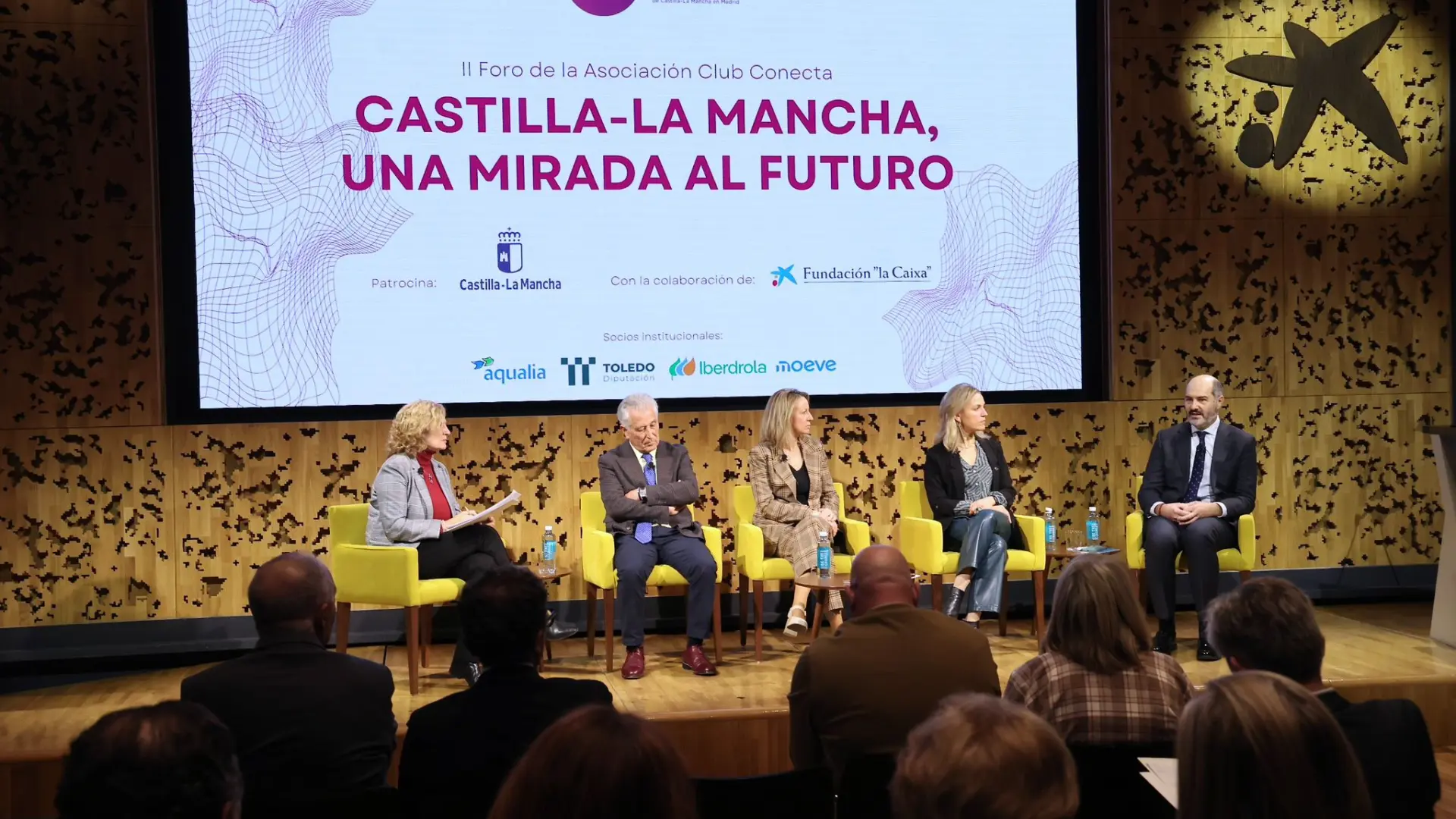
The Conecta Club brings together institutional leaders at CaixaForum Madrid to debate the future of Castilla-La Mancha

The Connect Club The second edition of the forum was held this Monday at CaixaForum Madrid “Castilla-La Mancha, a look at the future”, a meeting that brought together institutional officials, mayors of heritage cities and representatives of the agri-food sector to analyze territorial development, cultural promotion and quality products from the region.
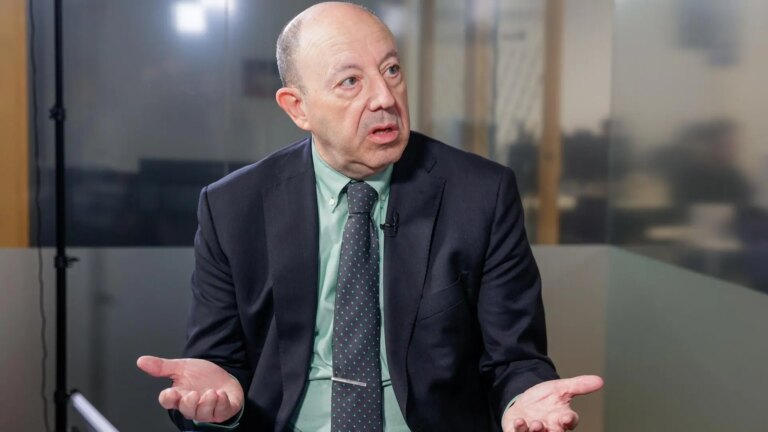
The second vice president of the Communities Board, Jose Manuel Caballeroopened the program with an interview conducted by Esther Esteban, executive president of El Español de Castilla-La Mancha, in which she stated that she sees it as impossible to exhaust the legislature and predicted that “We are not going to get through the fall without elections”thus placing the political calendar at the center of the debate.
In terms of regional financing, he recalled that Castilla-La Mancha suffers from “a situation of underfinancing since 2014” and has warned that “there will not be a new financing model in the short term.” Therefore, has considered “a transition fund of 3.2 billion euros” to be essential until a definitive system is agreed upon.
The vice president has defended that the region “has improved with autonomy”, he has stressed that the new Statute “is not in question” and has hoped that it can be approved “before the summer.” He has also highlighted the competitive advantages of Castilla-La Mancha—accessible renewable energy, available land and strategic location—and the regional government’s efforts in the fight against depopulation and in tourism sustainability, innovation and digitalization projects.
Heritage cities: tourism, culture and territorial cohesion
The first round table of the forum, moderated by Yolanda Gómez, deputy director of ABChas analyzed How the heritage cities of Castilla-La Mancha face the challenge of converting their historical wealth into an engine of sustainable development. The interventions have shown that, despite the diversity of realities, all municipalities share similar needs and challenges.
In this sense, the mayor of Almadén, Raquel Juradohas underlined the urgency of “put Almadén on the map”, a town that – he recalled – has “impressive but little-known heritage treasures“, such as the historic mercury mine, its unique hexagonal bullring or the Real Cárcel de Forzados. Jurado has insisted that the lack of good connections, “with a train that leaves us in the middle of the field“, hinders the arrival of visitors and limits tourism potential. Therefore, it has called for more investment and promotion so that these resources “really serve the neighbors”.
From a more consolidated heritage reality, the mayor of Almagro, Francisco Urenarecalled that the Corral de Comedias is “the main economic and cultural engine” of the city, capable of attracting “more than twelve times its population in visitors” each year. He has warned, however, that maintaining the historic center is “unaffordable with the municipal budget alone” and has asked that public financing take into account the patrimonial weight of the municipalities. He has also defended that it be the town councils who decide whether or not to apply a tourist tax.
Along these lines, the mayor of Sigüenza, Maria Jesus Merinohas claimed that heritage will only be an engine against depopulation with policies adapted to complex territories like his, with 28 districts and strong administrative and budgetary limitations. Has claimed a specific regulations for small municipalities and has highlighted that Sigüenza’s candidacy for World Heritage would allow the consolidation of a sustainable tourism model based on its “unique historical-artistic ensemble“Its proximity to Madrid, he has pointed out, opens “a clear opportunity to establish population and generate quality employment” linked to tourism and the primary sector.
That vision has been shared by the Tourism Councilor of Toledo, Jose Manuel Velascowho recalled that the capital has 120 Assets of Cultural Interest and faces the challenge of guaranteeing “quality tourism that coexists with a living historic center“He has highlighted measures such as the regulation of tourist housing – which has allowed abandoned buildings to be rehabilitated – and the agreements to convert properties with heritage value into housing, attracting new population to the historic center. Velasco has called for public investment.”fair and sustained” when considering heritage a first-order economic engine.
On the whole, the interventions have agreed that The heritage wealth of Castilla-La Mancha constitutes a decisive opportunity for developmentbut it requires better communications, specific financing and a coordinated strategy that allows cultural tourism to coexist in a balanced way with the lives of neighbors.
Quality products and Designations of Origin: identity and rural development
The second round table focused on gastronomy and its participants agreed that, behind the prestige of quality products from Castilla-La Mancha, there is enormous potential, but also common challenges: generational change, lack of labor, competitive stress in the markets and the need for greater institutional protection. Cheese, wine, marzipan and saffron have shown the same reality: the gastronomic identity of the region is a decisive economic engine that will only be sustained with specific policies.
The president of the Manchego Cheese DOAntonio Martínez, has remembered that Manchego cheese is “one of the most important heritages of the region” and one of the most internationally recognized Spanish brands, but has warned that the sector is experiencing a fragile situation: “we are a giant with feet of clay” due to the aging of the livestock herd, the lack of replacement and milk prices that do not cover costs. Furthermore, he has warned that more than 80% of the cheese consumed in Spain “is not authentic Manchego”demanding more fight against fraud and greater institutional commitment to DOs.
That concern has been shared Juan Ignacio de Mesa, president of the Santo Tomé factory, who has claimed the authenticity of Toledo marzipan, considered Protected Geographical Indication. You have remembered that only The supreme marzipan—“the only truly authentic one”—contains more than 50% almondstoday mostly Valencian, and has defended that Castilla-La Mancha promotes the cultivation of its own almonds to guarantee supply and allow marzipan to aspire to a future DO La Mancha. He has also asked to protect family factories from the advance of large industry: “We are the ones who keep the essence of the product alive.”
The president of the Saffron DOP of La Mancha, Valentina Cabrahas placed emphasis on the lack of labor and the harshness of cultivation: the flower must be picked and roasted in less than 24 hours and mechanization barely exists. He has called for support to develop machinery that alleviates this process. and allows us to compete in an international market in which tariffs and foreign competition “suffocate producers.”
The most structural vision has been provided by Esther Bello, advisor of the Virgen de las Viñas Cooperative, remembering that the problems of the sector “are the same for everyone”: labor, prices and costs. He has stressed that 3,500 families depend on the cooperative, 70% of the production is exported and that the great challenge is to increase bottling to reinforce the positioning of DO La Mancha in international markets. “Looking to the future can only be understood from the union of forces“, he stated, highlighting the role of cooperativism as an economic and social engine of Tomelloso and the region.
The chef Rocío Arroyowinner of the Cuillère d’Or 2019, has completed the table by recalling that “Chefs are the best ambassadors of La Mancha products“He has defended that culinary innovation must always be accompanied by respect for the product and has regretted that, on occasions, “There is not enough pride in local gastronomy” from the municipalities.
Moderated by Amador G. Ayora, director of The Economistthe table concluded with a shared diagnosis: Castilla-La Mancha has unique and highly valued products inside and outside of Spain, but it needs more promotion, better protection against fraud, support for the producer and a determined push for generational change to ensure its continuity.
Institutional closure
The Development Minister, Nacho Hernandowas in charge of closing the event and focused his final intervention on one of the key challenges for the competitiveness of Castilla-La Mancha: the need to reinforce electric transport networks. He has defended that the country must “open the door for companies like Iberdrola—and others—to invest directly in the construction and improvement of electrical networks“, without depending exclusively on the capacity of Red Eléctrica. “If we do not resolve this bottleneck, we will lose strategic opportunities”, he warned.
Hernando has framed this message in a vision of the future based on “long look” and in a growth model that prioritizes opportunities —“the buds, not the bars“—. He has claimed a style of government.”without shortcuts, transparent and with glass pockets“, convinced that “99% of problems are solved by listening”.
The counselor has recalled the urban development impulse of the legislature, with 140 commissions, almost 1,000 approved projects and 39 declared prioritywhich add up to more than 3 billion investment. All of this, he said, requires greater regulatory flexibility for small municipalitiesthat “They cannot be governed by the same rules as the capitals”.
Likewise, he has highlighted the industrial weight of Castilla-La Mancha, where the industry represents 22.7% of the regional GDPa proportion higher than the national average, and the strong increase in foreign investment, which has doubled in recent years. Sectors such as data centers, logistics, the aerospace industry, defense and renewable energies – including green hydrogen – symbolize, he said, the new future niches of the region. Hernando has also insisted on the importance of guaranteeing affordable housing and to support the agricultural sector, remembering that the demands of farmers and ranchers for a better Common Agricultural Policy respond to the defense “of what we all put in our mouths”.
The event has been led throughout the day by Bernardo Diazhead of the print edition of Five Daysand was attended by Juan Luis Vidal, territorial director of Castilla-La Mancha and Extremadura of CaixaBank, and José Luis Camp, director of Institutional Banking in the region. The day, which was attended by more than fifty guests, ended with a Spanish wine in which attendees were able to exchange impressions and outline future lines of cooperation.
The forum has been sponsored by the Board of Communities of Castilla-La Manchathe support of “la Caixa” Foundation as a collaborating entity and the support of the institutional partners from Club Conecta: Aqualia, the Provincial Council of Toledo, Iberdrola and Moeve.
About Club Conecta
He Connect Club It brings together more than a hundred journalists and communication professionals born in Castilla-La Mancha who develop their careers in Madrid. Its objective is to give visibility and value the cultural, economic and social heritage of the region, in addition to strengthening the ties between Castilla-La Mancha and the community of Castilian-La Mancha communicators who work in the capital.
Its members include four media directors, as well as leading communicators in national and regional newspapers. Castilian-La Mancha communication managers who carry out their work in some of the main companies in the country are also part of the Conecta Club.