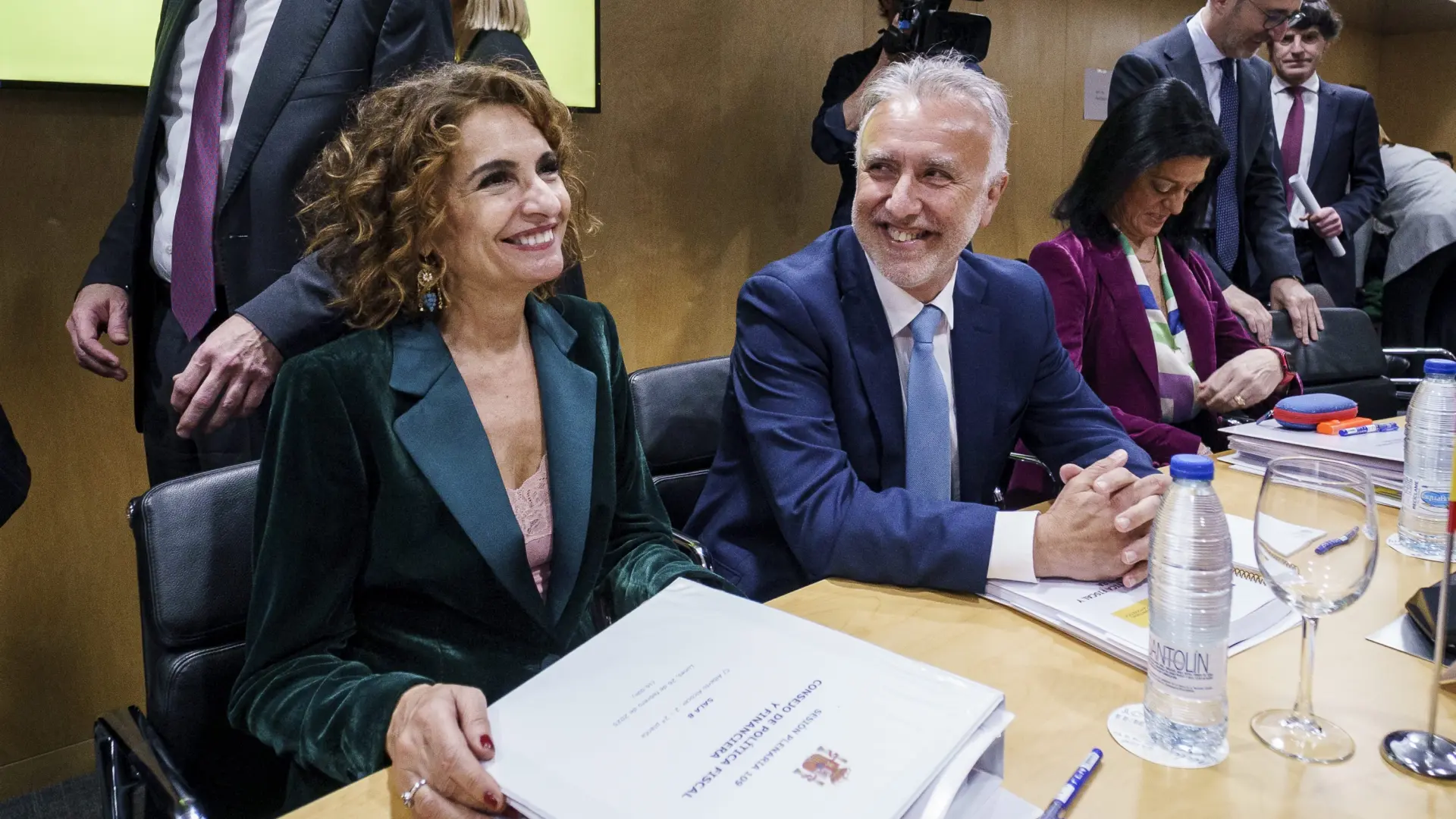
The Fiscal Policy Council faces a key meeting for the Budgets with the PP autonomies on a war footing for singular financing

Four months late, without the support of Junts guaranteed to carry out the General State Budgets of 2026 and with the precedent of the ‘leak’ of the PP councilors in the previous meeting, the Ministry of Finance and the autonomous communities are holding a new call from this afternoon of the Fiscal and Financial Policy Council (CPFF). Although the main point on the agenda will be the presentation to the territories of the new path of stability for the period from 2026 to 2028 – the deficit, debt and spending rule objectives to which they will have to adhere -, the proposal for singular financing and the reform of the distribution model (the latter appears as a point to be debated), will take up a good part of the conversations… at least behind closed doors.
The first vice president and minister of the branch, María Jesús Montero, has already explained that she will not yet put on the table a specific proposal for a new financing model, although the sixth point on the agenda does specify that the “state of affairs” will be addressedand it is the first time that this issue is explicitly incorporated in the list of topics to be discussed. In the Generalitat they value very positively that the debate on the reform of regional financing is opened and, in the words of Illa, that it is done based on “dialogue, with rigor and responsibility.” The Government has intensified negotiations with the central Executive and they are working to ensure that the reform prospers.
From Catalonia they emphasize that the current model needs to be reviewed, because does not respond to the “real” needs of the Autonomous Communities; an idea that they assure generates consensus between autonomies. In this context and at Monday’s multilateral table, where Councilor Alicia Romero will sit, they want to defend the “legitimate interests of Catalonia”, with “institutional loyalty” and in a way committed “to solidarity between territories.”
The position of the Government representative contrasts with the previous skepticism of the autonomies governed by the PP, which already stood up to Montero and abandoned the previous conclave, held on February 26, by opposing the proposal to forgive the autonomous debt that the Executive assumed as a result of the pact between the PSC and ERC for the investiture of Salvador Illa in Catalonia.
Sources from the Junta de Andalucía explain to Economic Information that The starting point of the negotiation of a new system is the 1,528 million euros that would correspond to it to Andalusia for the underfinancing to which the current model subjects it, according to the calculations of the Foundation for Applied Economic Studies (Fedea), a ‘think tank’ close to the CEOE employers’ association. To this amount we would have to add the 4,000 million ‘extra’ euros per year that the group of regions would need to cover Health, Education and Dependency.
Among the worst financed communities are also Castilla-La Mancha, Murcia and the Valencian Community. “The reform of the financing model cannot be postponed, it is essential and the Government of Spain cannot continue delaying it while it negotiates privileges with the separatist parties,” denounced these days the Valencian Minister of Finance and Economy, Ruth Merino. In his opinion, all the technical work has been done, so putting it into a document is just a matter of “political will of the Government.”
At the end of October, the Secretary of State for Finance, Jesús Gascón, gave some touches on the reform of the regional financing system that the Government would be devising. The ‘number two’ of the ministry proposed a new system of transferring income in real time to the communities instead of the current one of payments on account and a “limited” transfer of tax powers to the autonomous communities.
What has been said to date does not convince Madrid, which expects “little” from this Monday’s meeting. His advisor, Rocío Albert, stressed in a recent interview with Europa Press in which the current system “has become opaque” and gives rise to “many imbalances and many changes of location depending on what is contributed”, although he considered that this meeting is just “one more justification for singular financing.”
Necessary step for preparing budgets
The path of stability that is presented to the autonomies today and the spending ceiling or non-financial spending limit will be approved tomorrow in the Council of Ministers, as Montero herself confirmed last week. The current stability objectives are those included in the April 2023 Stability Programthose of the budgets that were extended both last year and this one, in which the Government did not even present any accounts.
Now, both the deficit and debt goals and the spending rule must adhere to what is established in the medium-term Fiscal and Structural Plan committed to Brussels and what is required by the new fiscal rules. The plan limits the deficit to 2.1% of GDP next year; public debt, at 100.1% and the growth of computable spending at 3.5%.
The path of stability will receive the green light from the Council, where the Treasury has half of the votes and, after being approved by the Council of Ministers on Tuesday, it must be sent to Congress, where the Executive has a very difficult time being able to move it forward due to the lack of sufficient support. In any case and even if it received the approval of both Chambers, it is unlikely that the new accounts will be able to take effect in a timely manner next January 1, which will make the 2023 Budgets the longest in democracy.