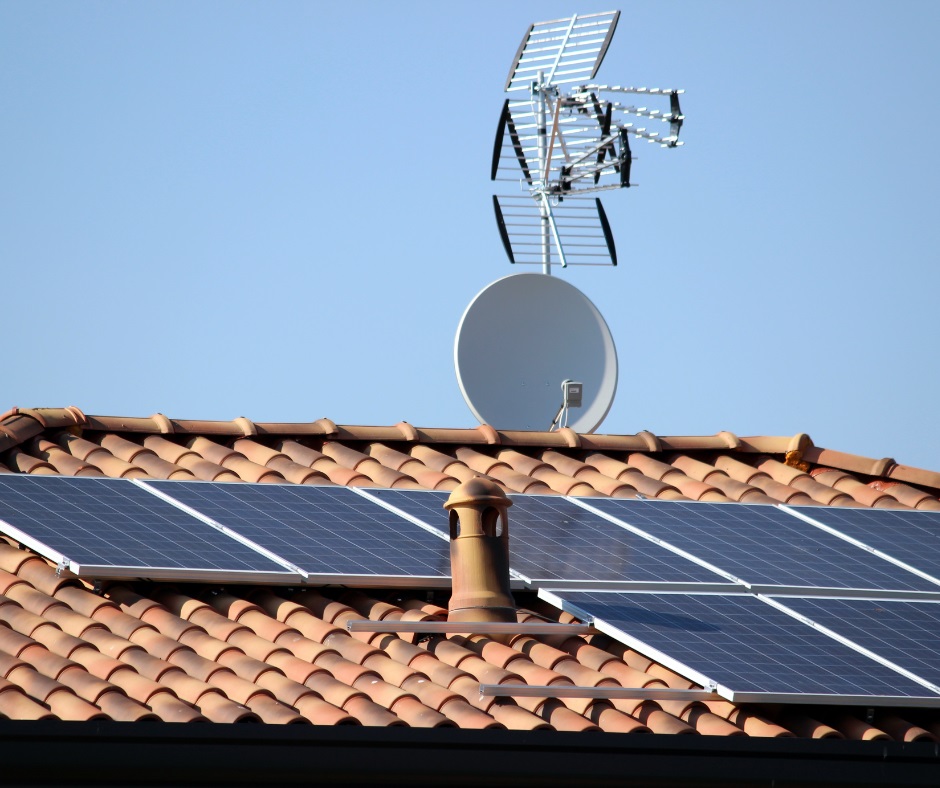
The lack of information and living in an apartment building slow down the decision to install self-consumption in up to 78% of cases.
The lack of information about the possibilities and benefits on the electricity bill stops almost 80% of decisions to install self-consumption by citizens and, in particular, by those who live not in individual houses, but in communities of ownerswhere 44% say they are not willing to deal with their neighbors to install solar panels, according to a sector report presented this Tuesday by Sotysolar and the Spanish Phototovoltaic Union (UNEF), which shows that there is still a way to go despite the explosion in the installation of solar panels on roofs in the last two years. Right now, only 5% of homes have them installed in their homes, 17% of households are “potential clients” who are considering, have requested information or have started the procedures to install them and 78% who are either not interested or do not consider it right now.
Among the latter, who are the majority, is the bulk of the citizens afflicted by the two large “pre-barriers” to self-consumption, lack of information and living in a block of flats, that detects the Radiography of Self-consumption of Spain 2024, which aims to be the largest annual study in the sector and that on this occasion detects that “a high degree of ignorance persists” among the general public about the installation of photovoltaic panels, their benefits and also the possibilities that exist for this in neighboring communities.
More information, more interest
He interest in installing self-consumption is directly proportional to knowledge what is known about him. 89% of people who say they are not interested also say they are not at all or very little informed about self-consumption, among those who are interested but do not consider it, 29% say they are quite or very informed and the proportion rises to 60% among those who have requested information or are in the installation process. He higher level of knowledge -83%- is among those who They are already users, despite the fact that 17% of them say they are not at all or very little informed about self-consumption.
“The massive penetration of solar energy in Spain is influenced by the poor level of knowledge and information,” says the report, which reflects that only 19% of homeowners say they are quite or very informed about self-consumption.
Deal with the neighbors
Besides, 47% of homeowners He says he is interested but that he is not considering it and among them the majority are those who live in housing blocks, which represents approximately 70% of the homes in Spain.
If we differentiate between owners who live in houses and chatts and in apartment blocks, the disinterest is greater among the latter – up to 81.6% who neither have nor are interested – than in the former – 65.8% -. 14.9% of those who live in single-family homes already have solar panels while it is only in that case of the 2% of homeowners in apartment blocks.
“Living in a community of neighbors is the main deterrent for 40% of apartment owners,” says the study, which says that in 44% of cases having neighbors and ““struggle” to get approval to install solar panels is a “pre-barrier” to self-consumption. Returning to the lack of information in this specific case, two out of every 10 residents know that in order to make this decision unanimity is no longer necessary and that “the approval of a third of the neighbors” is sufficient for the plates and private use. When they have this information, the report indicates that interest in self-consumption increases and that 63% consider it “interesting.”
The conditions under which self-consumption is installed in a neighboring community is not the only lack of information that negatively affects the installation of photovoltaic panels. Three out of four owners They also don’t know that there is help public and tax benefits for putting them, such as deductions in personal income tax for the cost or discounts in IBI. Again, when you are aware of this, the interest rises to 14%.

Savings, determining factor
In any case, the report confirms that the existence of subsidies such as those from the EU Recovery Fund are not a determining factor for a household to decide to install self-consumption. The most important, for 60.1%, is the economic savings on the electricity bill in a country where, according to SolySolar, “the average Spaniard spends 8% of his salary to pay for the energy of his home.” The reasons are followed by being able to “generate my own electricity” (40.3%), “be more sustainable” or “pollute less” (39.8%), take advantage of solar energy (38.7%) or reduce consumption energy (36.9%).
To a lesser extent, the reasons for embarking on self-consumption are “to be less dependent on electricity companies” (28.2%) and then the subsidies or tax benefits, which refers to 20.9%. Behind them, for 18.9%, a determining factor is “the changing price of energy.”
With a general lack of knowledge (78%) of the existence of various aids to install self-consumption, 46% of those consulted would lean toward to finance the cost, preferably in a period of three to five years (37.9% of cases) and paying the lowest possible fee, less than 50 euros per month. The next option (for 19.7%) would be a repayment period of between 6 and 10 years or an installment of between 50 and 100 euros (24.2%).