China advances in de-dollarization and uses cryptocurrencies for international trade
China is increasingly willing to advance the process of de-dollarization of its economy. As an example of this, several companies from that Asian country have been using cryptocurrencies for international trade with Brazil, as explained by the CEO of the Ripio exchange, Sebastián Serrano.
In statements to the press, Serrano said that Brazilian importers are already paying Chinese suppliers with cryptocurrencies, and although he did not specify which crypto assets are used for payments or which companies are involved, he noted that the settlement of transactions, without the dollar, has become something regular among companies in both countries.
It is worth remembering, in this sense, that the use of the yuan in trade between China and Brazil began to materialize a year ago, when both governments agreed that joint investments and exchanges be carried out in yuan and Brazilian reals.
In this way, the yuan becomes part of China’s trade with several South American countries, since it was recently learned that there are also plans to use the currency in trade with Boliviaaccording to the announcement made this week by the Bolivian Minister of Economy and Public Finance, Marcelo Montenegro.
The news spread shortly after it became known the alliance for dedollarization established between China and Russia, after the meeting between the presidents of both countries. It is known that more than 90% of payments for commercial exchange between the two Asian giants is carried out using rubles and yuan.
Trade with yuan is also a reality between China and Pakistan. Alliances for the use of the Chinese currency include African countries, such as Nigeria and South Africa.
This is a trend that is gaining more and more strength internationally, as the Chinese government agrees on dedollarization with more countries around the globe. It is therefore expected that the US currency will not only be replaced by national currencies, but also by cryptocurrencies such as bitcoin (BTC).
Figures show the rise of trade in yuan
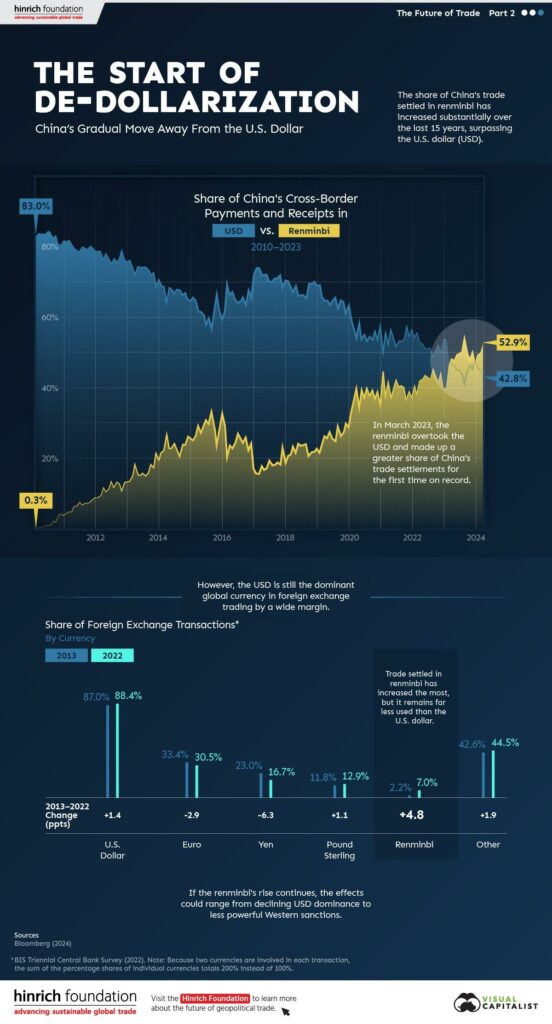
There are several figures that show the way in which the de-dollarization process is progressing in China, since according to data from the Hinrich Foundation, in 2010, the majority of the Asian giant’s cross-border payments (83%) were settled in US dollars. Less than 1% of transactions were carried out with the yuan.
A situation that began to change from the first quarter of 2023, when – for the first time – the yuan surpassed the dollar in international trade. Calculations indicate that, until March 2024, more than half (52.9%) of Chinese payments were settled in the national currency, while 42.8% were settled in dollars.
According to Goldman Sachs analysts, the greater willingness of foreign countries to trade yuan-denominated assets contributed significantly to de-dollarization in favor of the Chinese currency. Such willingness became evident after countries like Brazil and other BRICS members expressed their willingness to leave aside the US currency.
China and Brazil are precisely part of this block of 10 countries. As reported by CriptoNoticias, the BRICS no longer only carry out transactions using their local currencies, but are developing their own payment system based on central bank digital currencies (CBDC) that would be settled with their own stablecoins.
The path to de-dollarization opens
According to experts, the global de-dollarization process has accelerated due to the tensions generated by the significant increase in interest rates in the United States, along with the sanctions that left Russia out of the global banking system.
Both events caused not only China and Russia, but many other countries to try to challenge the leadership of the dollar. Hence, experts predict that, with the global rise of the yuan, the dollar’s control in international trade will decrease over time.
However, although the prevalence of the Chinese currency in international payments is expected to increase, it is believed that a complete de-dollarization of the world economy in the short or medium term is still unlikely.