The new regional financing would take away resources from the State with which to pay pensions, debt and defense spending
The new regional financing system proposed by the Ministry of Finance would put an additional 21,000 million euros on the table to be distributed among the autonomous communities. Some funds that come from the battered coffers of the central State, which would transfer them despite the fact that Some of the spending items that will increase the most in the coming years—pensions, debt interest, and defense—fall on their shoulders. All of this at a time when Spain has committed to Brussels to adjust its unbalanced public accounts, an effort that will also fundamentally be assumed by the central administration.
The proposed changes to the financing system highlight the delicate balance between providing more resources to the autonomous communities —some of them with obvious underfinancing problems— at the cost of reducing the State’s capacity to act. The president of Airef, Cristina Herrero, already spoke out in October on this issue and noted that she sees it as “difficult” for the State to be able to put “more money on the table” for the autonomous communities taking into account the challenges that await the State.
Among all these spending items that will put the country’s public accounts in check in the coming yearsthe most notable is that of pensions. The retirement of the generation baby boom (born between the late fifties and late seventies) will put pressure on Social Security accounts for decades to come. Income from social contributions is no longer sufficient to support all the expenditure, so the State has to finance this deficit with money from taxes, assuming a part of the disbursement.
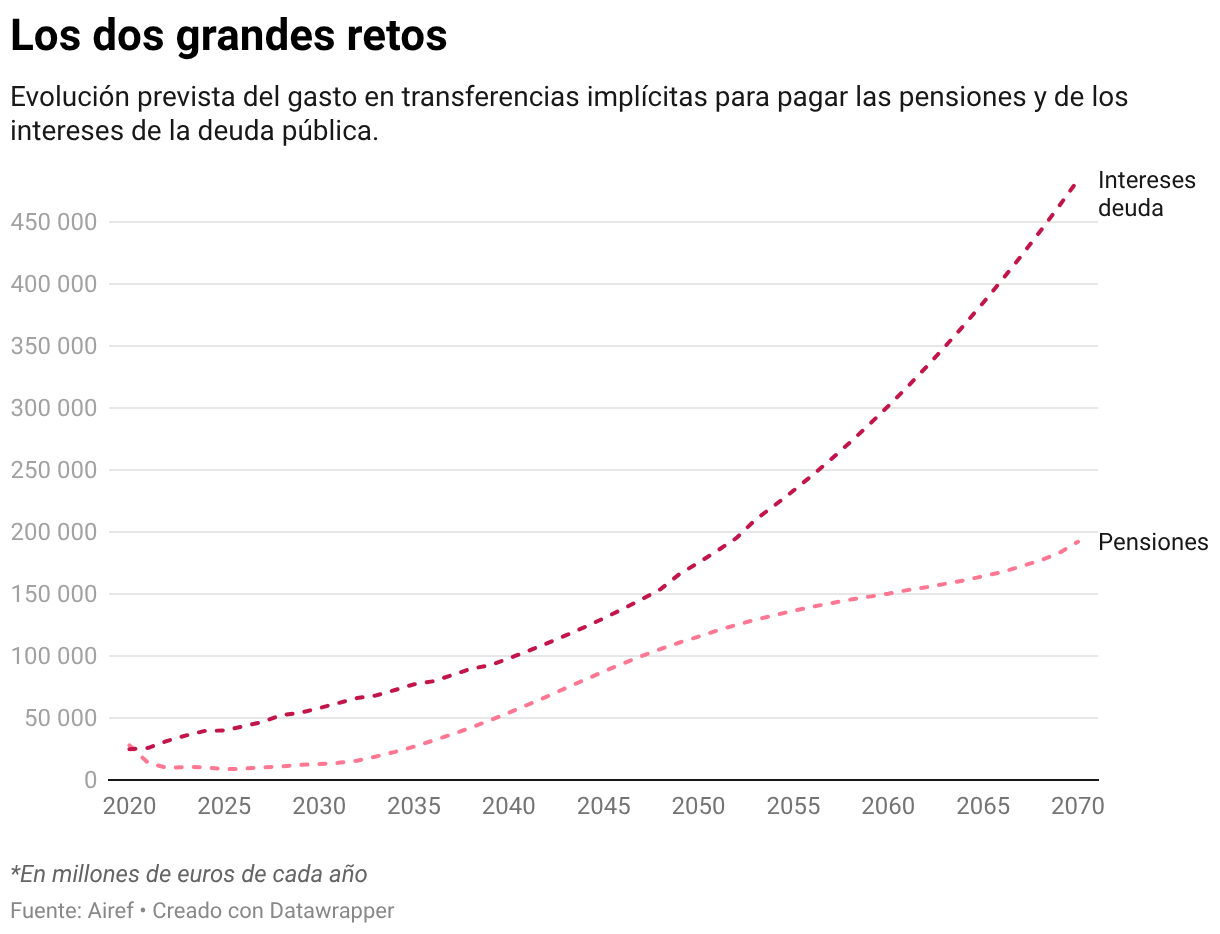
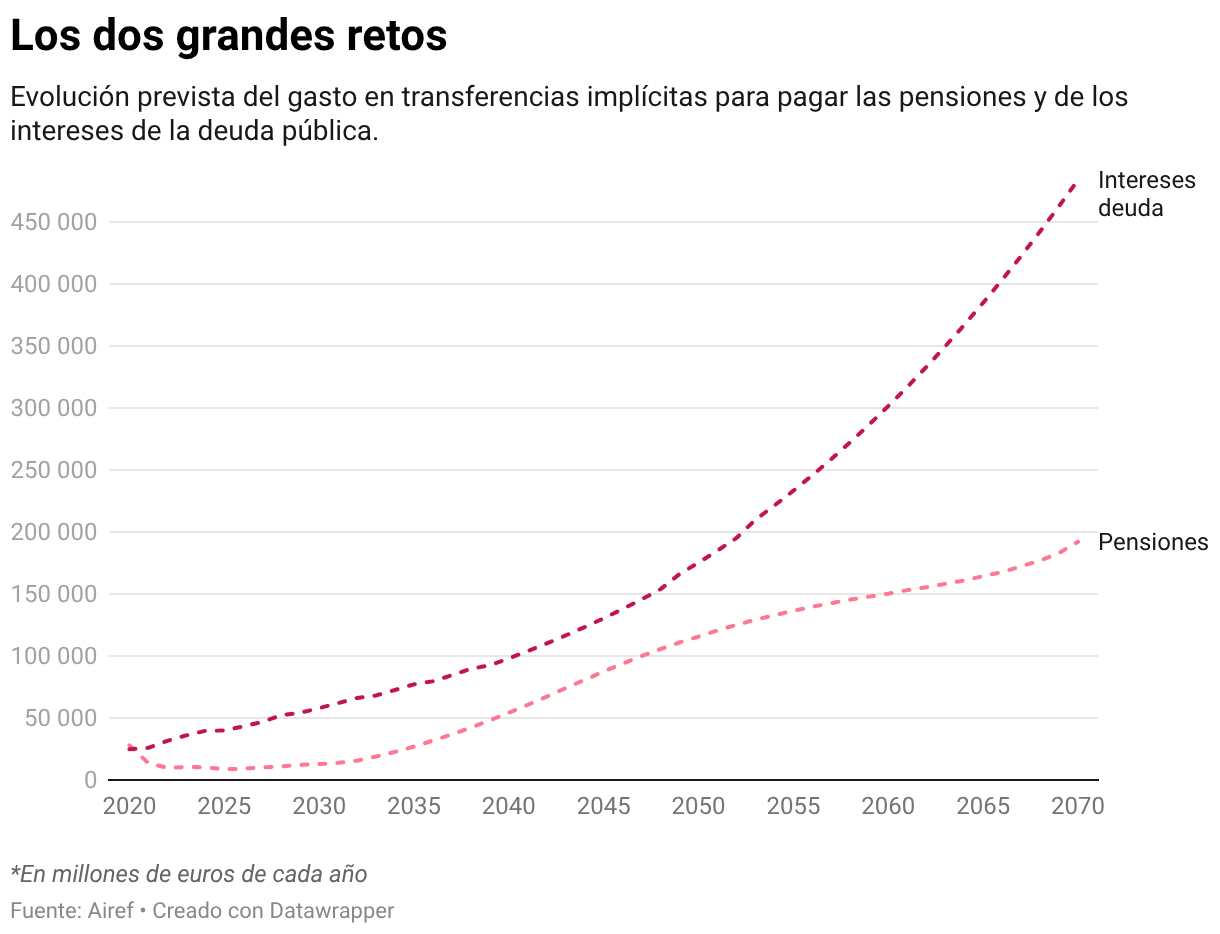
Projections from Airef, the independent authority that oversees Spain’s public finances, indicate that The part of pensions that is financed through State transfers is going to skyrocket in the coming decades.
In your Opinion on the long-term sustainability of public administrations, published in March of last year, the agency’s experts estimated that implicit transfers from the State to Social Security or other agency funds not dedicated to pensions will multiply by more than four until 2050.
From the 0.7% of GDP that was allocated in 2023 (10,488 million) it will increase to 3.1% in the middle of the century (115,658 million euros). This is without taking into account that the State already explicitly pays through taxes for the minimum supplements to contributory pensions and all non-contributory pensions.
The Airef then pointed out that, if measures are not taken, the resources allocated to cover this pension deficit will not be able to be spent on other budget items or will have to resort to debt, something that is not compatible with the adjustments to which Spain has committed.
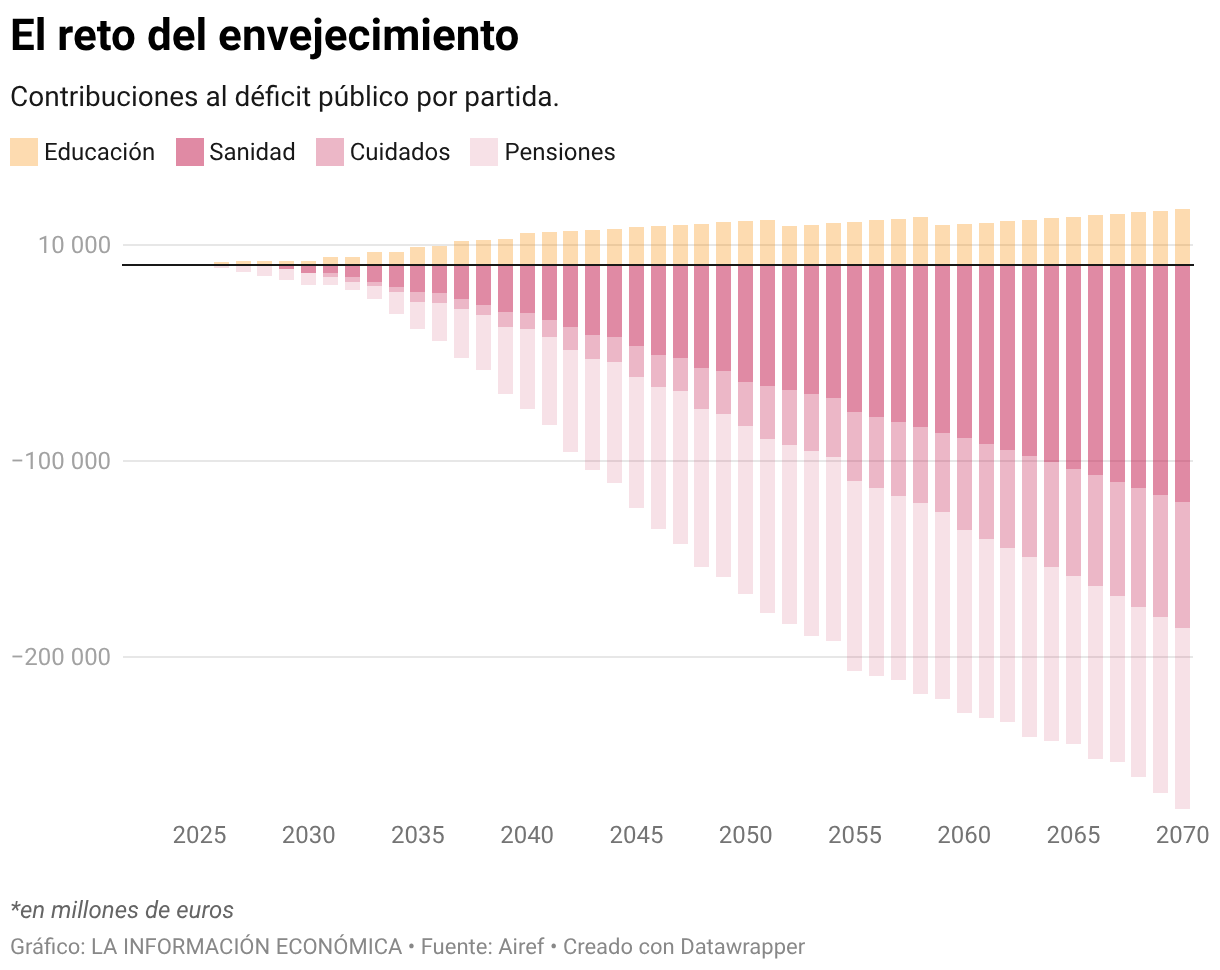
However, the autonomous communities will also assume in their accounts an important part of the impact that the massive aging of the population will have. According to Airef calculations, Spending linked to aging will have an impact on the deficit of 3.9 points of GDP in 2050 of the entire country, which translates into about 145.5 billion euros on that date.
Of them, half (2.2 points) will be due to spending on health and long-term carewhich fall fundamentally on the autonomous communities. However, the country’s demographic drought will also reduce the needs for spending on education – also largely a matter of regional competence –, limiting the balance of the communities to 1.6 points of GDP (57 billion) compared to 2.3 points due to the pension deficit that falls on the State.
The interest on the debt
Another of the items that is going to cause the most headaches for the governments that are in charge of the country in the coming decades is the interest paid on the public debt. The end of the era of zero or even negative rates is causing a slow but constant increase in the costs assumed by the Executive to cover the imbalance in public accounts.
In this section, Airef estimates that interest expenditure on public debt will go from 2.4% of GDP in 2025 (39,911 million) to 3.3% in 2035 (77,178 million) until reaching 4.7% in 2050 (175,532 million). A scenario that contemplates that public debt would escalate to 180% of GDP in 2070 if no measures are taken.
In this section, the State assumes practically the entire effort. Of the 1.7 trillion public debt that Spain accumulates (103.2% of GDP), 92% is in the hands of the central administration. We must not forget that more than half of the regional public debt (60%, specifically) has the State itself as a creditor.
Defense spending
Finally, another of the spending items that will increase the most in the coming years is defense spending, which is an exclusively state responsibility. The calls for rearmament in Europe, in the face of a world in which the defensive umbrella of the United States is in question and external threats are growing, will force governments to draw on their checkbook.
The Executive has already had to significantly increase the funds it allocates to this spending chapter to reach the 2% of GDP demanded by NATO allies. However, Donald Trump and Mark Rutte are pushing for the disbursement to be even higher and closer to 5% of GDP in 2035.