The salary offer to civil servants indicates that they will not gain enough purchasing power to compensate for what was lost between 2022 and 2024
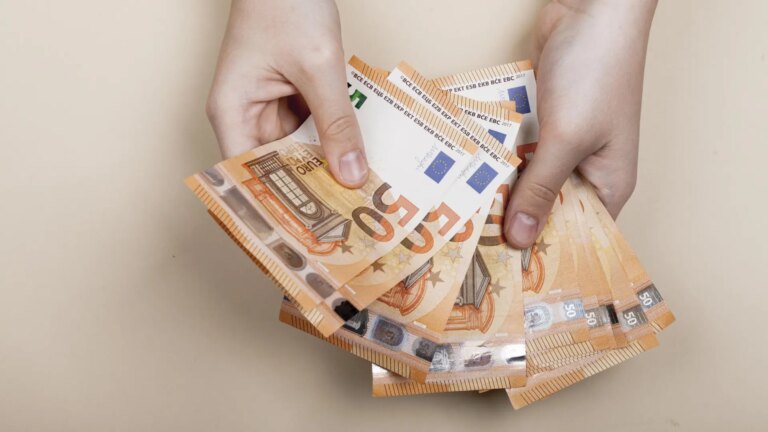
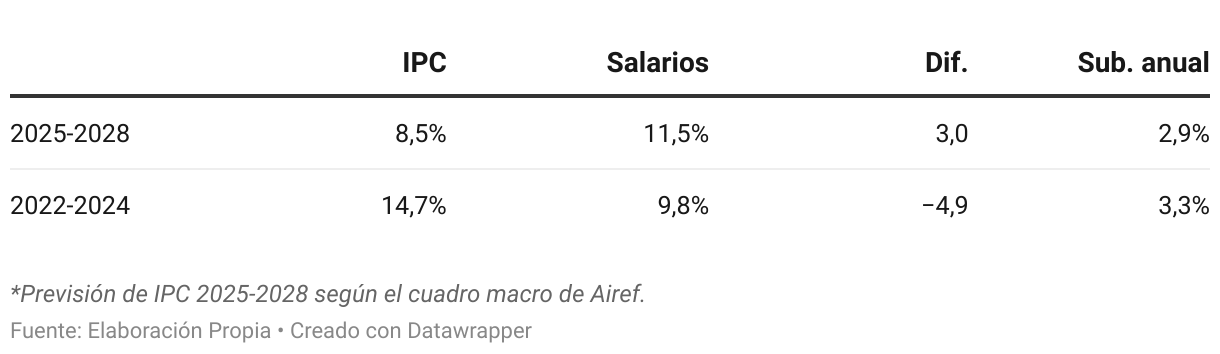
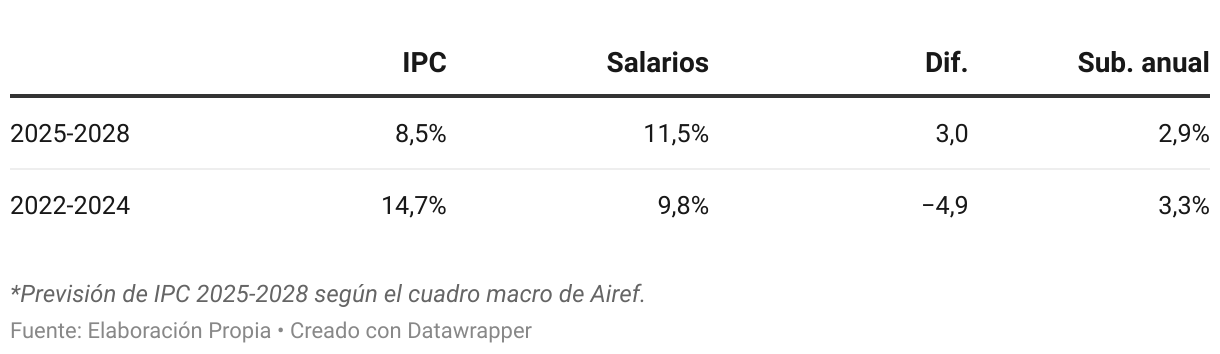
The Government and the unions are getting closer to closing an agreement to raise public salaries in the period 2025-2028. The latest offer – and it seems definitive – that the Public Service has put on the table proposes a total guaranteed increase of 11% (11.5% if the cumulative effect of the increases is taken into account). If an agreement ends up being signed in those terms, Everything indicates that public employees would gain some purchasing power. Although not enough, in principle, to compensate for what they lost with the previous agreement, valid between 2022 and 2024.
If we take the inflation forecasts of the Fiscal Authority (Airef) for 2025 and the next three years, the expected accumulated price increase would be around 8.5%. A figure that would remain three points below the salary increase that is now on the table. However, it must be taken into account that this estimate is surrounded by great uncertainty and could be small if a new shock inflationary like the one experienced in 2022 and 2023.
However, although the around three million public employees in Spain would gain about three percentage points of purchasing power, this improvement would not be enough to compensate for what they lost with the previous pact. The agreed salary improvement for the period 2022-2024 reached 9.5% (9.8% with the carryover effect), a remuneration increase that It was clearly below a price increase of around 15% in that period.
To all this we must add that The Government does not seem willing for the salary increase in the first two years of the agreement (2025 and 2026) to exceed 4%when most forecasts indicate that the inflation forecast for that two-year period will be close to or even somewhat above that 4%. This is estimated by prestigious organizations such as Airef, Funcas, the Bank of Spain or the European Commission.
According to what the unions defend, the ministry headed by Óscar López maintains that The spending ceiling in force this year and the one recently approved for 2026 do not allow salaries to be raised more than 4%. This limitation is one of the main reasons why the CSIF union, the majority in the General State Administration, refuses to accept the ministry’s offer.
When negotiating salary increases The situation of Spanish public finances weighs heavily. The country is immersed in a fiscal adjustment process to try to reduce its swollen public debt. At the same time, it must face increasing disbursements such as debt interest, defense spending or aging.
In this context, the salary increase for civil servants is also noticeable in public accounts. According to data from the General State Intervention (IGAE), Spain spends 172,749 million euros on public salaries. An increase of 11.5% would imply raising that amount to around 20,000 million in four years.
The officials are one of the income groups that have come out worst from the inflationary crisis that shook Spain in 2022 and 2023. Their salaries grew below those of pensioners (who have their payroll protected by law against prices), private salaries and other incomes such as the minimum wage.
At the same time, public employees also They receive higher starting salaries than the rest. The average gross salary in the public sector averaged 3,232 euros per month in 12 payments last year. 1,051 euros more than those of the private sector, which stood at 2,189 euros per month. Behind this gap there are various factors. Public employees have more stable careers, they tend to work more full-time. Furthermore, salaries are more homogeneous than in the private sector, where there are sectors with significant economic weight where salaries are precarious.
Lowering, freezing and recovery
The evolution of civil servants’ payrolls in recent decades is marked by the effects of the great recession of 2008. With the economy bleeding, the Government of José Luis Rodríguez Zapatero approved a reduction in the salary of civil servants of 5% in 2010 to try to balance public accounts. In 2012, under Mariano Rajoy, the Executive decided to suspend their Christmas pay, which years later they would partially recover.
Between 2011 and 2015 (both included) the payroll of public employees was frozenin a context of strong depression in the economy. The first increases did not arrive until 2016, when Rajoy’s Executive approved a timid increase of 1% in a context of already economic growth and on the eve of elections. In 2017 the salary improvement was also 1%.
As the economic situation normalized, the Government has resorted to multi-year agreements. In 2018, Rajoy’s Executive agreed on a fixed salary increase of 6.1% for the period 2018-2020 and a variable part linked to macroeconomic objectives that could raise the total amount to 8.8%.