The self-employed quota would have to rise up to 211% in seven years to achieve contributions based on real income
The 180-degree turn of Social Security with the self-employed quota will force contributions to increase further starting in 2027 if the objective of the group paying according to what they really earn is to be achieved. Last Monday, the ministry led by Elma Saiz rectified its initial proposal for quota increases: it froze them for the lowest-income groups and set increases of up to 2.5% for the rest next year.
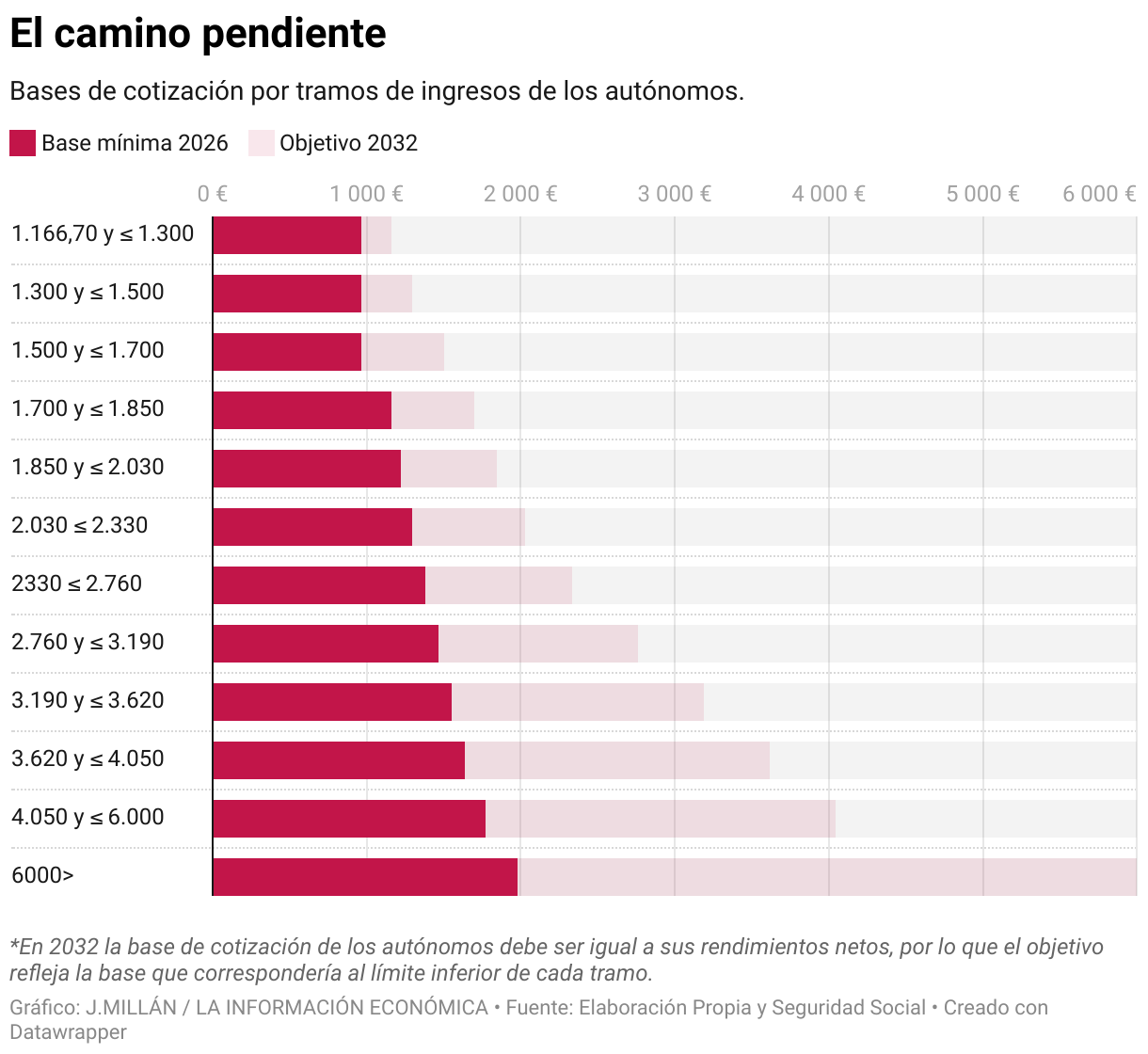
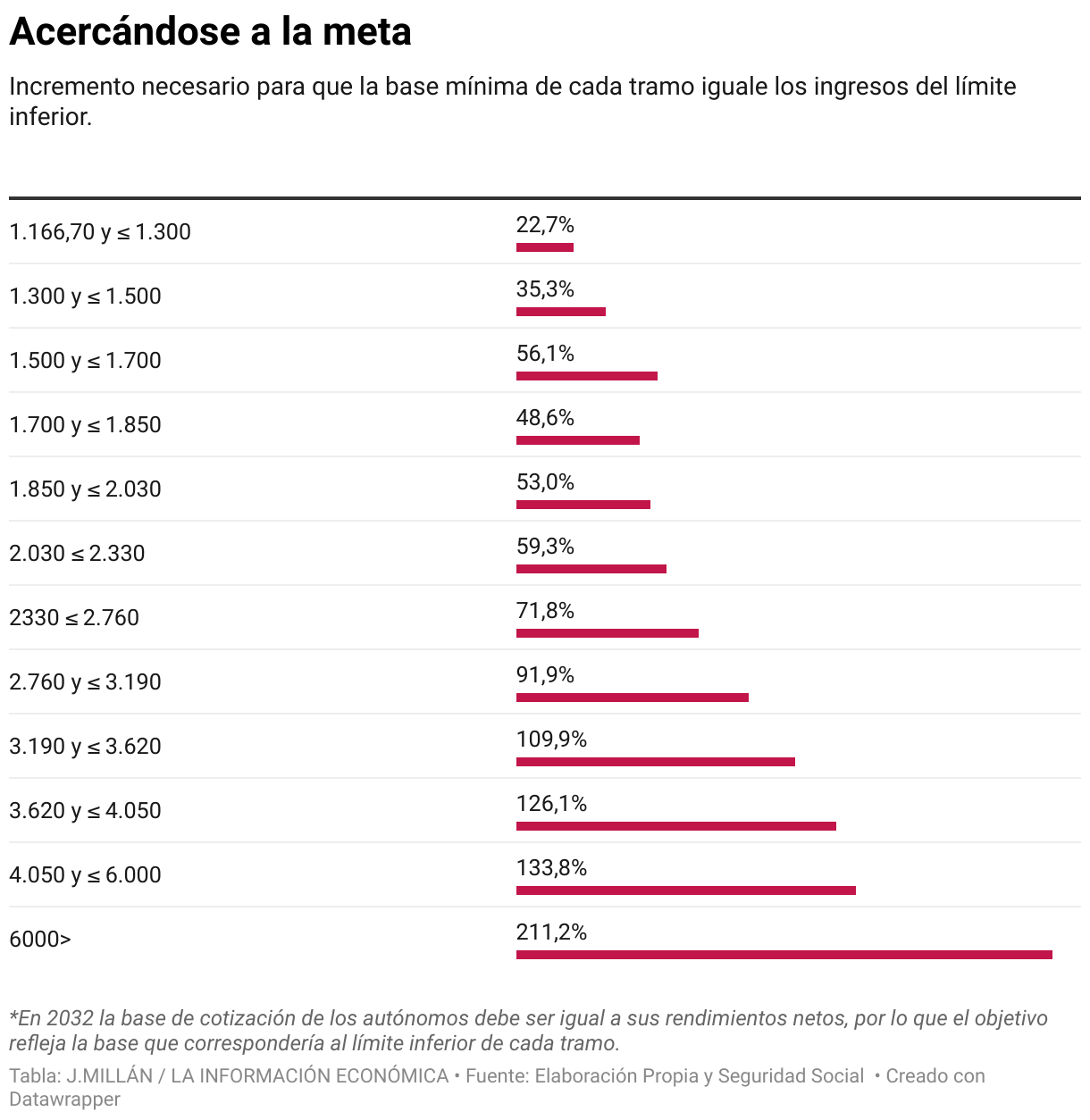
However, the ministry continues to maintain its goal that in 2032 the contribution base of the self-employed is equal to their real income, just as it happens with employees. They maintain that this is reflected in the law, although sectoral organizations such as ATA reject this interpretation. For this to happen, the minimum contribution bases for self-employed people who earn more than 1,167 euros per month should increase between approximately 23% and 211% between now and 2032.
The self-employed with the lowest income – the majority in the system – are the closest to the goal. For example, the lowest section of the general table already quotes for a minimum base of 951 euros per month, so, with an increase of 23% spread over seven years would be enough so that a self-employed person who earns 1,167 euros per month (lower limit of the section) contributes based on his or her real income.
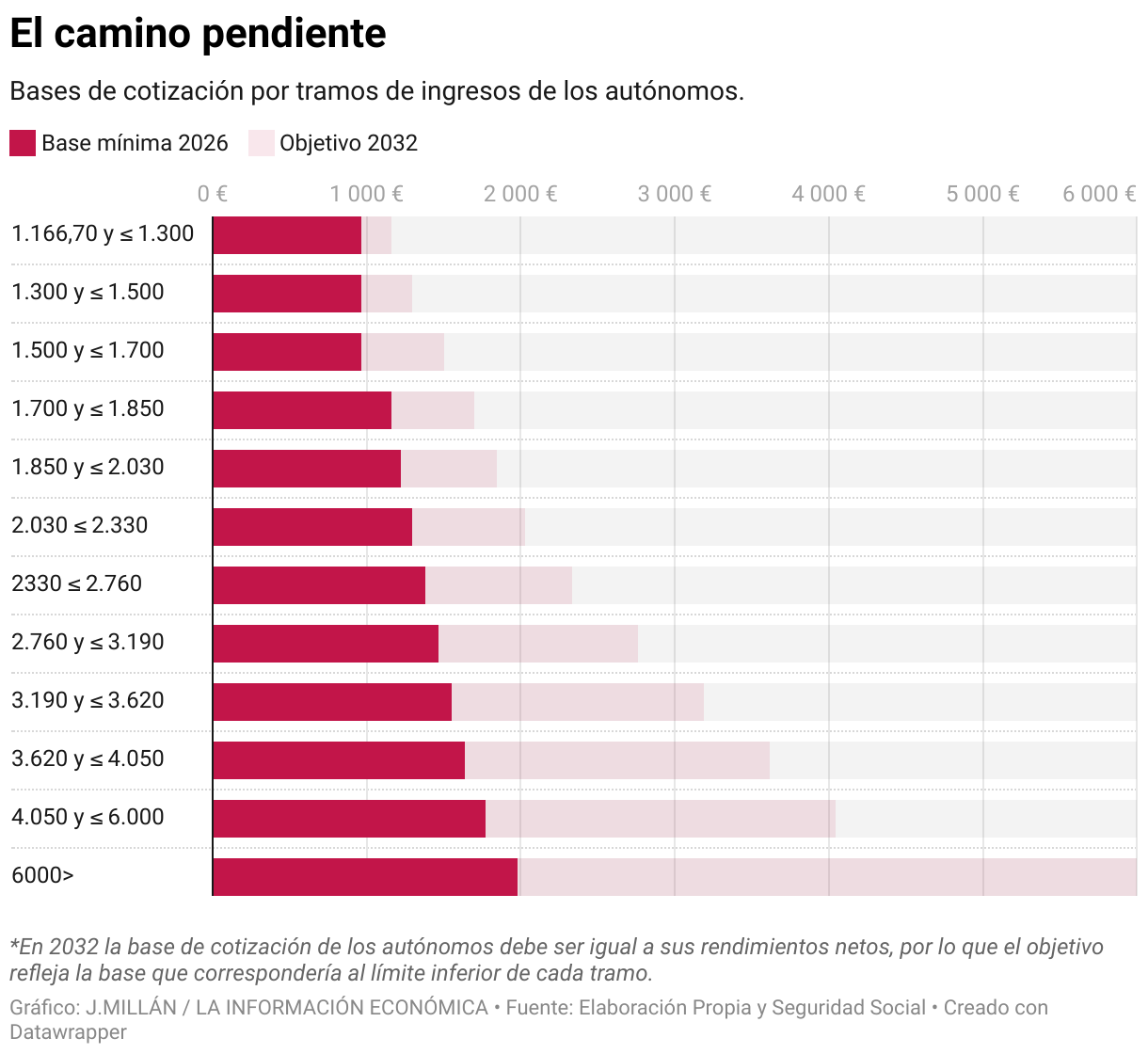
The effort necessary to get closer to the 2032 goal grows as the self-employed worker’s income level increases. For example, the minimum base (and, consequently, the quota) of the income bracket between 3,190 and 3,620 euros should be doubled so that the lower limit of the bracket coincides with the contribution base.
The most extreme case is that of the self-employed with net income of 6,000 euros or more per month (a figure that roughly coincides with the maximum base planned for the year 2032 by Social Security). Currently, this group has a minimum base of 1,976 euros per month. For this quote to correspond to your actual income, the base should triple in just seven years.
In the case of income brackets less than 1,167 euros per month (the SMI in 2022), the situation is different. The initial idea of Social Security was that the minimum bases would grow in proportion to the minimum wage interprofessional. In fact, the minimum bases in these sections are already very close to the real income of the self-employed. The Government decided to freeze the contributions for these three sections of less than 1,167 euros in 2026, in which there are around 1.4 million self-employed people, according to official Social Security sources. A good part of these self-employed workers decided to contribute above the minimum in 2023, according to the same sources.
Overexertion from 2027
Social Security has gone from proposing quota increases of between 3.8 and 35% annually in the period 2026-2028 to proposing an increase of a maximum of 2.5% only in 2026. This lower growth rate would require more drastic increases in the coming years to reach the 2032 goal.
“If the increases are postponed – as is the case with the 2026 proposal – the effort will have to be concentrated in the second half of the period, and That can generate tensions for many self-employed people.“explains Jesús Fernández-Bravo, president of the Registry of Labor Advisory Economists (EAL), in conversation with Economic Information. “The magnitude of the pending adjustment is considerable. Without a clear path of gradual increases, it will be difficult to achieve the objective of contributing to real income in 2032,” adds the specialist.
“The 2026 decision may be interpreted as a political pause that makes the future more expensive. Either it accelerates later, or full convergence is de facto renounced. It is unlikely that real income pricing will be achieved in 2032 if the increases continue to be so moderate,” the specialist points out.
Fernández-Bravo considers that the objective set is “desirable”, in terms of equity and sustainability, but “difficult to achieve in practice.” “The heterogeneity of the group—self-employed people with very low incomes, false self-employed people, liberal professionals, small family businesses or entrepreneurs with very variable incomes—makes applying a strict correspondence between contribution and income very complex,” he maintains.
“If a total equivalence were reached, Many businesses with low profitability or with irregular income would not be able to assume full contributions. In sectors such as retail trade, hospitality or certain personal services, the margin is so tight that a strong increase in quotas could push part of the group into the underground economy or to the cessation of activity,” he points out.
The president of EAL maintains that The most “realistic” thing is to think that in 2032 a “reasonable approximation” will be reached in the contribution with respect to real income, but not perfect equality. “It is likely that the system will maintain some flexibility: broad sections, reductions or deductions for low incomes, and formulas that allow adaptation to seasonality or monthly variations,” he says.