These are the three reasons the countryside set fire to the streets of Brussels yesterday

The negotiators of the European Parliament and the Council reached a political agreement this Wednesday to adopt the safeguards proposed by the European Commission to strengthen protection for European farmers in case the free trade agreement of the European Union (EU) with Mercosur has a serious impact on its activity. Trade Commissioner Maros Sefcovic says it is “excellent for farmers”, but then, Why does Brussels wake up today populated by noisy tractors?
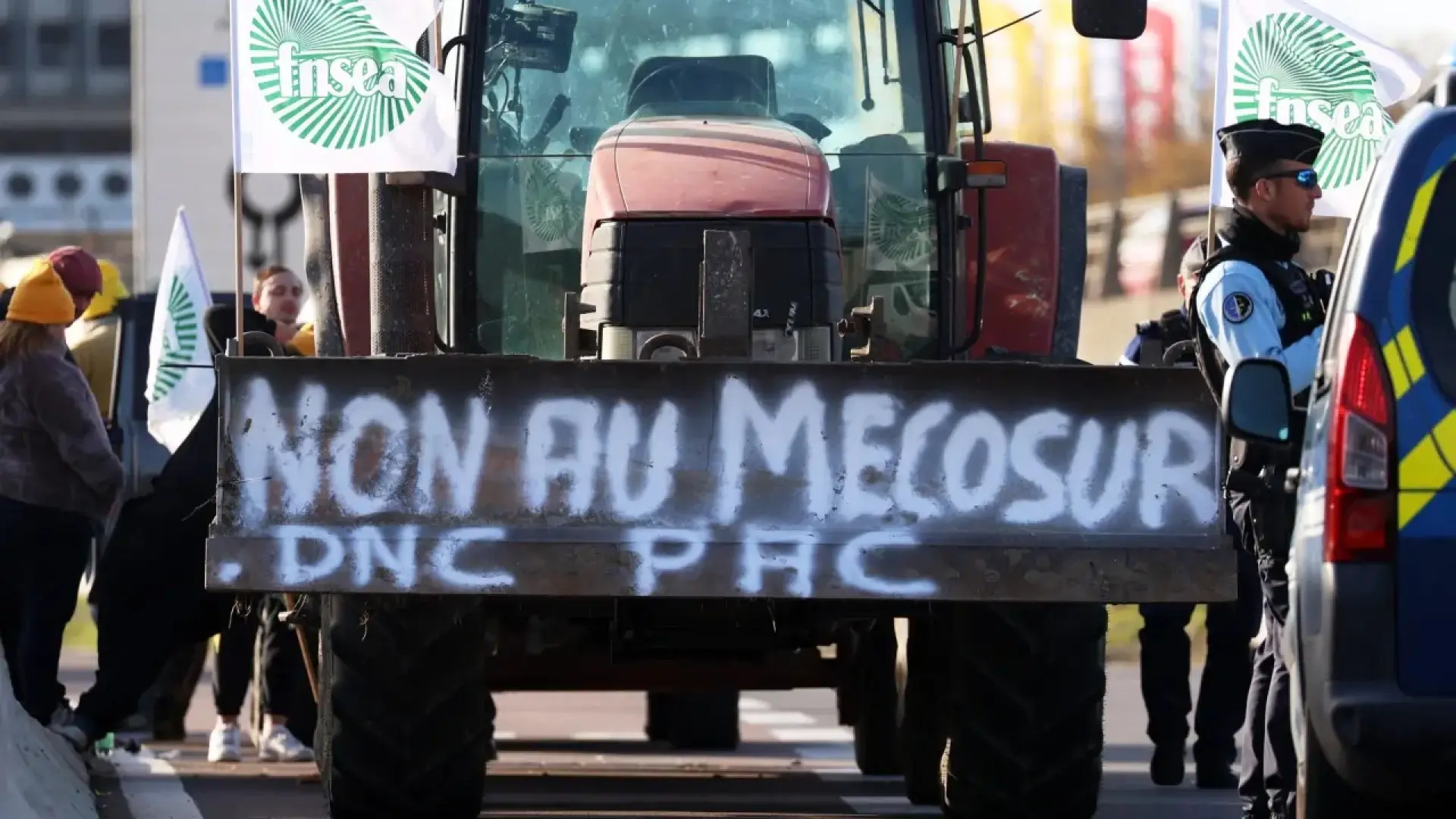
Up to 15,000 farmers from the 27 EU countries walked the streets of Brussels this Thursday. Hundreds of tractors blocked some of the road entrances to the Belgian capital and caused traffic congestion in much of the city. The protesters are linked to 40 organizations different groups brought together under the umbrella of COPA-COGECA (the largest agricultural entity in the EU).
First, the parts. On one side we have the EU and on the other the Mercosur, the Common Market of the South. It is an economic bloc founded in 1991 by Argentina, Brazil, Paraguay and Uruguay. Mercosur incorporated Venezuela in 2012 (but was suspended in 2016) and Bolivia in 2023. As associated states are Chile, Colombia, Ecuador, Peru, Panama, Guyana and Suriname.
EU-Mercosur, two decades of negotiating
After twenty years of negotiations, on June 28, 2019, at the G20 summit in Osaka, a free trade agreement between Mercosur and the EU was announced. It was a principle of agreement. The negotiations concluded on December 6, 2024but a year later the definitive texts have not been signed, due to the opposition from some partners, mainly France.
The adoption of the safeguards that we saw at the beginning (those agreed this Wednesday) is the previous step that the Danish presidency of the EU was awaiting to propose to the 27 to approve the signature of the free trade agreement. The initial idea is that the president of the community Executive, Ursula von der Leyen, and the president of the Council, Antonio Costa, travel to Brazil this Saturday to sign the agreement.
What does the agreement translate into?
The EU and Mercosur want to create one of the largest free trade areas in the world, reducing tariffs and trade barriers, making it easier for companies on both sides to export goods. It would cover more than 700 million people and almost 25% of the world’s GDP.
The agreement would mean a reduction in tariffs for the EU on products such as cars, machinery and chemicals. The Mercosur countries would benefit from a better access to EU markets to export their agricultural products.
Right now, negative balance for Europe
- In the last year, the Twenty-seven exported agri-food products worth 3,500 million euros while they were imported from Mercosur for an amount of 24,734 million. Which generated a negative balance, against the community block, of 21,235 million. 4.2% less than in 2023. In the case of Spain, last year it sold products for 463 million euros to the Mercosur countries and imported products for 4,118 million euros. An imbalance that reached 3,655 million.
If ratified, it would represent the largest trade agreement achieved by both the EU and Mercosur in terms of citizens involved. But a good part of the European camp continues to reject the pact.
Why the European camp opposes
The countries most reluctant to the trade agreement are Italy, Poland and especially France. Spain has been in favor of the agreement, but its farmers are not and in fact they are represented in the Brussels protests by the main agricultural organizations, Asaja, COAG and UPA. Because?
In general, there are three objections that EU farmers and ranchers put into the pact with Mercosur:
- Production cost differences.
- Differences in quality and food safety standards.
- Environmental impact (would go against sustainable agricultural practices).
The main idea of the rejection is that lifting 90% of the tariffs would imply a unfair competition due to unequal conditions. The criticism of European farmers and ranchers lies in the lack of reciprocity in production standards, especially in animal health, use of agrochemicals and traceability.
According to Eli Tsiforou, secretary general of COPA-COGECA, which brings together European cooperatives and producers, the pact “imposes an enormous cost on the sector” and comes at a sensitive time, marked by depressed revenues and increased regulatory demands. This organization considers that the Commission could commit “a historical error by relegating agriculture to the background.
Do safeguards correct imbalances?
For the European field, the EU-Mercosur Agreement can open the door to unsustainable and tariff-free imports. These would be the cases of poultry, beef, sugar, rice or corn. These are products that on the other side of the Atlantic are produced with standards that are significantly more lax than those required in the EU.
An example. In Belgium, meat producers fear that high-value cuts such as entrecôte will lose competitiveness compared to South American offerings. That is why this package of safeguards has been agreed.: Imports would be restricted if it is proven that they pose a threat to the internal market. The European Commission would act when imports of sensitive products increase on average by 8% and prices fall by the same percentage over a three-year period.
But according to COPA-COGECA these safeguards do not correct “the deep structural imbalances nor provide truly effective protection to the agricultural sectors.” According to the union of European agricultural organisations, the proposed safeguards remain insufficient to prevent market disruption, do not guarantee a real level playing field and do not offer credible guarantees to EU farmers and manufacturers, “who already operate under much stricter regulatory and economic constraints.”
Unfair competition and the new CAP arrives
The fear is dumping environmental and social. EU farmers and ranchers They could be exposed to unfair competition. Mercosur producers often operate without the same rigorous safeguards on labor standards, deforestation, sustainable land management, carbon emissions or pesticide use.
Another example: more than 30 active substances approved for use in the cultivation of sugarcane In Brazil they have been banned for use in sugar beet in the EU. And the same with him corn: 52% of the substances authorized there are not found in Europe.
Finally, it is important to take into account the context. If the agreement with Mercosur is signed this Saturday, it would come after learning of the Commission’s proposal to cut the budget of the CAP, the Common Agricultural Policy, by almost 30% for the period 2028-2034. This cut implies leave the allocation of funds to the discretion of national governmentswhich is seen as a setback in European food security policy.
Ultimately, that would be it, less money to subsidize the European countryside. Farmers warn that the disappearance of the CAP as it was will make the shopping basket more expensive by up to 500 euros per year.