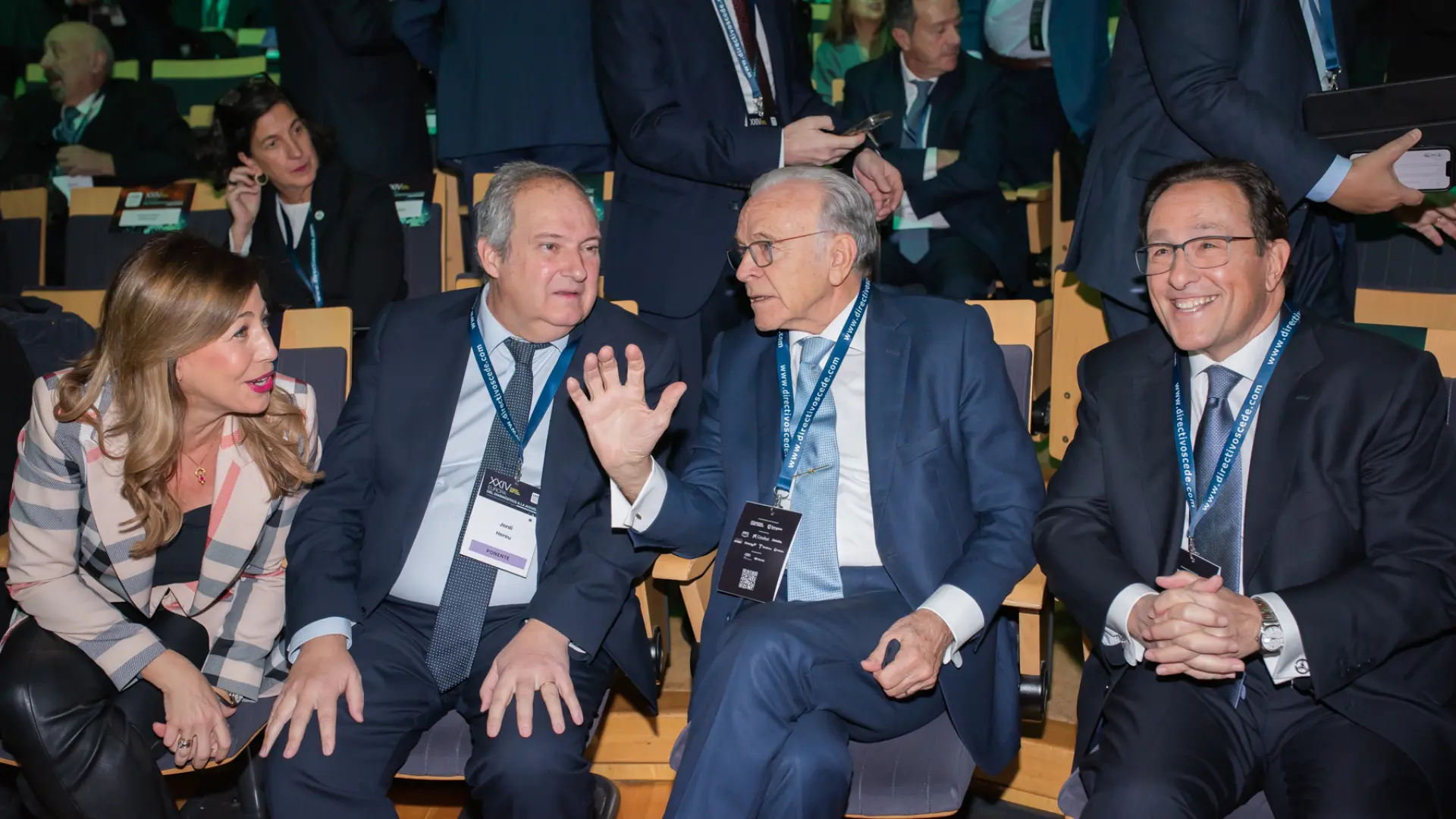
Top managers warn that excess regulation costs the economy 90 billion a year and defend the company as a “social shield”

Excessive regulation costs the Spanish economy 90 billion euros each year, around 6% of GDP. The calculation has been launched, as a warning, by the Spanish Confederation of Directors and Executives (CEDE) within the framework of its XXIV Congress, which the organization is celebrating this Thursday in Zaragoza under the motto Europe: from diagnosis to action. “The authentic social shield of our country They are not unions, governments, much less any political party, “we are the companies”stressed Fernando Rodrigo, president of the Organizing Committee before an auditorium in which he brought together more than 1,800 executives from the main organizations in the country.
At the start of the conference, the Minister of Industry and Tourism, Jordi Hereu, called for strengthening the productive base so that Europe can defend its social model and warned that the stage of “naive globalization” and not conditioned by geopolitics has ended. “Only with more industry will we have more social quality,” he assured.
Hereu, who was present the previous day at the event in which the automotive group Stellantis and the Chinese company CATL laid the first stone of the next battery gigafactory in Figueruelas (Zaragoza), has highlighted the collaboration that the joint venture created by the two companies, but also that of Spain with China, remembering that Europe is autonomous, is open “to cooperation with the whole world” and that, although the Atlantic axis is “strategic”, they also want to enhance collaboration with Asia.
“The integration now of the telecommunications (connectivity), energy and financial services sectors is a precondition for our competitiveness and security,” said Enrico Letta, former Prime Minister of Italy, who agreed in his speech that if the European Union is not economically independent there will be no possible security. Letta has emphasized that, of the three sectors, the financial one is the one that “must most urgently be integrated”given that its fragmentation forces Europe to fall behind the US and pay a high price for it. For this reason, Letta has highlighted the historic opportunity that the European roadmap to 2028 represents to complete the Single Market.
The “sweet” and “historical” moment of Aragon
“We need more Europe, we need more integration, more collaboration, we need more union to be truly more competitive,” stressed the mayor of Zaragoza, Natalia Chueca. The first councilor has defended the opportunity that the city and autonomy represent for those who want to start a business due to its favorable taxation. “Aragon is experiencing a sweet and historic moment,” agreed Fernando de Yarza, president of Grupo Henneo, when confirming that There are more than 70,000 million committed in investment for the coming years. From his point of view this has been possible thanks to the institutional complicity and of social agents (for social peace) and the work of businessmen.
Regulation in Europe was initiated to protect the consumer and the environment, but “has reached a disproportionate level”lamented Susana Alejandro, president of the Saica Group, producer of corrugated cardboard and packaging. This undermines, in his opinion, the competitiveness of the EU. Jorge Costa, CEO of Costa Food Group, has valued food and supply chain safety; while Benito Tesier, general director of Brembo Iberia, recalled how despite the fact that Europe produces the best electrified vehicles in the world, China has several decades of technological advantage and is capable of manufacturing them between 30 and 40% cheaper. Therefore, he has made it clear that the time has come for the EU to “stand up.”