What if the digital euro is the biggest error in Europe? The debate turns on
-
Given the risk, Parliament intervenes to measure the real impact.
-
The debate focuses on: Is the cash anonymity for programmable money?
The digital euro is presented as the inevitable solution, the logical step towards the future. From the European Central Bank (ECB) it is believed that the Central Bank digital currency (CBDC) is necessary to guarantee Europe’s sovereignty in a hostile world. But under the shiny wrapping of technological innovation, the most poisoned gift could be hidden that the continent has made itself: the end of financial freedom as it is known today.
October 2025 is the date announced by the president of the ECB, Christine Lagarde, for the launch of the digital euro. And as the date approaches, He displays eloquent defense of his most ambitious project.
In a recent and detailed speech, Piero Cipollone, a member of the Executive Committee of the Financial Institution, drew an emergency and opportunity panorama.
He talked about a Europe whose sovereignty of payments is at risk. It is dependent on “non -European actors” and is fragmented by ineffective national solutions. The digital euro, says, is not an option, but a need to “complement the cash”, guarantee our “strategic autonomy” and promote innovation.
Cipollone said that The digital euro will guarantee monetary sovereignty and a high level of privacy. “We are committed to implementing the most advanced data protection techniques, surpassing current digital payment methods.”
For the Executive, the digital euro represents a significant advance towards a more inclusive payment system, complementing the cash and offering an alternative to private solutions. Its adoption will depend on the legislation, but it is expected to be ready by 2028.
However, it is crucial to emphasize that “similar” does not equals identical. Cash privacy is absolute, while that of a digital system, however advanced, is programmable and, therefore, potentially revocable.
The Promise of the ECB is reduced to “trust us”, a significant change with respect to the principle of “it is not necessary to trust” that offers a ticket. Like Bitcoin, with its decentralized design, which seeks to eliminate the need to trust a central authority.
Critical voices: the digital euro is a threat
“The truth is that every day they take away more freedoms and worsen our quality of life, and the digital euro is one more trap in that direction: they want us defenseless, dependent and under their control,” said Abraham Amo, a member of the Spanish Association of Citizens, which has committed to curb the progress of the CBDC for Europe.
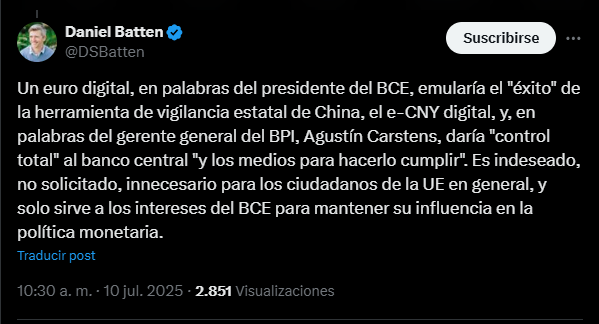
The fears of civil society are amplified by the words of figures such as Agustín Carstens, general director of the Bank of International Payments, who last year admitted that the CBDC grant a “total control” to the monetary authority and “the means to make it fulfill.”
In his arguments, Cipollone focuses on defending the development of the digital euro to gain “European sovereignty.” However, its narrative does not convince the public, some wonder which sovereignty? The one of the State or that of the individual?
When centralizing the payment system under its direct control, The ECB would gain unprecedented institutional sovereignty, But citizens would give the final sovereignty about their own transactions. The ability of a government to schedule money – limiting its use or applying real -time policies – would go from being a theory to a technical possibility.
Therefore, the organization “make yourself heard”, is calling to protect cash and avoid the digital euro. «You have to make noise now, so that everyone knows what they want to do with our money. So that the members of the European Parliament vote no, ”they point out.
The European Parliament is determined to listen
And while this debate intensifies, the political sphere begins to move, recognizing that the implications go far beyond monetary policy.
The Eurodiputa Fernando Navarrete (PPE), a key figure as responsible for the legislative report on the digital euro, He launched a pioneer initiative in the Eurocamara. It is a “active listening” program to hear all the actors involved.
“The digital euro is not just a technical issue: it will affect the way we pay, how our shops operate, the role of banks and the equilibrium of the financial ecosystem,” said Navarrete.
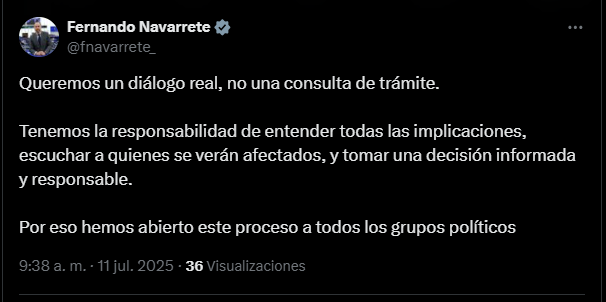
His most revealing phrase is a direct warning to precipitation: “This decision cannot be taken blind or back to reality.”
Navarrete organized A series of seminars, as of July 14which will feature the participation of the Cipollone and Valdis Dombrovskis, commissioner responsible for Economics, productivity in the European Commission.
With his actions, Navarrete intends to open the debate to consumers, merchants, banks and fintechs. This as an attempt to strengthen the “democratic legitimacy” of a transcendental decision.
His initiative shows that, at least in Parliament, there is awareness that A fundamental piece of the future European Society is being designedand that cannot be built without the support of the majority.
In short, the debate on the digital euro extends. Thanks to initiatives such as the Navarrete MEP, the fundamental question has been elevated to the political and public forum. The question to which everyone will answer now is what if the digital euro is the biggest error in Europe? The answer may determine whether its development continues to progress or if it is definitely deceived.