What will happen to Bitcoin after the truce of tariffs between the US and China?
-
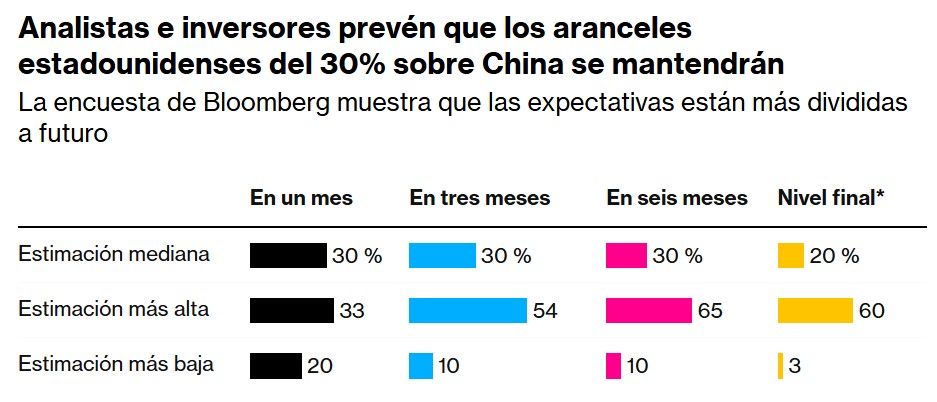
Trump will maintain tariffs of 30% to December, according to a survey of 22 analysts.
-
Investors will have no choice but to adapt to this new reality.
The truce of tariffs between the United States and China, agreed on May 12, has brought temporary relief, but also a wave of uncertainty that shakes markets, including Bitcoin investors (BTC).
The United States reduced its tariffs on Chinese products from 145% to 30%, while China dropped its own from 125% to 10%. This agreement, which includes a formal mechanism for negotiations that end on August 10 seeks to avoid an escalation greater to the commercial conflict.
However, fear persists: what will happen when this truce ends? Some Bitcoin investors may be frightened, wondering if the recent price rebound will resist a possible tariff recessed.
According to a Bloomberg survey in which 22 Asian, European and American research analyzes and firms were consulted, it is projected that US tariffs will be maintained at 30% until December 2025.
This rate, although less than 145% initial, could reduce 70% of Chinese exports to the world’s largest economy in the medium term.
The problem: uncertainty and impact on Bitcoin
This scenario generates fears of inflationary pressures and disruptions in global supply chains, which negatively impacts traditional markets.
An escalation in import costs could decelerate global economic growth, reducing the available liquidity for investments in perceived assets such as “risk”, such as Bitcoin, which could exert a bearish pressure on its price. Bitcoin, despite its decentralized nature, is not immune to these dynamics.
In April, during the tariff climb, Bitcoin fell to $ 74,000 due to the confrontation between the United States and China. However, in the days prior to the agreement between both powers, its price began to rise, exceeding $ 100,000. On the current day listed at 105,000 dollars, as seen in the TrainingView graph.
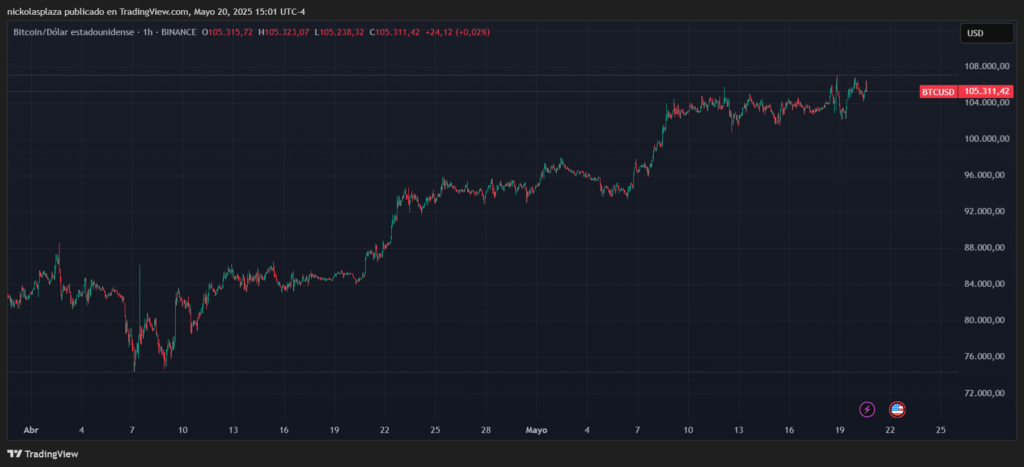
Despite this recovery, If the negotiations fail, it is possible that a tariff recessed cause another fall.
Nancy Qian, Economics professor at Northwestern University, points out: “Trump and his advisors are trivializing the true economic difficulties that could cause high tariffs. Most Americans already have difficulty covering their basic needs.”
But why Bitcoin is affected by something that seems as distant as tariffs? The answer is in its correlation with traditional markets. Although Bitcoin (capitalized, referring to the protocol and the network) is independent of commercial policies, the price of Bitcoin (with lowercase, referring to the currency) is influenced by the feeling of the market, since it also behaves as a financial asset that responds to the macroeconomic stimuli and the humor of the global markets.
When investors see economic risks – such as those generated by a commercial war – tend to sell perceived assets as risky, including Bitcoin, to seek refuge in safer options such as dollar or bonds. This explains the April fall, But also its rapid recovery before the agreement, shows its ability to resist adversity.
The tariffs stay, but Bitcoin has its own path
Despite uncertainty, The tariffs seem to be to stay, but Bitcoin will shine for their own reasons. The Bloomberg survey indicates a low expectation that negotiations quickly eliminate tariffs imposed by the president of the United States, Donald Trump who averaged 12% since their first mandate.
Reduce them would be a concession that could irritate their political base, So tariff free trade is probably a thing of the past. This structural change in global economic relations, where competition between the United States and China defines the panorama, creates an adverse environment for markets.
However, Bitcoin has characteristics that make it unique. Although it can stumble along with the markets during crises, its capacity for recovery is remarkable, since it usually multiply the movement of other assets, as demonstrated by its rebound to $ 107,000 after the initial volatility of April.
This pattern is not new. In 2022, when the war between Ukraine and Russia began, Bitcoin fell 10%, from 40,000 to 36,000 dollars. Since then, its price has grown, reaching a historical maximum of $ 109,000 in January 2025.
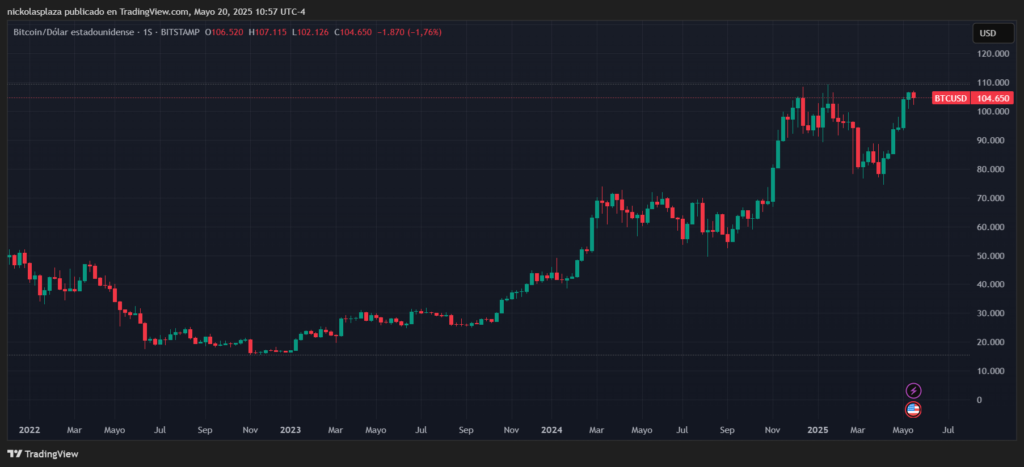
This development reinforces the idea that Bitcoin can prosper even in global tensions. The intrinsic properties of Bitcoin reinforce its potential. Its offer is limited to 21 million BTC, and the halving of April 2024 reduced the issuance of new BTC, increasing its shortage. This event, which occurs every four years, historically triggers bullish cycles for digital assets.
In addition, its resistance to censorship and its unconiscability make it an attractive asset against unsustainable fiscal policies. The discretion it offers protects the privacy of users, a valuable attribute in times of crisis. These qualities do not eliminate the initial falls, but they do allow Bitcoin to recover faster than other assets.
Bitcoin will shine despite the storms
Despite the descents and financial uncertainty, Bitcoin will end up shining in this adverse environment. Its recovery capacity, combined with the post-halving cycle, positions it for a significant rally.
Analysts such as Joe Albano project a rally around $ 176,000, while David Zanoni estimates a price of $ 150,000 for October 2025. These projections are based on Bitcoin’s scarcity dynamics and its growing adoption as an asset of corporate investment.
In a scenario where tariffs persist and trade negotiations do not achieve significant advances, traditional markets could face volatility. Bitcoin, however, is well positioned to capitalize this uncertainty.
Trump promised to pacify Europe and the Middle East while reactivating the US economy through tariffs, but these promises face the complexities of geopolitics and commerce.
While traditional markets deal with uncertainty, Bitcoin follows their own path. The currency created by Satoshi Nakamoto looks victorious and willing to break price records before the end of 2025 (and, perhaps, in the next few hours marks a new historical maximum).
Investors must overcome fear and recognize that, Although Bitcoin falls with the markets, its rapid recovery and its unique foundations make it an active resilient. The tariff truce can be temporary, but the rise of Bitcoin is a trend that will not stop.
Discharge of responsibility: The views and opinions expressed in this article belong to its author and do not necessarily reflect those of cryptootics. The author’s opinion is informatively and under no circumstances constitutes an investment recommendation or financial advice.