Castilla y León and Galicia lose ground while Catalonia and the Valencian Community gain ground
The new regional financing model that the first vice president, María Jesús Montero, presented last Friday comes with the promise that all communities will improve their situation with respect to the current system, in force for seventeen years and which expired in 2014. To this end, the Government has promised increase the size of the ‘pie’, that is, the funds that the autonomies will be able to use. However, the Government’s proposal has changed the way in which this ‘pie’ is distributed between the different territories.
With the new model, Valencian Community, Andalusia, Catalonia, Murcia and Castilla-La Mancha They would increase their participation in regional income, while the rest of the territories would lose weight (with the exception of Aragon, which would remain in the same position it is in now). Except for Catalonia, the other four are considered underfinanced by the current system, receiving up to 1,000 euros per adjusted inhabitant less than those that benefit the most.
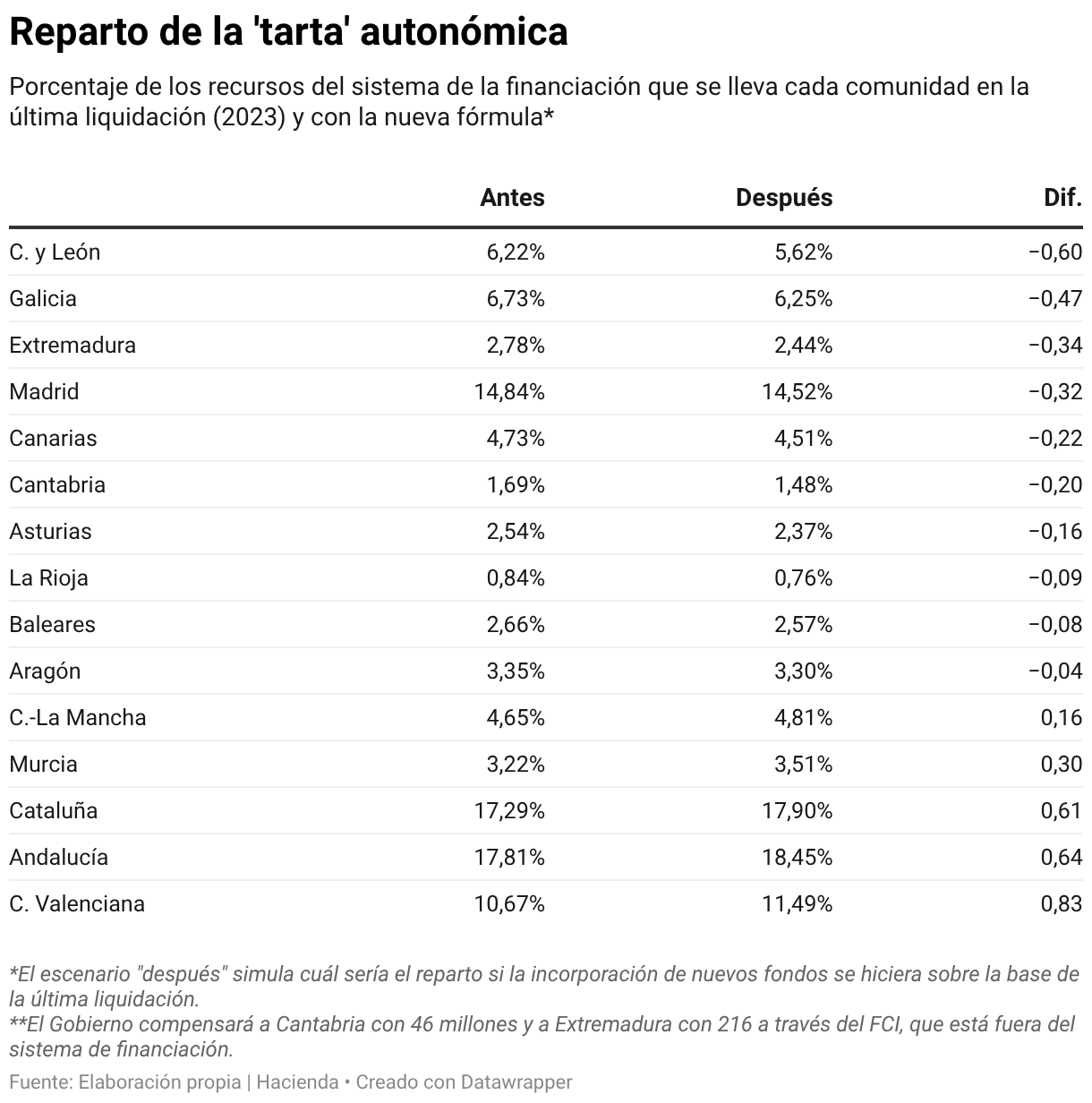
The new Treasury proposal contemplates injecting 20,975 million euros into the enormous piggy bank of resources that the autonomous communities have in 2027 compared to what the initial system would contemplate. If we take as a reference the distribution of those almost 21,000 million that the Treasury has broken down by community and apply it to the latest data available from the system (the 2023 settlement), it is observed that Castilla y León and Galicia are the autonomies that lose the most weight.
Specifically, Castilla y León would receive from 6.22 to 5.62% of the funds in this theoretical exercise and Galicia from 6.73 to 6.25%. Behind them are Madrid, which has seen its share reduced by three tenths (from 14.84 to 14.52%) and Extremadura (from 2.78 to 2.44%). A second group of autonomies, formed by the Canary Islands, Cantabria and Asturias, each lose two tenths of weight in the distribution, while La Rioja and the Balearic Islands lose one tenth in their share of income.
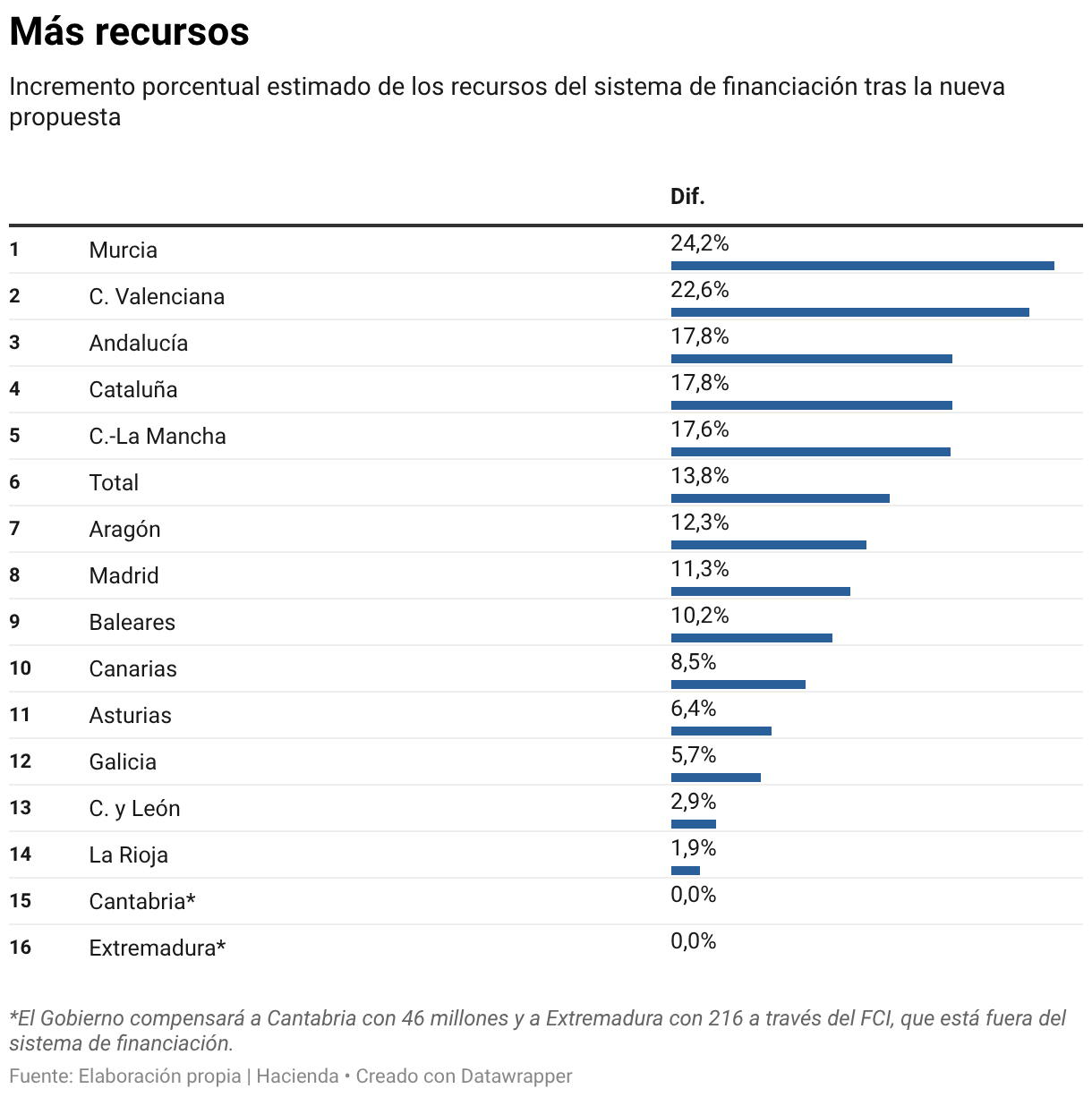
This land that these territories have given up has benefited only five territories (the effect in Aragon is neutral): the four communities that form the group of those ‘underfinanced’ with the current system (Valencian Community, Andalusia, Murcia and Castilla-La Mancha) and Catalonia, which has financing per inhabitant practically on average for the country.
Valencian Community, which would gain eight tenths of share (it would go from receiving 10.67% of the resources to 11.49%) is the one that benefits the most, closely followed by Catalonia (from 17.29 to 17.90%) and Andalusia (from 17.81 to 18.45%), which increase their participation by six tenths. Completing the list are Murcia (from 3.22 to 3.51%) and Castilla-La Mancha (from 4.65 to 4.81%), which gain three and two tenths, respectively, in weight in the distribution.
It is a proposal that completely moves away from the idea of a concert for Catalonia similar to the regional one, which makes positive progress on some issues, and which “addresses the problem of underfinancing of some communities, among which the Valencian and Murcia stand out”, maintains Economic Information Santiago Lago, senior economist at Funcas and member of the commission of experts created in 2017 by Mariano Rajoy’s government to prepare a reform proposal.
However, he understands that at the same time it “substantially” alters the distribution, especially for Catalonia, among those that already had financing per inhabitant adjusted to average or above. “To the extent that the rest of the autonomies have not participated in the definition of this redistribution, it will generate contrary responses and resistance, in addition to the opposition of Junts,” says Lago.
“When we touch on pieces of the model and especially ordinality, we must first look at the communities that were well positioned in the status quo 2009,” Diego Martínez López, professor of Economics at the Pablo de Olavide University and researcher at Fedea, told this newspaper. On the other hand, the expert agrees that The system is relatively continuous with respect to the previous one. It does not imply an amendment to the entirety, as the political agreements for the investiture in Catalonia or that of Pedro Sánchez could imply.