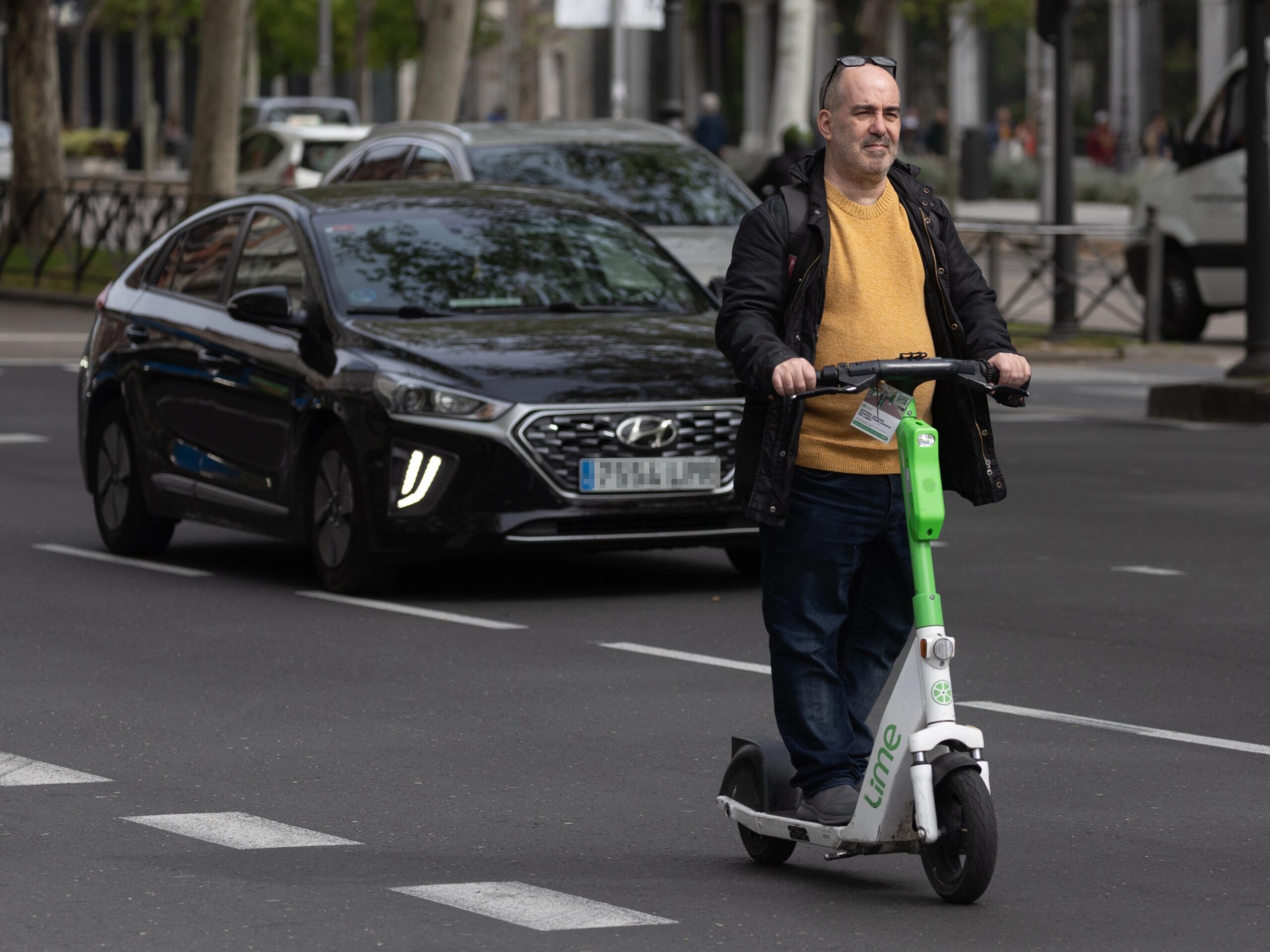
The Government will require insurance for electric scooters and will require them to be registered with the DGT before 2026
Electric scooter users will have to take out insurance to be able to circulate on the streets of Spanish cities. In addition, they must register these devices, which will be considered light personal vehicles, with the General Directorate of Traffic (DGT). This is established in the Automobile Insurance bill that the Government approved this Tuesday in the Council of Ministers. A rule that must still be processed in the Cortes, so its entry into force will not foreseeably be delayed until 2026.
The around five million electric scooters that are estimated to exist in Spain must take out mandatory civil liability insurance if they want to continue circulating. These policies cover personal and material damage that may occur to third parties in the event of a traffic accident. This is the same type of insurance that is required for drivers of most motor vehicles, such as cars, trucks or motorcycles.
Additionally, along the same lines as what happens with these vehicles, scooters must be registered in a registry with the corresponding Provincial Traffic Board. Over there They will be assigned a type of registration or badge that allows them to be secured. or identify them in the event of an accident in which they are responsible, transfer sources from the Ministry of Economy, the department that has developed the standard. The insurance holder must be, in this case, the owner of the electric scooter in question. Scooter drivers will have until January 2, 2026 to register their vehicle, as established in the bill.

The obligation to take out insurance will also extend to users of personal mobility vehicles and agricultural and industrial motor vehicles, who until now were not required to take out a policy. On the other hand, electric bicycles will be exempt. Economy sources argue that in this case the electric motor is only an assistance to pedaling and not the main source of movement.
Yes indeed, The characteristics and scope of the policy that will be mandatory to subscribe to are still unclear. The bill states that the Executive must approve a regulation on this issue no later than six months after the law is published. Something that will not happen in the short term, since the initiative must still go through the Congress of Deputies and the Senate.
However, the aforementioned sources maintain that The premiums that will have to be paid to insure the scooters will be lower to those of a normal motor vehicle. “The risk is lower and so is the damage that can be caused. The accident rate will be lower,” they point out.
According to a study by the Mapfre Foundation, In 2023, 300 accidents were recorded involving electric scooters, which left a balance of 187 people injured and 12 dead (one of them after being run over by a scooter). The Spanish Federation of Personal Mobility Vehicles (Fevemp) estimates that there are more than 5 million electric scooters in circulation in Spain.
Several Spanish cities and European countries already require it
The bill is called to unify the scattered municipal regulations that regulate the use of these vehicles. Currently, cities like Barcelona, Palencia or Valencia already require you to take out insurance or plan to do so. The last city to join this group was Zaragoza, which approved its own regulations last Thursday. The requirement for mandatory civil liability insurance is also not strange in Europe. Countries such as France, Germany, the Netherlands or Norway have established this requirement to be able to circulate with electric scooters.

The mandatory nature of scooter insurance is one more step in increasing regulation that surrounds these vehicles that have proliferated massively in recent years. Last January, the ban on driving on sidewalks and roads came into force. In addition, starting this year it is mandatory that all vehicles sold have an identification that proves that the technical requirements for quality and durability are met. Those who are not certified will not be able to circulate from January 2027.