Food inflation moderates in May to 4.4% but the CPI confirms its third consecutive rise
Prices accelerated their growth in May, although food gave a slight respite. The National Institute of Statistics (INE) confirmed this Thursday that Inflation rose three tenths in the fifth month of 2024 to an interannual rate of 3.6%, its highest level since April 2023. The increases in the price of electricity and fuel mainly contributed to the rise. Despite losing three tenths compared to April, food is still 4.4% more expensive than a year ago. The final inflation data for May are known one day after the President of the Government, Pedro Sánchez, announced his intention to extend the VAT reduction for these basic products.
After advancing four tenths in April to an interannual rate of 4.7%, the rate of increase in food prices slowed in May. The INE attributes the decline to the drop in the price of oils and fats and the slowdown in fruit and meat. The inflation of this category of products has recorded its second lowest mark since the end of 2021, only surpassed by the 4.3% registered in March. It is, therefore, below the level at which the year began, at 7.4%. The moderation in food prices, which remained stable in May in monthly terms, has been progressive from the double-digit levels it reached a year ago.
This slowdown does not mean that food prices have fallen across the board, but rather that they have risen more slowly. In fact, the increase in prices experienced by some products continues to be notable. Specifically, the item in the shopping basket that has increased its price the most in the last year has been the olive oil. It is 62.8% more expensive than in May 2023, despite having dropped 2.1% in the last month. Its annual increase contrasts with the decrease in the rest of oils, which are 17.8% cheaper than a year ago.
Along with olive oil, The rise in fruit and vegetable juices and fresh and chilled fruit also stands out., whose price is 15.9% and 12.1% respectively more expensive than a year ago. Chocolate, sheep meat, frozen legumes and vegetables, salt and spices, fresh and chilled fish, potatoes and cocoa powder have also risen between 9.2% and 6.5%. On the other hand, pizzas, skimmed milk, pasta and canned fruits have become cheaper by between 4.4% and 2% compared to May 2023. To a lesser extent, the price of butter, flour, Nuts, fresh legumes and vegetables, whole milk and seafood have also been reduced.
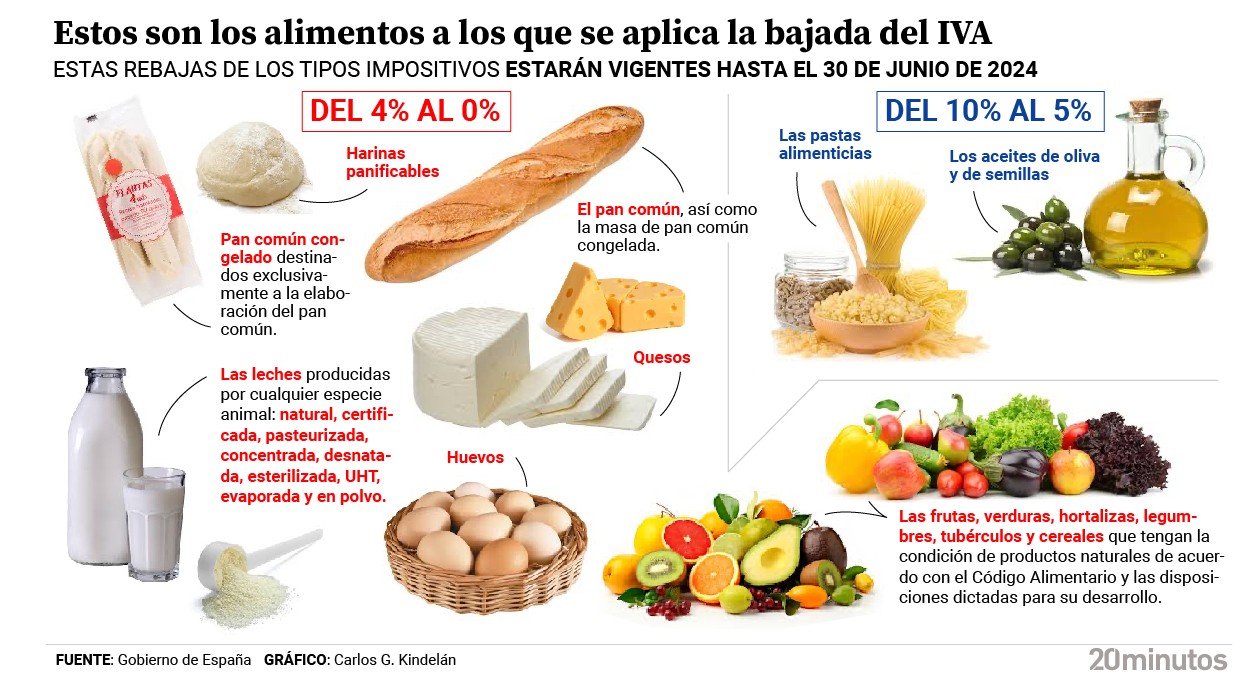
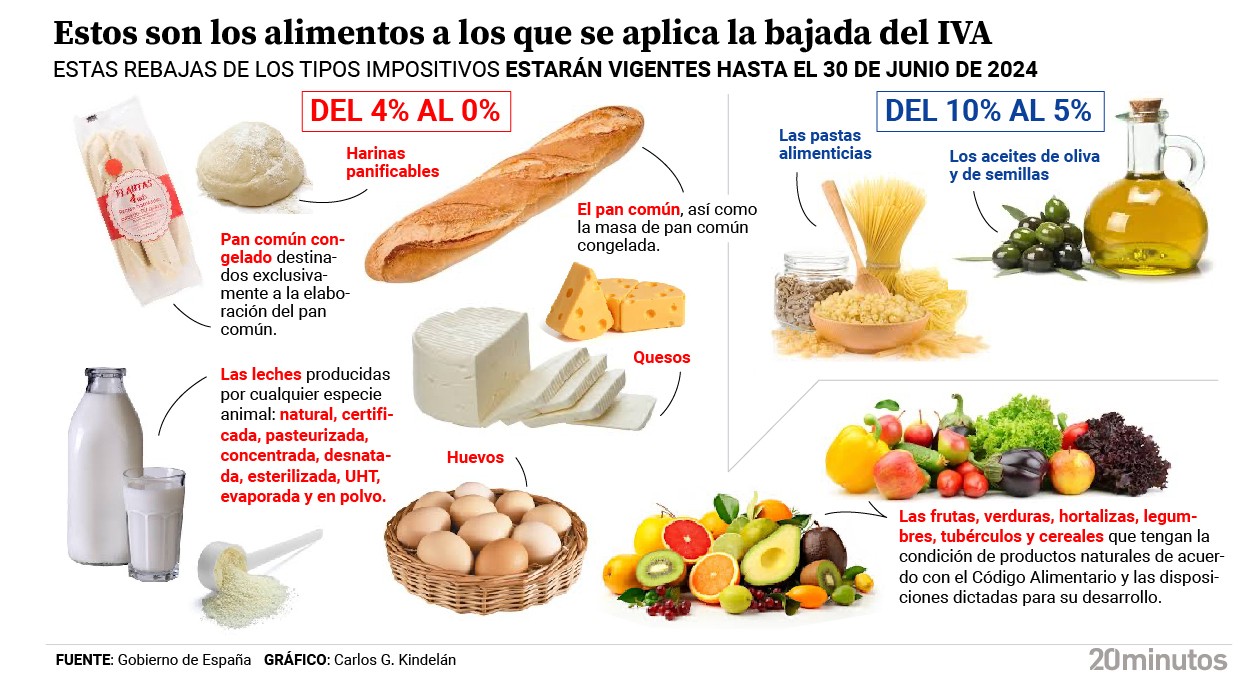
Some of these commodities currently have the reduced VATa bonus that ends June 30, but that The Government has already committed to extending, after Sánchez acknowledged this Wednesday that food prices remain “high.” This reduction sets a rate of 0% for foods such as bread, flour, milk, cheese, eggs, fruit, vegetables, legumes and cereals and reduces the tax to 5% in the case of the oil and the paste. Other basic foods such as meat and fish are excluded.

“You have to have ambition and do more. It is not enough to reduce VAT on food”, the second vice president of the Government, Yolanda Díaz, assessed this Thursday on the social network X, after knowing the inflation data. “There is no point in raising the SMI if prices are not controlled,” she added. In that sense, data from the Ministry of Labor indicate that the salary increases negotiated in an agreement until the month of May are 2.96%, below the price increase.
Electricity and gasoline drive prices
Unlike what happened with food, as the INE’s preliminary reading pointed out, the general CPI advanced in May by third consecutive month on the upward path resumed in March, then falling in February to 2.8%, its lowest level since summer of last year. Since then, inflation has not stopped growing and is now above the 3.4% level at which the year began. The INE attributes the rebound in this last month as being fundamentally due to the behavior in the price of electricity and fuel.
On the one hand, the price of electricity rose 14.3% compared to May 2023, in contrast to the decrease experienced a year before. After a month of April with extraordinarily low prices – and VAT has already returned to 21% since March -, the price of electricity rose in May to an average of 30.4 euros/MWh in the wholesale market, which meant an increase in the average bill of up to 54 euros. On the other hand, natural gas has become cheaper by 6.1%.

For its part, the average price of fuel has accumulated weeks of declines, according to data from the European Union Oil Bulletin. In the last week, the price for a liter of gasoline at the pump has been below 1.5 euros and for diesel, slightly above 1.6 euros. In fact, according to CPI data, both fuels are respectively 1.3% and 3.6% cheaper than in April. However, these latest declines do not prevent that compared to May 2023 gasoline has become more expensive by 6.1% and diesel by 6.6%.
By discounting the price of energy and unprocessed food from the calculation due to their high volatility, Core inflation stood at an interannual rate of 3.0% in May. It rose slightly by one tenth compared to the 2.9% recorded in April, its lowest mark since the beginning of 2022, which it reached after ten consecutive drops. It thus widens its distance from the general index and remains below it for the second consecutive month.
The Ministry of Economy blames the slight rebound in underlying inflation to the increase in prices of services related to tourism in view of the summer. In this sense, among the components of the CPI that became more expensive are maritime passenger transport and national tourist packages, 22.2% and 17.7% more expensive than a year ago respectively. This increase contrasts with the behavior of the cost of tickets to travel abroad, which has decreased by 7.5%. In the last month alone, domestic flights and hotels have become 7.7% and 7.4% more expensive compared to April price levels.