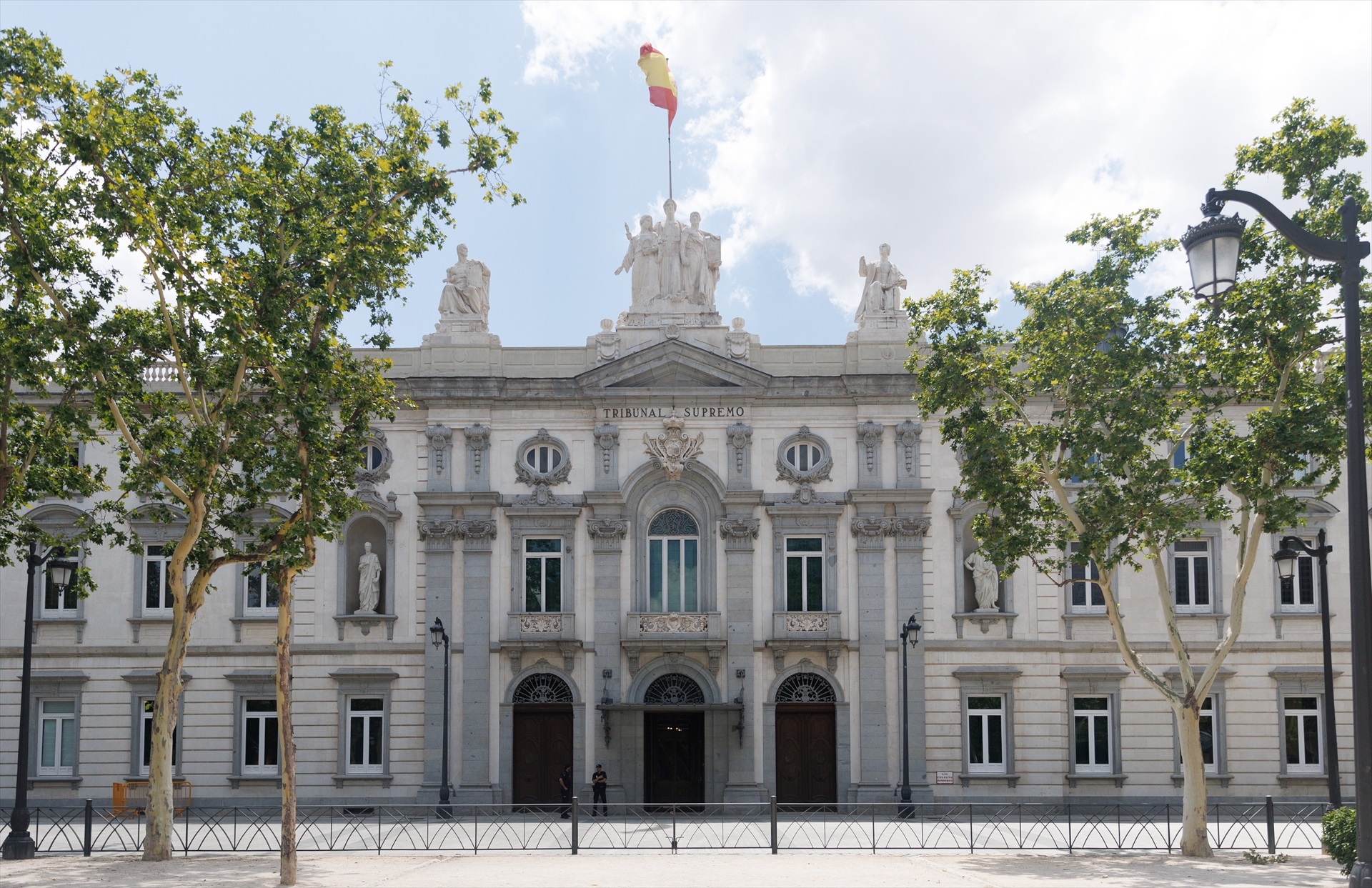
The CJEU clashes with the Supreme Court and rules again in favor of making the interims indefinite
New blow from European justice to the Spanish public administration. The Court of Justice of the European Union (CJEU) has ruled again in favor of transforming interim officials who have been accumulating temporary contracts in fraud of law into permanent ones.
A decision that clashes with a recent ruling by the Spanish Supreme Court that rejected automatic conversions in those cases, considering that it contradicts the principles of equality, merit and capacity in access to the Spanish public service. The High Court announced on March 7 that it will ask European justice how a previous ruling by the CJEU that opened the door to granting fixity should be interpreted.
The decision of the CJEU this Thursday responds to a preliminary question that a Barcelona court planned for three Catalan public employees who have been chaining interim contracts in the Generalitat and who demanded to obtain permanent employment. The Luxembourg court insists on the arguments it already gave in February in another similar ruling and emphasizes again that the conversion to indefinite is a valid option to correct abuses of temporality.

“In the event that the referring court considers that the domestic legal system in question does not contain, in the public sector, any effective measure to prevent and, where appropriate, punish the abusive use of successive contracts or employment relationships of fixed duration (…) The conversion of these contracts or relationships into an employment relationship for an indefinite period may constitute such a measure.“, reads the text of the sentence.
In this case, the CJEU goes further than on the previous occasion and openly asks the Barcelona court to ignore the jurisprudence of the Supreme Court. This is an important point because the legal doubts that the courts have are based precisely on the fact that permanent conversions can go against the Constitution and the doctrine of the Supreme Court.
In this sense, the CJEU maintains the following. “If the referring court considers that the consolidated jurisprudence of the Supreme Court opposes the conversion must then leave said jurisprudence of the Supreme Court inapplicable whether this is based on an interpretation of the provisions of the Constitution that is incompatible with the objectives of Directive 1999/70 and, in particular, clause 5 of the Framework Agreement”.
That is, the CJEU gives letter of freedom to the Barcelona court —and others who may follow later— to make their own interpretation, even if this means ignoring the doctrine of the Supreme Court. And he once again reinforces the path to fixity, by insisting that conversions to indefinite are a viable option.
Furthermore, in a complaint to the Barcelona court, one of the public employees requested that she be granted civil servant status career or transform their situation into “a fixed relationship comparable to that of career civil servants”. On this issue, the CJEU recognizes that the solution may be to convert these temporary contracts into permanent contracts subject to the same causes of dismissal and dismissal as career civil servants, but without acquiring the status of civil servant.
Escrivá defends the stabilizations
In 2021, the Government launched a stabilization process for interim positions to try to reduce the rampant temporary employment in the public sector, which is still close to 30%. Questioned about this second CJEU ruling, the Minister of Digital Transformation and Public Function, José Luis Escrivá, commented that the measures promoted by the Executive are giving “extraordinary results”, in statements reported by Europa Press.
Escrivá has defended that 75% of the interim regularizations have already been completed that were proposed for this year (about 300,000) and has indicated that the CJEU ruling “fundamentally concerns the courts and how the courts have to resolve these conflicts.”