Holmium laser for prostate hyperplasia
The Holmio Laser (Hlep) is a highly effective minimally effective technique to treat benign prostate hyperplasia, even in large cases. It offers rapid recovery, less bleeding and less hospitalization, with low risk of side effects. Its success depends largely on the surgeon’s experience.

Holm Laser treatment for Benign Prostate Hyperplasia (HBP) is called holm or holm laser prostatic enucleation (“Holmium Laser enucleation of the prostate”). It’s a minimally invasive surgical procedure that uses a high power laser to eliminate the prostate tissue that is obstructing urinary flow.
What is HBP?
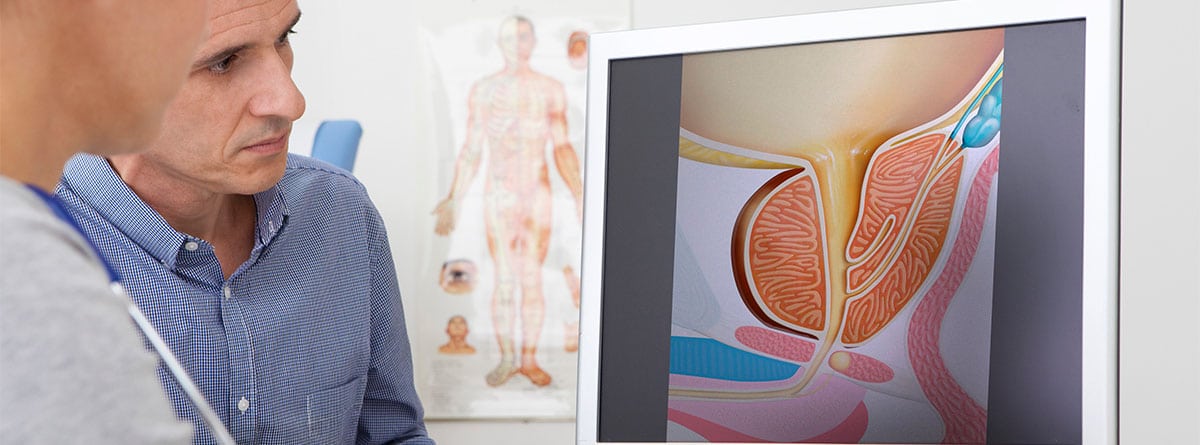
The prostate is part of the male reproductive system and It is located just below the bladdersurrounding the urethra (the duct through which the urine passes).
The HBP or prostate adenoma is a non -cancerous enlarging of the prostate glandular tissue that usually gives symptoms from the age of 50 and is believed to be related to hormonal changes that occur with aging. It affects 60% of men over 60 years and this percentage increases with age. In general, a prostate is considered enlarged if it has a volume greater than 30 ml or CC.
The symptoms are due to the fact that the enlarged prostate presses the urethra and hinders the normal flow of urine; The volume of the prostate does not always correlate with the HBP symptoms. The most common symptoms are:
- Difficulty for Start urination.
- Weak or interrupted urine jet.
- Need to urinate frequentlyespecially at night (Nicturia).
- Sensation of incomplete emptying of the bladder.
- Urinary urgency (sudden and uncontrollable need to urinate).
- Drip at the end of urination.
Among the complications of this pathology are: recurrent urinary infections, bladder damage, acute urinary retention (inability to urinate), renal damage if not.
How is HBP studied?
- Clinical history and physical examination: Includes the description of the symptoms using the “International Prostate Symptom Score (IPSS)”. The rectal touch, which is performed by introducing an ingrained and lubricated finger in the patient’s rectum, is a simple and fast medical procedure that is used to evaluate the size, shape and consistency of the prostate.
- Blood and urine analysis with evaluation of the specific prostate antigen (PSA).
- Urinary flow, evaluation of postmication residue (amount of urine that remains in the bladder after urinating), prostatic ultrasound or resonance to assess the size and morphology of the prostate.
When is surgery in HBP recommended?
Surgery is recommended for patients presenting renal failure or refractory urinary retention secondary to HBP, urinary infections or vesical calculations of repetition or macroscopic hematuria (visible bleeding in the urine) due to HBP and/or Symptoms of the lower urinary tract that do not respond to medical treatment [alfabloqueantes (ej. tamsulosina) o inhibidores de la 5-alfa-reductasa (ej. finasterida)].
The transureral resection of the prostate (RTUP) has been considered for decades the Reference surgical treatment for HBPespecially for small or medium -sized prostates. In the RTUP a special instrument is introduced with a chamber and a cutting handle, through the urethra, until reaching the prostate where the hyperplastic tissue is dry using monopolar or bipolar energy. For very large prostates, simple prostatectomy (open, laparoscopic or robot assisted) can be considered as the hyperplastic internal part of the prostate is extracted.
However, new techniques for the surgical treatment of HBP are currently available such as:
- Laser enucleation [HoLEP (con láser de holmio), ThuLEP (con láser de tulio)].
- Photoslective vaporization.
- Thermal therapy with water vapor.
- Prostatic urethral elevation.
What is Holep?
The surgeon introduces an endoscope through the urethra, with the Holmio laser, carefully separates the enlarged prostate tissue from the rest of the gland (enucleation); This fabric is fragmented inside the bladder with an instrument called a morcerator and extracted.
At the end of the procedure, a bladder probe is placed to drain urine and avoid the formation of clots; It is usually removed at 24 to 48.
If you have doubts about the procedure, the advantages or advice to take into account for the Holmium laser in the health insurance of Mapfre you have great specialists to solve all your doubts.
Calculate your price
Advantages of Holmio’s laser against other treatments
- High efficiency, even in very large prostates.
- Less bleeding compared to conventional surgery, so it can be an option for patients in anticoagulants.
- Faster recovery and less hospitalization time (1-2 days). Most patients resume their usual activities in 1–2 weeks.
- Less risk of needing new surgery in the future.
- The prostatic tissue removed can be analyzed to rule out the presence of cancer, which is not possible with vaporization techniques.
Possible side effects (generally rare)
- Ardor when urinating temporary.
- Mild bleeding In the urine.
- Retrograde ejaculation (Ejaculation towards the bladder, without semen visible to ejacular), which does not affect sexual function but can affect fertility.
- Rarely: urinary incontinence or infections.
The surgeon’s experience is the most important factor in the appearance of possible complications with this treatment.
Preparation
- Pre -surgical evaluation since the procedure is performed with general or spinal anesthesia (epidural).
- SUSPENSION OF MEDICINES: If the patient takes anticoagulants or platelet antiaregagers (such as aspirin, clopidogrel, warfarin, acenocumarol …), should temporarily suspend them following the doctor’s instructions, to avoid bleeding during surgery.
- Previous fasting: Do not eat or drink anything (or water) for at least 6 to 8 hours before surgery, especially if general anesthesia is used.
- Hygiene: You can include a shower with antiseptic soap the night before and the morning of the procedure. Shaving or cleaning of the genital area can be performed by the medical equipment if necessary.
- Informed consent: The patient must sign a document where surgery accepts, after the Urologist has explained risks, benefits and alternatives.
- The patient must organize that Someone accompany him and take him home after discharge. During the first week there may be mild discomfort.
What you should know …
- Holmio laser prostatic enucleation (HEP) is a minimally invasive effective technique to treat benign prostate hyperplasia, even in large prostates, eliminating the tissue that obstructs urinary flow.
- It presents advantages over other surgeries, such as less bleeding, fast recovery, short hospitalization and possibility of analyzing the extracted tissue, although it can cause mild side effects such as retrograde ejaculation.
- It requires previous preparation (medical evaluation, anticoagulant suspension, fasting) and its success depends largely on the experience of the surgeon who performs it.
Literature
- Sandhu JS, Bixler Br, Dahm P, et al. MANAGEMENT OF LOWER URINARY TRACT Symptoms Attributed To Benign Prostatic Hyperplasia (BPH): AUA Guideline Amendment 2023. J Urol.