
Onchocerciasis or river blindness, what is it?
Onchocerciasis or river blindness is a parasitic disease transmitted by black flies that affects the skin and eyes, and can cause preventable blindness.

MAPFRE Health Blog is a leading blog in the world of medicine thanks to the fact that all its contents are written by specialized doctors.
MAPFRE’s years of experience in the sector guarantee us as a source of truthful and practical information, helping you with your questions about the health of the body and mind.
Onchocerciasis, or river blindness, is a parasitic disease caused by a wormthe filarial nematode (filaria) Onchocerca volvulus, transmitted by repeated bite of black flies of the genus Simulium that breed in rivers and fast currents.
When biting, the fly that acts as a vector or transmitter of the disease introduces parasite larvae into the skin. The larvae mature into adults (macrofilariae) in subcutaneous nodules (“onchocercomas”), and generate microfilariae (microscopic larvae).
It is a disease that mainly affects the skin and eyes and it is one of the main causes of preventable blindness in the rural world in endemic areas.
Epidemiology
It is endemic mainly in sub-Saharan Africa and, to a lesser extent, in Latin America and Yemen. Despite having been eradicated in Colombia, Ecuador, Guatemala and Mexico, the transmission of onchocerciasis continues in a small border area between Brazil and Venezuela, particularly in the Amazon rainforest area.
It affects men more than women, especially between 20 and 30 years old. given that they are the people who, due to their work (farmers, fishermen), are more exposed to black fly bites.
Clinical manifestations
They are produced both by the invasion of microfilariae and by the inflammatory response against dead microfilariae and their Wolbachia endosymbionts. Wolbachia endosymbionts are bacteria that live inside the parasite cells. When O. volvulus microfilariae die, they release Wolbachia into human tissues. This causes a strong inflammatory response from the immune system, which is responsible for much of the damage to the skin and eyes.
Clinical manifestations usually develop 1 to 3 years after the bite and consist of:
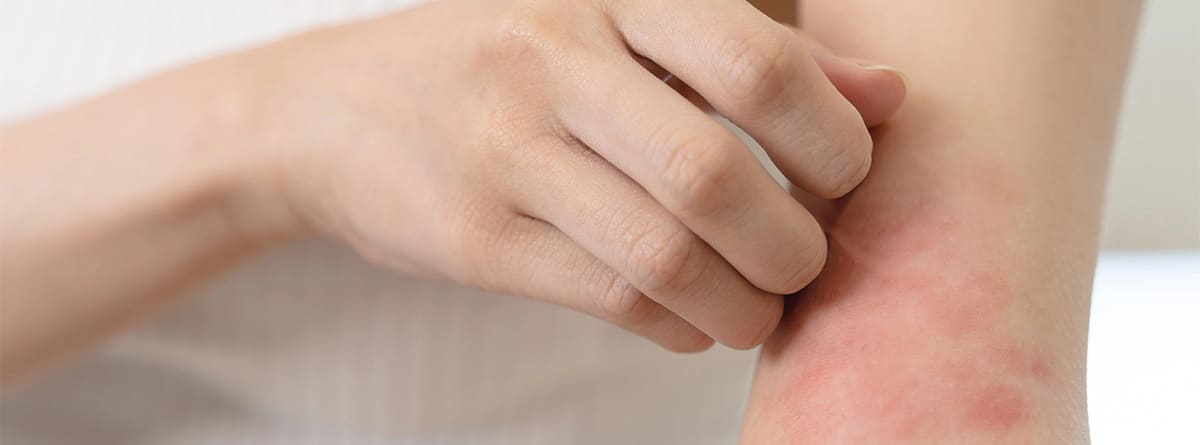
- Severe itching and skin lesions (acute or chronic papular dermatitis, lichenified plaques), subcutaneous nodules (on the neck, head, knees, pelvic area) and thickening, atrophy or depigmentation or hyperpigmentation of the skin (“leopard skin”). As a consequence of the skin disease onchocerciasis, an increase in the size of the lymph nodes may develop, most often in the inguinal region and in the mammary region, which can ultimately lead to genital elephantiasis.
- Progressive eye damage that can lead to blindness. It can cause damage to the cornea (punctate or sclerosing keratitis), the retina, the optic nerve or uveitis (inflammation of the uvea, which is the middle layer of the eye located between the retina and the sclera).
- Neurological symptoms: epilepsy associated with onchocerciasis. Onchocerca volvulus infection could also be related to Nodding and Nakalanga syndrome, which mainly affect children in poor communities in Africa. Nodding syndrome is a neurological disorder characterized by episodes of ca
 involuntary licking, seizures, developmental delay, and malnutrition; Nakalanga syndrome manifests itself with short stature, incomplete sexual development, epilepsy and mental deterioration.
 - In blood tests Eosinophilia (an increase in eosinophils, a type of white blood cells) is often seen.
Diagnosis
Serological tests for the detection of antibodies against infection by ELISA (“Enzyme-linked Immunoabsorbent Assay”).
The multi-antigen LIPS assay (Luciferase Immunoprecipitation Systems) is a immunological test based on the rapid detection of antibodies against several recombinant antigens of Onchocerca volvulus,
PCR test (Polymerase Chain Reaction) and LAMP (Loop-Mediated Isothermal Amplification) for detection of parasitic DNA.
He eye exam With a slit lamp, it allows the detection of microfilariae in the eye and the associated inflammation. Filariae can also be detected in the skin through skin biopsies (invasive and insensitive method in hypoendemic areas).
If you have traveled to any of the areas mentioned above and have identified any of these symptoms, MAPFRE Health Insurance has medical assistance to treat and diagnose any ailment.
CALCULATE YOUR PRICE
Treatment and management
Always under medical supervision:
Ivermectin
- Ivermectin primarily kills microfilariae (larvae) and does not kill adult worms.
- It is the drug of choice and is administered orally. It is administered periodically, every 6-12 months in mass control programs. It should be continued until transmission is interrupted, which usually requires 10–15 years due to the long life of the adult worms.
- Contraindicated in pregnant women and children under 5 years of age or weighing < 15 kg; It should be administered with caution during breastfeeding.
- Before administering ivermectin, it is necessary to evaluate patients to rule out co-infection with Loa loa, another filarial parasite, since in infected people. This treatment can cause serious and life-threatening neurological reactions. To reduce this risk, the “test-and-treat” strategy has been implemented in endemic areas through the use of the LoaScope, a microscope connected to a smartphone that allows patients infected by Loa Loa to be quickly identified.
Moxidectin
- Longer acting microfilaricide, potentially superior to ivermectin,
- It is administered in a single dose.
- Do not use if pregnant or breastfeeding or in small children.
- It can cause the same serious complications as ivermectin in patients also infected with Loa Loa.
Doxycycline
- It acts against Wolbachia, with a partial macrofilaricidal effect and reducing the fertility of nematodes.
- Oral administration. Limited for massive programs due to the duration of treatment (4–6 weeks) and contraindications.
- It can be administered combined with ivermectin.
- Contraindicated in small children and pregnant or lactating women.
Drugs in development
- Anti-Wolbachia drugs (flubentylosin, azaquinazoline)
- A vaccine with candidate antigens such as Ov-103, Ov-RAL-2 and Ov-CPI-2M is being investigated.
Nodule surgery
- Reduces the load of adult parasites and microfilariae; improves skin symptoms.
Despite progress, onchocerciasis remains a public health and development problem.
The eradication of the disease requires integrated approaches, diagnostic and therapeutic innovation and the application of strategies adapted to the ecology and local co-infections.
Eradication programs are based on:
- Vector control (black fly, Simulium) through aerial or ground fumigation and larval control in rivers.
- Massive treatment aimed at the community with periodic administration of ivermectin. In 2023, preventive treatment against onchocerciasis will need to be provided to at least 249 million people.
- Education about the disease and the importance of taking treatment regularly, motivating the community to participate in treatment programs and protection measures against bites (use of protective clothing, mosquito nets, repellents).
- Epidemiological surveillance.
What you should know…
- Onchocerciasis is a parasitic disease transmitted by the bite of black flies that mainly affects the skin and eyes, being an important cause of preventable blindness in endemic areas, especially in sub-Saharan Africa.
- Diagnosis is based on serological, molecular and clinical tests, and the main treatment is ivermectin administered periodically to control the infection, along with other options such as moxidectin and doxycycline.
- The eradication of onchocerciasis requires a comprehensive approach that includes vector control, mass community treatment, health education and epidemiological surveillance to reduce transmission and impact of the disease.
Literature
- Frallonardo, L., Di Gennaro, F., Panico, GG, et al., 2022. Onchocerciasis: Current knowledge and future goals. Frontiers in Tropical Diseases, 3, p.986884.

