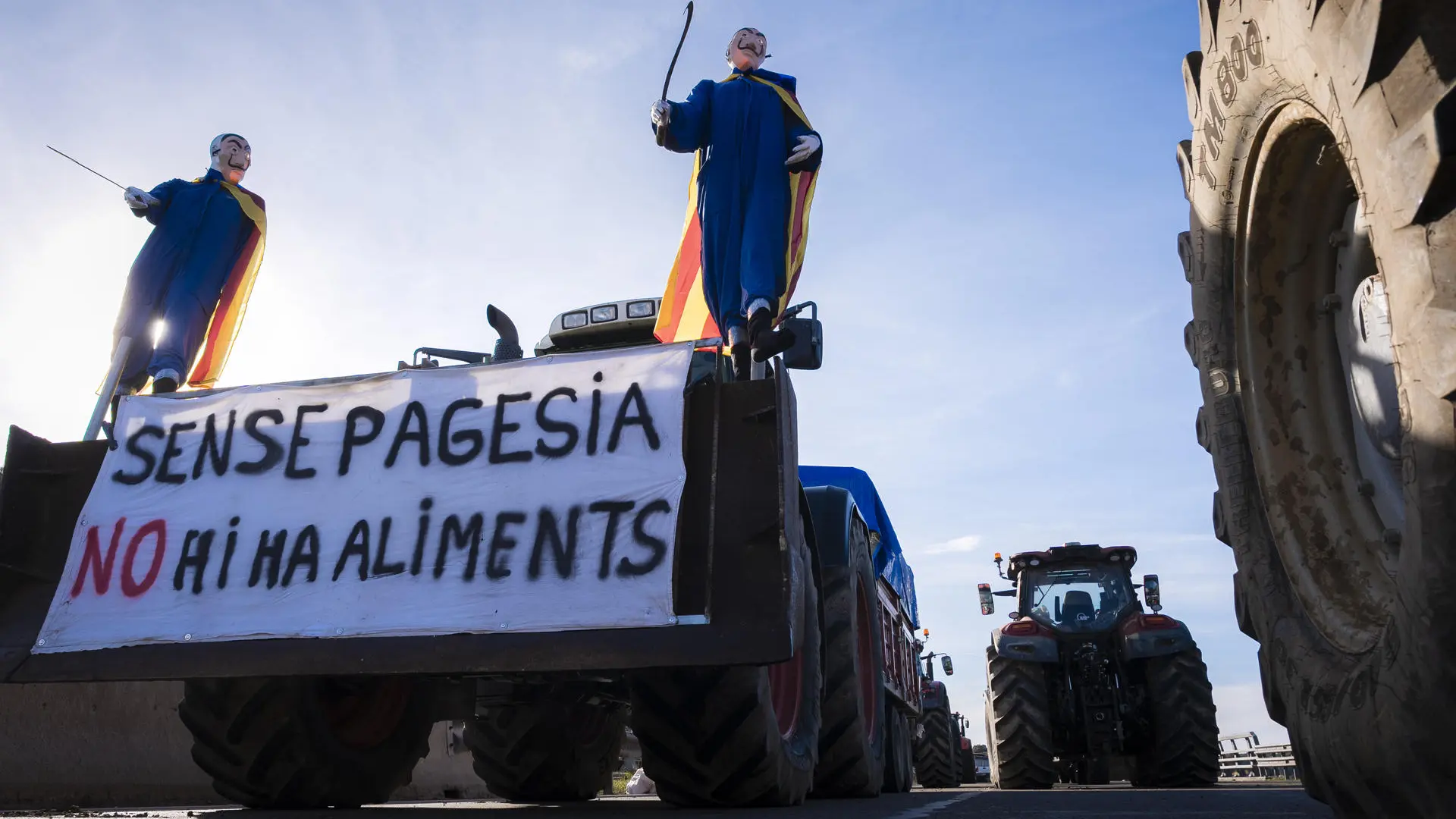
The agreement with Mercosur adds fuel to the rural protests and opens the door to ‘tractors’ throughout the country
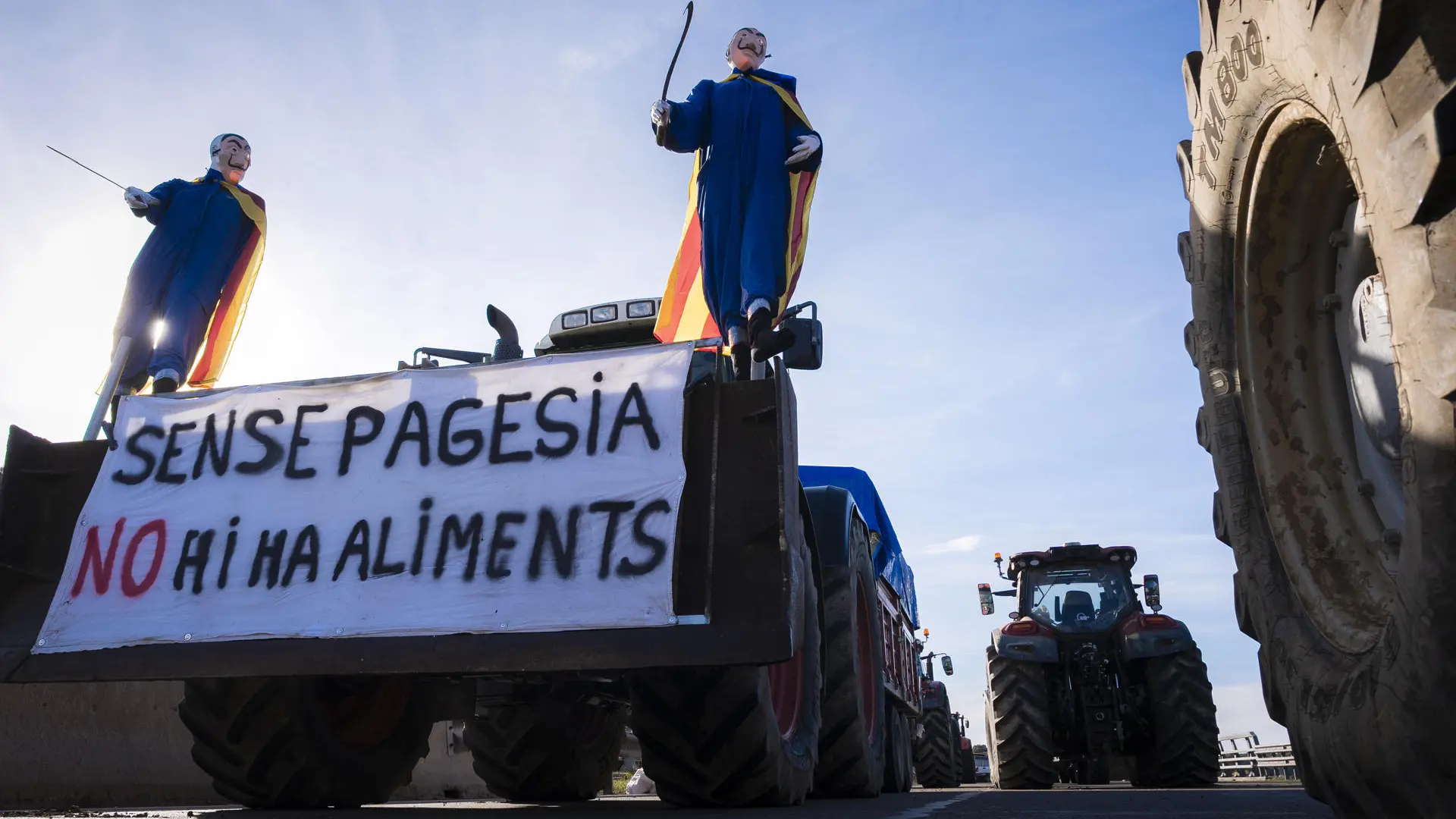
The signing of the commercial agreement between the European Union (EU) and Mercosurwhich will be made official on January 17 in Asunción (Paraguay) with the presence of the president of the European Commission (EC) Úrsula Von der Leyen, has poured gasoline on the malaise of the Spanish countryside and opened the door to a new cycle of protests or ‘tractors’ across the country. Agricultural organizations as relevant as Asaja, COAG and EPS They meet this week with their decision-making bodies. At the moment, there are already closed calls this month in Asturias, Navarra, Lleida, Cuenca or Extremadura. For its part, the Union of Unions finalizes its particular ‘menu’ with a special dessert: a tractor unit in Madrid on February 11. To the fear of a ‘unfair competition‘ on the part of agri-food products from Brazil, Uruguay, Paraguay, Argentina, the strong opposition to the 22% cut – proposed by Brussels – in the funds of the Common Agricultural Policy (CAP) 2028-2034 and the management of problems such as animal healthamong other topics. A breeding ground that evokes the mobilizations of the winters of 2020 and 2024.
Green light for the protest calendar?
Asaja is holding meetings this Tuesday of its executive committee and board of directors with Mercosur as the main item on the agenda and in which, most likely, it will approve a mobilization schedule for the next few weeks. Some protests that can pass, as on previous occasions, through ‘unity of action’ with COAG and UPA. The first of the two organizations will meet this week with its executive committee and, although they have not yet talked about specific dates or places, they do guarantee their support for the call promoted by the largest European agricultural association – the COGECA CUP – in Strasbourg (France) on January 20 on the occasion of the first plenary session of the year in the European Parliament (EP).
Asaja, COAG and UPA meet this week with their management bodies for the EU-Mercosur Agreement. The three agrarian organizations have scheduled protests in Asturias, Navarra, Lleida, Cuenca and Extremadura, among other places.
The director of European Affairs at the LLYC consulting firm, Pablo Rupérez, warns that “The signature is not the end of the road but the beginning” and clarifies that, in reality, two agreements are going to be formalized: a general partnership agreement (with a political part, another cooperation part and a third commercial part) and a Interim Trade Agreement (iTA)which is the product of having “severed” the commercial part of the association agreement. The first will require the individualized approval of each of the 27 states that make up the European Union (EU), while in the second case the approval of the European Parliament (EP) will be sufficient and the Mercosur countries to come into force.
Rupérez believes that the EP will vote for him in March and believes that “so much division is not good news,” in reference to the opposition of countries like France. Furthermore, he regrets that in the ambassadors’ vote last Friday only 21 European countries endorsed him, which represent 68.5% of the European population: “It is a bad sign, when positions tend to come together in the Council and there is consensus,” he explains about the uncertainties surrounding the EU-Mercosur Agreement.
“A new era with its challenges and opportunities”
This expert believes that, starting next spring,“we are going to enter a new phase: that of implementation, in which the European Commission will have an important role, in the case of possible adjustments due to price deviations and the implementation of possible safeguard measures.” Rupérez is committed to the fact that the agricultural sector “monitor” possible distortions in the markets and work closely with the Directorate-General for Trade of the European Commission (EC). “The key will be in the implementation, and in the adaptation effort of the different sectors and companies,” reiterates the head of European Affairs at LLYC who adds that “we are facing a new era with its challenges and opportunitieswhich must be overcome and taken advantage of.”
“We are going to enter a new phase: that of implementation, in which the European Commission will have an important role, in the case of possible adjustments due to price deviations and the implementation of possible safeguard measures,” says Pablo Rupérez (LLYC)
UPA: Participation in “various mobilizations”
The Union of Small Farmers and Ranchers (UPA)which sees improvements in the trade pact after the latest negotiations, has convened its Federal Council this Thursday “to analyze the situation after the green light of the EU-Mercosur Agreement.” Asaja, COAG and EPS They marched alongside farmers from other European countries through the streets of Brussels on December 18, to oppose the latest reform of the Common Agrarian Policy and the pact with Mercosur. From UPA they also explain that “In the coming days various mobilizations will be held of territorial scope, as have already been held these days, with the participation of UPA”. A direct reference to the concentrations that have already taken place in Catalonia, Cantabria and Galicia.
“We are aware of the very complex geopolitical context in which we live and we try to be resilient and achieve improvements like those that have been achieved,” they say from this agricultural organization. As an example, they cite the safeguard clausesthe border controls and in third countries; in addition to “the non-importation of products with pesticides considered dangerous, and the establishment of the level of ‘zero waste’ for some active materials”.
Union of Unions: ‘tractorada’ in Madrid on February 11
Unión de Uniones also has its own roadmap, which will end with a tractor unit in Madrid on February 11. Sources consulted point out that although the route is still unknown, the protest will probably end in front of the headquarters of the Ministry of Agriculture. A mobilization that will be the icing on the cake to a series of protests distributed throughout various parts of the country in opposition to the trade agreement with Mercosurbut which also wants to include other demands such as the rejection of possible cuts in CAP 2028-2034 funds. Specifically, there will be concentrations next January 22 in the Ebro lands as well as in Cuenca the January 27 and, three days later, in Lleida against “bureaucracy in the agricultural sector.” To which are added separate calls in Extremadura on the days 16 and 23 of this month.
Unión de Uniones has scheduled, to date, protests in the Ebro area on January 22, as well as in Cuenca (January 27), Lleida (January 30) and Extremadura (January 16 and 23).
From the aforementioned agrarian organization they also agree that, “once again the European countryside is once again the currency of trade policy of the EU” and believe that the trade agreement with Mercosur “puts thousands of farms at risk without ensuring conditions of fair competition” and maintain that there is no real reciprocity, despite the safeguard clauses. In Unión de Uniones they regret that all of the above is done “with the complicity of the Government of Spainwhich has definitively lost the opportunity to stand on the side of its farmers and ranchers.