The ‘Catalan quota’ and the reform of the oppositions monopolize the debate among the Treasury Inspectors

The unique Catalan financing has once again been the protagonist of the internal debates and round tables in the group of State Treasury Inspectors (IHE). The XXXV congress of the association, which is being held this Thursday and Friday in Salamanca, takes place against the backdrop of the negotiation to transfer the management of personal income tax to the Generalitat and while the Treasury continues to work on the reform of the financing system.
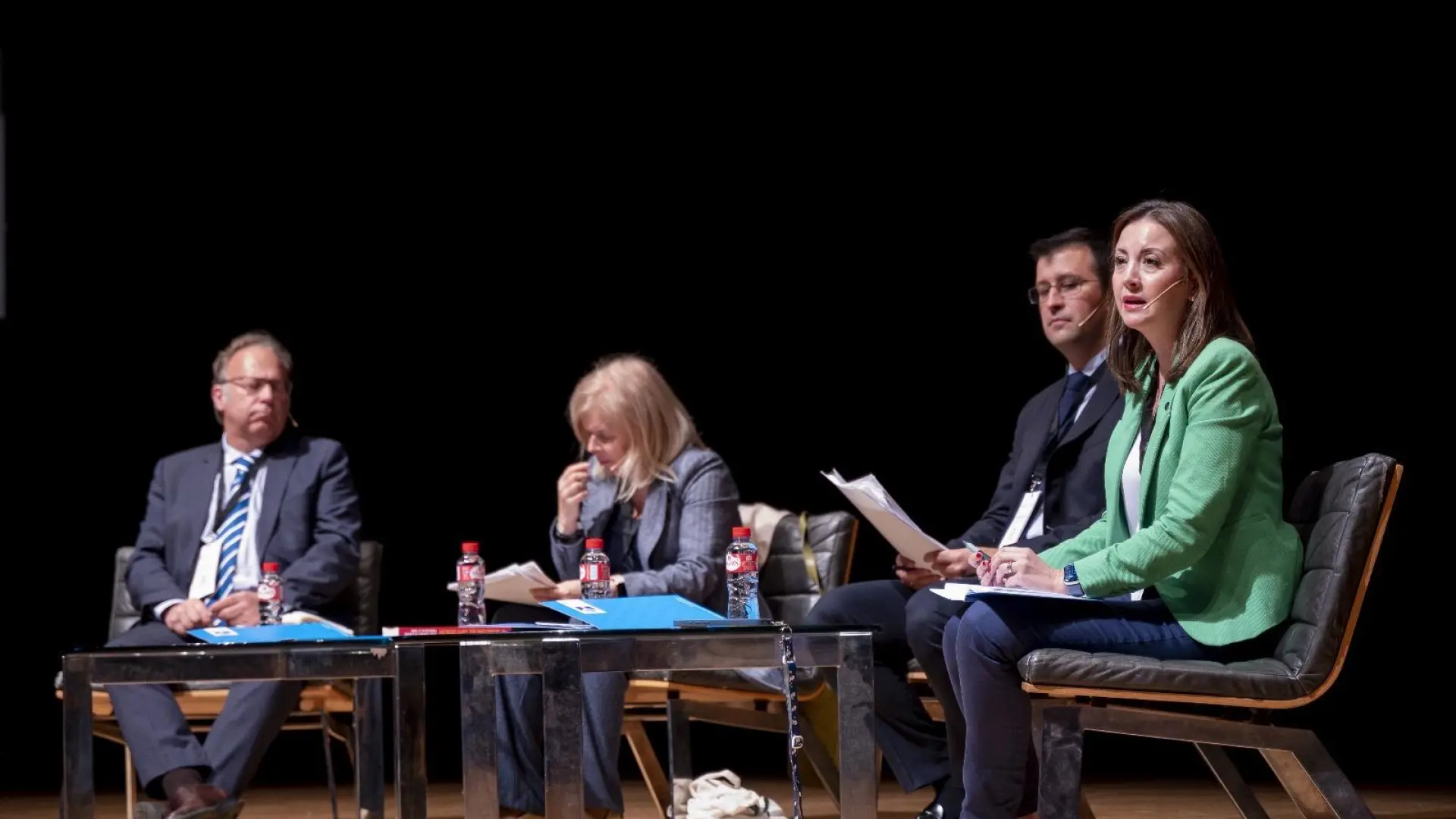
María Ángeles García Frías, professor of Financial and Tax Law at the University of Salamanca, considers that the Catalan singular financing proposal is not the appropriate way to reform the regional financing system “neither in form nor in substance.” “IRPF is the most important tax in our tax system. It is not starting with something trivial, it means turning our entire financing system upside down.said the expert, who was a speaker in one of the debates that marked the congress.
The jurist maintained that singular financing “does not fit in the Constitution” and defended that the transfer of personal income tax to Catalonia with a view to the 2026 financial year is “completely hasty.” García Frías defended that Catalonia “not only aspires to manage personal income tax, but also to regulate a new income tax. “If extrapolated to the rest, we would have as many personal income tax as there are autonomies. We would find ourselves facing a situation of regulatory chaosof absolute legal uncertainty,” he noted.
For his part, Pedro Herrera Molina, professor of Financial and Tax Law at the UNED, the expansion of the model pursued by the Generalitat “would be a disaster.” “There could be areas where inspection is carried out with less intensity”held. Herrera Molina also questioned the reference to solidarity in the proposal agreed between the Generalitat and the Government, which would be limited by the principle of ordinality. “We have the precedent of the Basque Country and Navarra which, according to the most widespread opinion, although it is not unanimous, is undercalculating the cost of the services provided by the State,” he concluded.
For Elisa de la Nuez, state lawyer and secretary of the Hay Derecho foundation, the agreement for singular financing is part of a trend of decline in indicators in Spain. For the jurist, the Catalan ‘quota’ is both a “legal” and “democratic” anomaly. “It is trying to move towards the Basque and Navarrese model, which is a deeply unsupportive model,” he defended.
Criticism of the reform in the oppositions
The Treasury Inspectors have also been one of the pressure groups that has most criticized the reform of the competitive examination system sought by the Government. A proposal focused on lightening the memory load and that proposes a type of opposition schools for higher level positions.
“What is intended is to lower the level and base access to the Public Service on political or opportunistic criteria,” said Ana Ercoreca, president of Fedeca, a federation that includes numerous associations of senior civil servants. “We are not closed to changes, but always based on the principle of equality, merit and capacity,” he added.
“At the moment in which the very ministry that calls the oppositions is the same one that prepares the oppositions, It will facilitate biases, it may condition the courtTherefore, there are already some disadvantages,” defended, for his part, Antonio Roma Valdés, from the Association of Prosecutors (AF).
Ercoreca also spoke about the situation of interim officials in temporary employment fraud, who continue to litigate in Europe to get them made permanent. The president of Fedeca pointed out that “it cannot be generalized” with stabilization, because ““Not all interim officials or labor personnel have agreed in the same way.” “In certain cases an abuse may have been committed, but what cannot be applied is fixity as a general rule without any type of control,” he concluded.