The civil servants’ unions point to a “very delicate” negotiation with the Government this Wednesday in search of a salary pact

The unions of civil servants attend with the “best of wills” to the meeting that they will hold at 6:00 p.m. with the Ministry for Digital Transformation and Public Service, although aware that this is a “very delicate” negotiation. The sources consulted by this newspaper express their intention to negotiate until the last minute to try to improve the Government’s proposal, which involves applying a cumulative salary increase of 11% for the period 2025-2028 to the 3.5 million public employees.
In the previous meeting, held last Monday, the Ministry led by Óscar López committed to approving a Royal Decree-Law this month that would allow payment in December – and with retroactive effects from January 1 – a salary increase of 2.5% for the current year. In addition, the Executive would have committed to making the salary increase fixed, so it would not have variable components as in the previous agreement. The unions point out that this would place the total salary increase at 11.45% between 2025 and 2028 due to the sliding of salary tables.
The text, however, still does not convince the unions. The main obstacle is that the Government refuses to allow the salary increase in 2025 and 2026 to exceed 4%, leaving the rest of the increase for the second part of the period. The representatives of CCOO and CSIF consider this proposal insufficient and maintain that with it, officials would lose purchasing power.
The inflation forecasts of most analysts suggest that prices will rise somewhat above 4% in that period. Hence, officials would not begin to recover purchasing capacity until 2027. In any case and as advanced Economic Informationif the expectations of economists and research services about the long-term CPI rate are met, the 11.45% offer proposed by the Government would not be enough to compensate for the purchasing power that was lost with the salary pact for the period 2022-2024, when public remuneration increased by 9.8% in total.
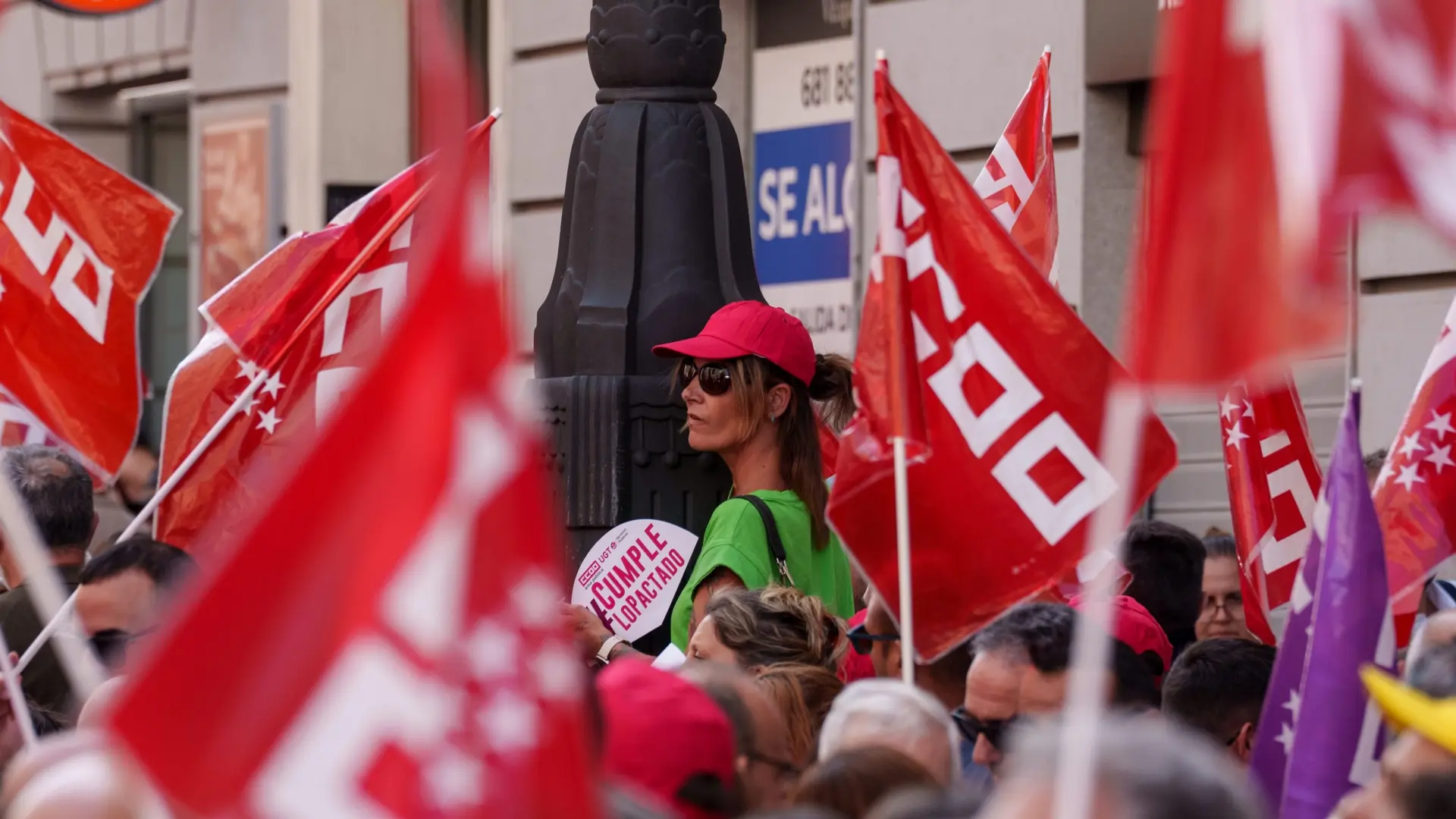
CCOO considers that there is room to reach an agreement that satisfies both parties, although They do not rule out any scenario, such as resuming the mobilizations or calling a strikeif necessary. “Haste is not a good advisor to sign an agreement of this magnitude,” warned the general secretary of the Federation of Citizen Services of CCOO, Lucho Palazzo.
The general secretary of UGT Public Services, Isabel Araque, put on the table the possibility of raising by half a point the proposed increase for this year and next (to 4.5%) and leaving 4.5% for 2027 at another, something that the Executive also did not want to consider. Meanwhile, from the majority CSIF they valued that Public Function be open to eliminating the replacement rate, to improvements in internal promotionto increase the amounts for insularity and for reasons of service (maintenance and accommodation) or to improve health care in Muface. “We value these aspects and we will analyze the agreement as a whole,” they stressed.
The Ministry started the negotiation last week with an offer of a salary increase of 10% accumulated in the four years covered by the multi-year agreement. The proposal was flatly rejected by the unions, considering it “offensive.” The department led by López raised its proposal to 11% between 2025 and 2028 (around 2,000 million euros), emphasizing that this was the limit and that it would not move from there.
Replacement rate, internal promotion and other improvements
In the area of employment and working conditions, the Executive had committed to review the replacement rate of the Administration’s workforce (it even contemplates eliminating it progressively and replace it with an alternative planning mechanism based on objective criteria and personnel forecasts). This point also includes both the streamlining and improvement of selection processes, as well as the promotion of internal promotion and professional development, personnel planning, attention to citizens and public services, equality and non-discrimination.