The Government sends to Congress the law that extends the CO2 emissions limitation system to land transportation and construction
This Tuesday, the Government approved the bill that modifies the CO2 emissions right trading scheme to extend it to maritime transport and extend it to the sectors of land transportation, fuel and construction, to which, from 2027, a regime that limits permitted greenhouse gas emissions will also be applied, as is already the case in heavy industry or manufacturing. aviationan area in which it will be modified to exclude flights between islands in the Canary Islands and other countries of the EU and the archipelago. Although without directly affecting usersin the road transport and building sectors, the limits that the Government will establish on the tons of greenhouse gases that can be released into the atmosphere will apply, as well as the possibility of purchasing more rights to this if they want to emit further. of the amount assigned to them.
This bill will entail transposing two European directives approved last year to expand and reform the European carbon market that as a novelty also will grant free rights emission to activities that do not emit CO2 and other greenhouse gases such as the production of green hydrogen to “incentivize” them and introduces a European border taxwhich products manufactured in countries outside the EU will have to pay where similar carbon markets do not operate and that, therefore, have not been produced taking into account this way of limiting emissions that the third vice president, Teresa Riberadescribed this Tuesday as “one of the more effective ways to reduce emissions of greenhouse gases in the EU”. The initial objective was to cut them by 55% in 2030 and the percentage is now expanded to 62%, so that each Government will have to reallocate the amount of emissions – the emission rights – that will correspond to each sector and companies.
Road transport fuel
The bill will now be sent to Congress for final approval of the modification of Spain’s law on the emissions rights market that has existed in the EU since 2005. It is something that the sector expected because it was in the Government’s legislative planning. The Council of Ministers has given it the green light just two days after the European elections after which riverbank aspires to occupy a “powerful” vice presidency of climate policies in the new European Commission that is expected to be formed in the autumn.
The EU emissions trading scheme establishes a maximum emissions cap -of CO2, methane, nitrous oxide, hydrofluorocarbon, perfluorocarbon and sulfur hexafluoride- for each of the sectors industrial and commercial that it contemplates, which until now were the electro-intensive industry, electricity generation, oil refining, aviation, aviation and maritime transport. If you want to exceed the allocated amount, you can buy it in the so-called “carbon market”, in which other industries sell the emissions that they do not release into the atmosphere.
This bill expands the sector menu because it will lead to a “parallel market” for el road transport and fuels, buildings and small businesses, in accordance with what was agreed last year by the Twenty-seven countries of the EU. As agreed, ultimate users and consumers will not be affected because the obligations will apply to the dispatch of fuel consumption for combustion in road transport and buildings.
European competitiveness and flights to the Canary Islands
The actor to whom certain emission rights will be assigned will not be the one who issues them – that is, the final consumer of the fuel – but rather the one who distributes or markets them for the consumption of a third party, as explained in a note from the Minister of Ecological Transition when the European directive was approved, when he stressed that “this regime explicitly excludes end consumers of the fuels used in these sectors.” “These are changes in which the obligations are not directed at the final citizens but at companies that sell the fuels,” stressed Ribera, who also stressed that the creation of a border tax It will increase the competitiveness of the European company, which will not be “damaged” by products with a lower environmental cost, given that the purchase of emission rights by the European industry increases its production costs.
It also modifies the regulation regarding CO2 emissions from aviation, to transpose another directive also approved last year that excludes flights from EU countries to an outermost region of another country from the emissions trading system. that in the Spanish case, will affect flights to the Canary Islands. On the contrary, flights between two outermost regions of the same Member State will be excluded, for example, between the islands of Tenerife and Las Palmas.
First international commitment on emissions
The extension of the emissions trading system to these sectors will not be exactly the same as until now. For buildings and fuel for road transport, It will be launched from 2027, although the monitoring and reporting of emissions began earlier, from January 1, 2025. Unlike the current scheme, these sectors are already They will not be assigned a free rights number and will only be sold by auction.
The emissions trading system in the EU makes up one of the 32 “carbon markets” that currently exist in different countries – such as China, the largest in the world that covers its entire territory – and within them, between specific areas, like in the US or Canada. In 2005, they became the first international commitment that countries took on to fight climate change and reduce greenhouse gas emissionsincluded in the Kyoto Protocol.
To each company in these sectors, They are assigned a certain amount each year. of CO2 emissions that are allowed to them -the “emission rights”-, which range decreasing every year depending on the reduction coefficient set by the EU. After reducing by 1.74% per year until 2020, emission rights in the EU have been cutting by 2.2% per year between 2021 and 2023 and the cut will be greater, 4.3% per year, between this 2024 and 2027 to increase again in 2028 to 4.4%.
In addition to using the rights to emit the CO2 that they are allowed, companies they can not do it and sell their rights issuance, in a market that last year generated income of about 40,000 million euros in the EU, a figure seven times greater than in 2017 and which serves to finance policies and aid from the European Commission.

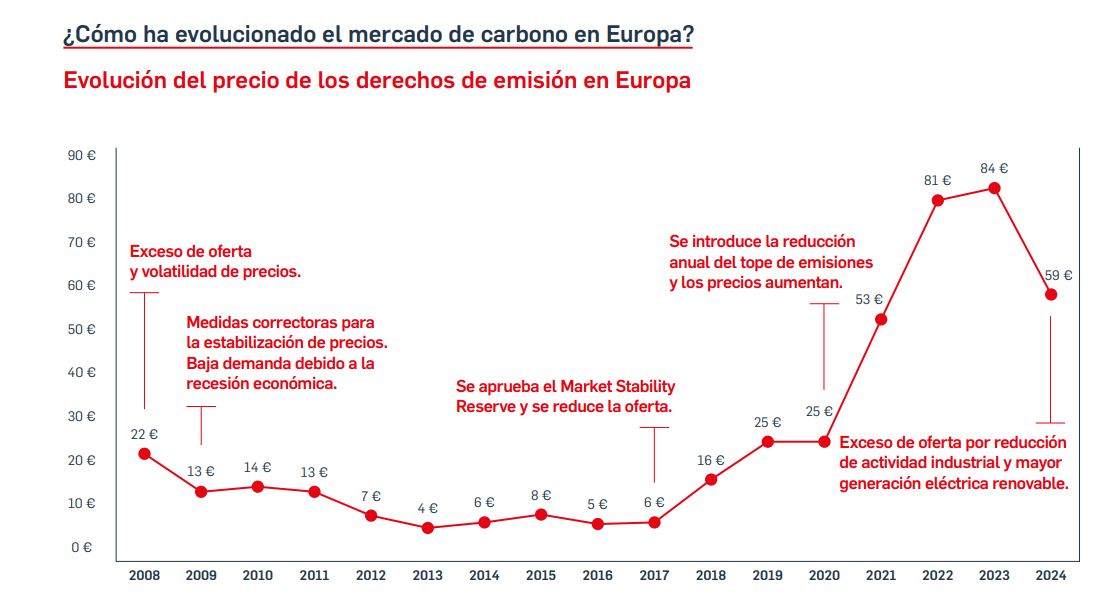
According to figures from the sector, the price of a ton of CO2 or other greenhouse gases experienced relative stability for the first few years and low prices, which skyrocketed when in 2020 The EU began to reduce the emissions cap annually. In one year, it shot up from 25 euros per ton to 53 and continued to rise in the following years, to 81 and 84 euros in 2022 and 2023.. It fell sharply again, to 59 euros, in 2024, due to an excess supply in emission rights due to a reduction in industrial production and also due to increased renewable electricity generation.
The two directives that will be transposed into legislation are part of the package of EU measures to fight climate change, Fit for 55of which the reduction of emissions in buildings, the reform of the electricity market or the creation of European markets for hydrogen and other renewable gases and of which in the legislature that ended with the European elections on June 9 alone it has not been possible to carry out the Nature Restoration Law.