Salaries are accelerating in the eurozone and putting the ECB in trouble, which is preparing to lower rates with mortgage holders on tenterhooks.
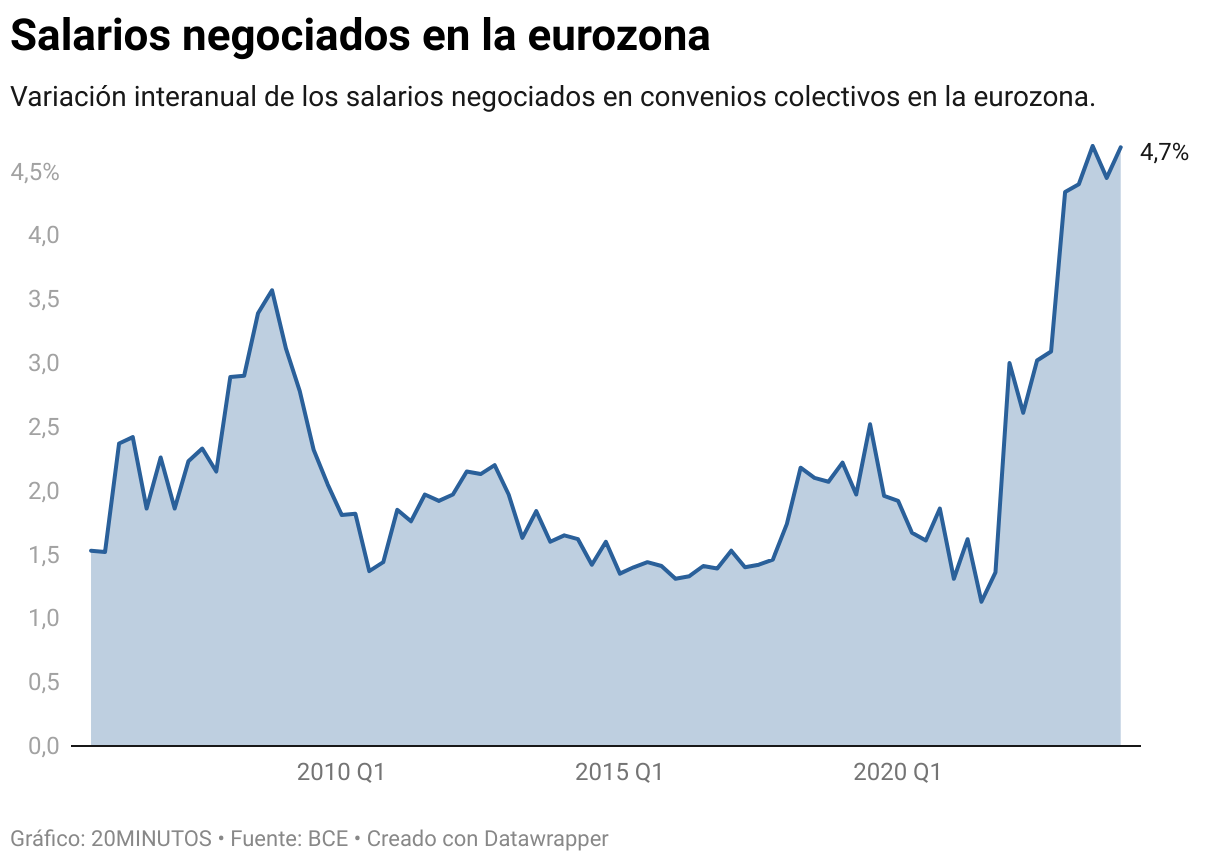
The European Central Bank (ECB) is just two weeks away from a key meeting in which, predictably, it will lower official interest rates for the first time since it began raising them almost two years ago. Mortgagors are eagerly waiting for the ECB to cut official rates, the force that drives the Euribor and, with it, the fees that families pay for their loans. In this context, the central bank published this Thursday highly anticipated data that will influence how and by how much rates will fall this year. Is about negotiated wage increases in the eurozonewhich accelerated their growth in the first quarter to 4.7%.
The rebound from 4.5% in the fourth quarter of 2023 to 4.7% at the start of 2024 is mainly due to salaries in Germany, where workers received important compensation payments for last year’s high inflation. The figure has surprised on the rise, something that is undoubtedly good news for workers and for the European economic recovery, but which can have a bitter setback for the mortgaged.
The evolution of salaries is a key variable for the central bank to decide on interest rates and, therefore, on how much households pay each month with variable rate debts. The president of the ECB, Christine Lagarde, stressed at the beginning of the year that the ECB needed to see that wage increases are moderated in order to claim victory in the fight against inflation. Something that the Frankfurt-based institution itself believes will end up happening, but there is still no conclusive data to support it.
Consumer prices in the eurozone are quite contained. In April, inflation in the euro area was 2.4% (3.4% in Spain), very close to the 2% goal pursued by the ECB. However, the institution responsible for the euro is concerned about services inflation, which still stood at 3.7% in April. The prices of services are highly conditioned by the evolution of salaries, given that they are the main cost faced by companies in the sector.
Ammunition for the ‘hawks’
The drop in rates in June seems clear, as different representatives of the central bank have taken care to point out in recent weeks. What is less certain is how much the official price of money will fall throughout this year., a key piece of information so that families and companies in debt at a variable rate know how much relief they can expect in their burdens. And when determining this speed, the salary data that the ECB governors receive will have a decisive influence.

The slight rebound in salary increases works as ammunition for the most conservative sectors of the ECB (the famous ‘hawks’), in favor of being prudent when it comes to lowering rates. The conservative Bundesbank – the equivalent of the Bank of Spain in Germany – warned this Thursday that there are still “risks” in the disinflation process and that services inflation could remain high for longer.
One of the ECB’s most influential voices, Isabel Schnabel, warns that the central bank is not committing to any predefined path of lowering rates. Schnabel, who is a member of the central bank’s Executive Committee, warns that two scenarios may arise: one in which wage increases continue to moderate and inflation returns to its course; and another in which salary increases remain strong. “In that situation, “We would need to be more careful because it could mean that the return to our objective is delayed or that inflation picks up.”he maintains.
A break in July
For some analysts, the data released this Thursday point to a slower rate cut than previously expected. “Wage dynamics will be an important determining factor in the relaxation of monetary policy in the future,” says Frederik Ducrozet, head of Macroeconomics at Pictet Wealth Management. Ducrozet bets on a rate cut in June, followed by a pause in July and a new cut in September.
“The hawks will use recent data to draw a scenario of stagnation in inflation”points out, for his part, Kamil Kovar, senior economist for the eurozone at the agency rating Moody’s. For their part, ING Think analysts believe that the salary data released this Thursday are “an uncomfortable signal for the ECB”, although they will allow a boost to the recovery of purchasing power.