The minimum wage faces an unprecedented legal and numerical battle
The increase in the interprofessional minimum wage (SMI) that Yolanda Díaz is proposing for the year anticipates a legal battle with unprecedented figures. The Ministry of Labor brings together unions and employers this week to begin official negotiations on a salary improvement surrounded by many unknowns. Because on this occasion, Labor is not only proposing to raise the minimum wage. He also wants to introduce major changes to the regulations that regulate this salary.
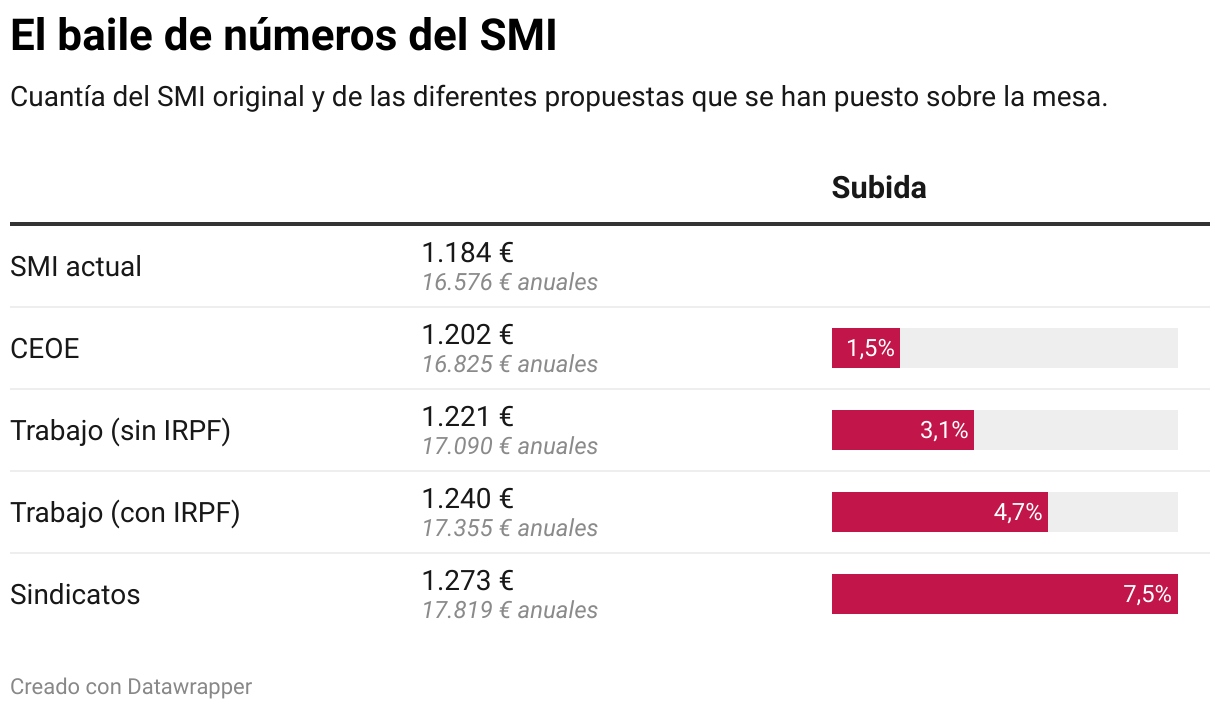
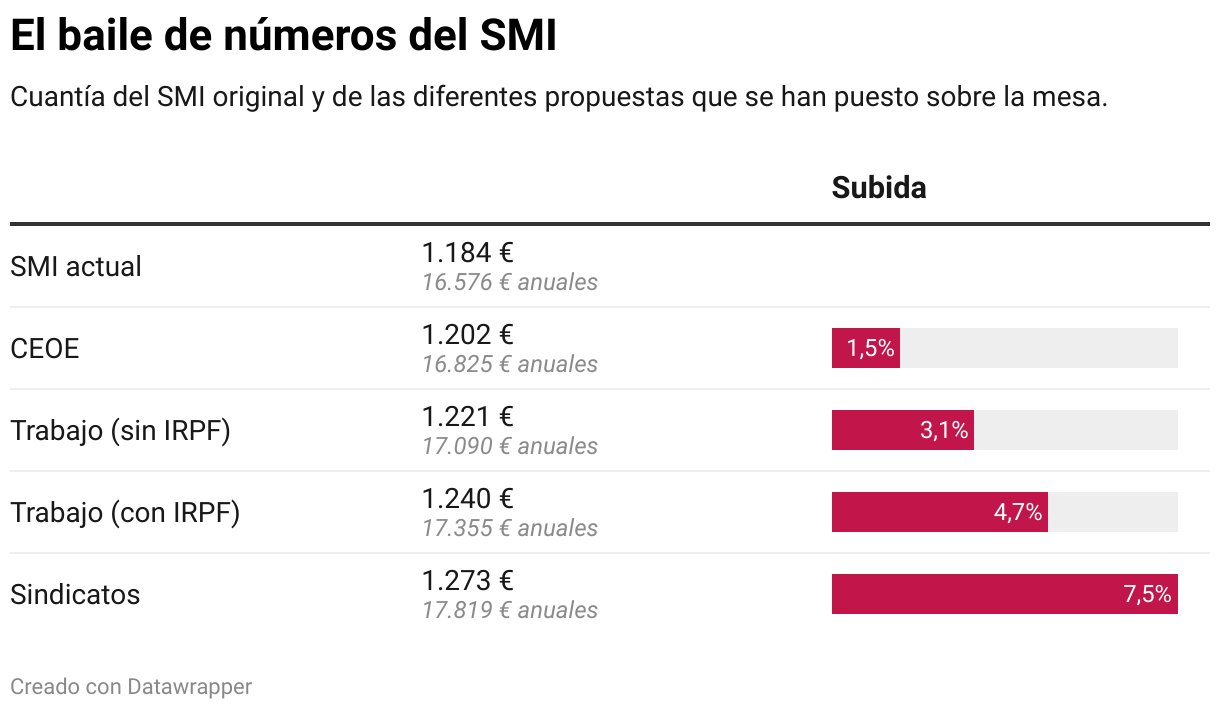
Those involved – the ministry, the unions and the employers – have already put their cards on the table. UGT and CCOO were the first to move and proposed an increase of 7.5% for the legal minimum remuneration. CEOE responded last Tuesday and proposed raising the SMI by 1.5%, an approach accompanied by an amendment to the calculations of the committee of experts appointed by Yolanda Díaz to define the ministry’s position.
The experts’ report, which was published last Friday, suggests that the approved increase will range between 3.1% and 4.7% depending on whether the SMI ends up being taxed next year or not. A mystery that has not yet been resolved, waiting for the Treasury, which is the one who has the initiative, to make a move.
The movement that María Jesús Montero makes will be key. Labor is waiting for the Treasury to make a statement to decide which of the two ranges of increases it prefers. Official sources from the ministry say that the Treasury is open to updating the deduction that has prevented the SMI from paying personal income tax in 2025, also next year. However, there is still no decision made.
The dance of figures that accompanies the minimum wage has been surrounded by a heated technical debate about wage statistics. The Government’s objective is for the SMI to be equivalent to 60% of the average net salary in the country. But since there is no collective agreement on which statistic to use, each of the actors at the table sweeps for their house.
The employers defend using data from the EPA which, according to their calculations, indicates that the minimum wage would already be 4.9% above that reference. Even so, businessmen advocate raising it by 1.5% in line with the agreement applied to civil servants.
On the other hand, the committee of experts appointed by Yolanda Díaz uses another reference, the Salary Structure Survey (EES). One of the most complete statistics available on remuneration, although it does not include information on the agricultural sector—two of the sectors most affected by the SMI—which makes it viewed with distrust by employers.
This year an unusual event has occurred within the committee of experts. Representatives of the ministries of Economy and Finance in the group have cast a private vote in which They distance themselves from the methodology that has prevailed in the report. Although his opinion has not been included in the final report, Economic Information has had access to the content of the dissenting opinion, in which they maintain that the estimate is less precise because instead of using the latest official data from the EES (corresponding to 2023), it has been based on that of 2022.
Despite the discrepancy, Economía has rushed to close ranks with Yolanda Díaz. Minister Carlos Corpo pointed out on Friday that the experts’ proposal “allows us to be happy” and guarantees that no worker will lose purchasing power.
The legal front
This year, a legal front is added to the battle of numbers. The intention of the Ministry of Labor is to approve, on the one hand, the increase in the SMI and, in parallel, work on a change in the regulations that regulate this figure. The idea pursued by Yolanda Díaz is that companies cannot deduct the increase in the SMI from certain salary supplements, a phenomenon known in labor jargon as compensation and absorption. Likewise, Labor seeks to ensure that the reference to 60% of the average net salary is protected through a standard, given that currently it is only an objective that the Government sets.
To this end, the ministry is working on a decree, which has already been put out for public consultation, but which would not have the status of law, to develop these two aspects. This would avoid the process of going through Congress, where the Government does not have a clear majority to advance regulations.
However, the business sector maintains that a law is necessary to undertake these changes. CEOE has already warned that they will go to court if Labor undertakes the changes without going through Congress.