“The proposed reforms are suicidal”
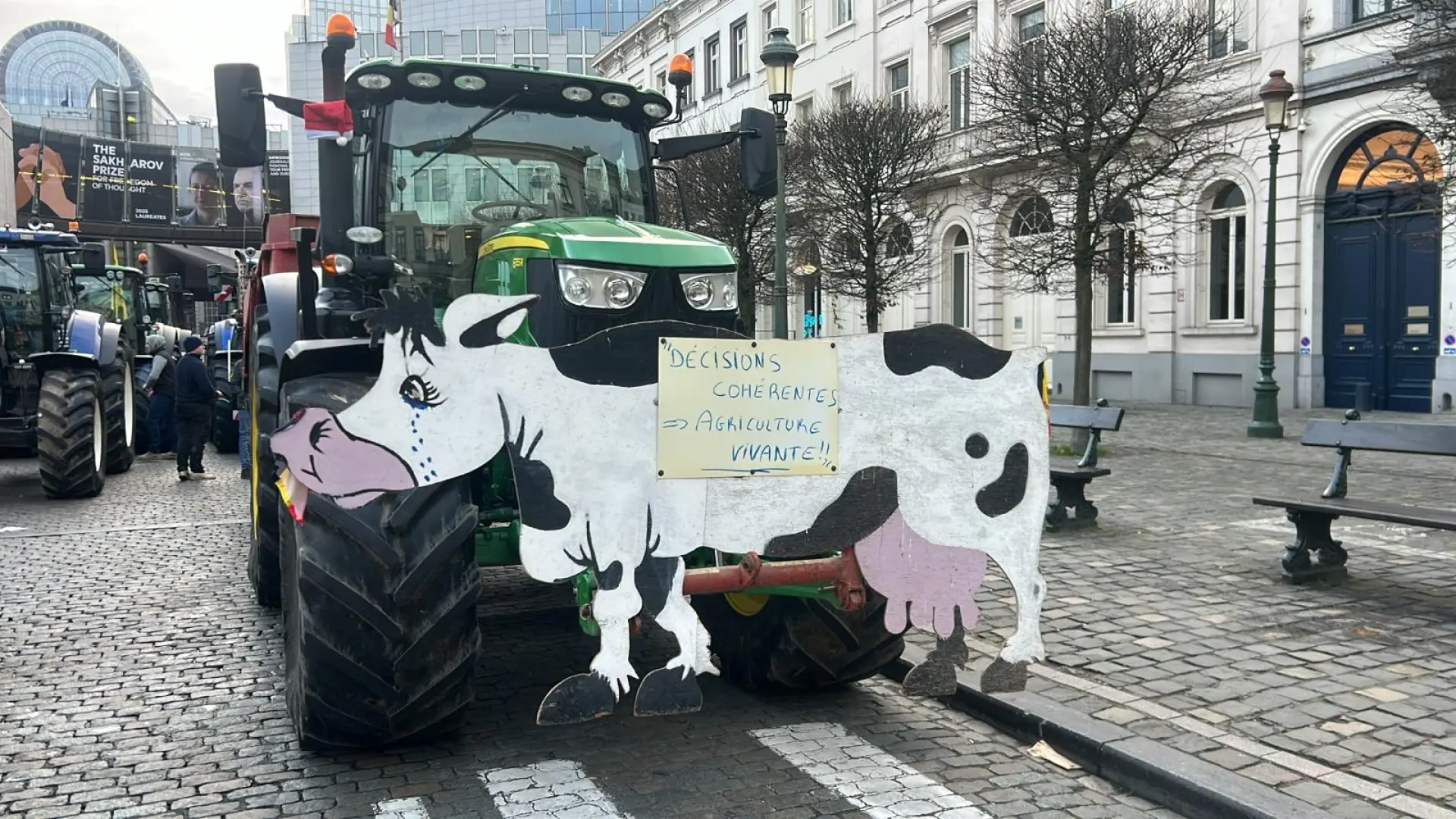
“Hungry child, angry adult.” That is one of the most repeated phrases on the banners seen on the streets of Brussels this Thursday, specifically in the European Quarter, in protests organized by the primary sector to oppose the EU agreement with Mercosur and the reforms proposed by the European Commission for farmers. Around the institutions, some 15,000 farm workers have been mobilizing, with a march through the main streets of the ‘political’ area of the community capital.
The message has been clear: they are against what is being proposed from Brussels. “They are suicidal reforms and policies”they explain to 20 minutes on foot of a tractor Jean and Thierry, two Belgian farmers who are not over 30 years old and who insist that the political class does not meet their demands: “The reality is that they don’t listen to us.”they repeat; They were already in the great march of 2024 and they assure that the situation “has not changed” and that even in some elements “it has gotten worse.”
The primary sector is one of the most affected sectors, they say, by the new long-term budget project of the EU for the period 2028-2034, where a new reform of the CAP will also be faced. At the time, the president of the European Commission, Ursula von der Leyen, assured that “300 billion euros are safeguarded to support farmers’ income”, which is the amount precisely for the CAPand defended that “agriculture will be strengthened.” But the sector does not see it that way at all.
Jean repeats that “it seems that they do not want to understand the sector” and that the distance between the political class and the citizens “is increasingly greater.” Thierry, for his part, opens the melon of the EU agreement with Mercosur, which is still pending approval: “We have been saying for a long time that it leaves us in unequal conditions”. In fact, the organizations emphasize that “imports without standards cannot be allowed.”
For farmers, Europe and politicians are carrying out “a plot against the countryside” and repeat the message that these policies are going to harm future generations. From ASAJA, for example, they remember that “agriculture has always been at the center of the European project”, but that has now changed. In their manifesto they criticize “the paradox” that exists right now: “The European Commission talks about defending agriculture but the words are not accompanied by actions.”
What’s more, his message does not focus only on the rejection of Mercosur. “Without reciprocity, without effective safeguards, there is no agreement,” they emphasize, and focus further. They ask at the same time “balanced imports from Ukraine so as not to destabilize EU producers” and also “review trade agreements such as the EU-US or the EU-Morocco to include effective safeguards and reciprocity.” In this sense, the safeguards that already have the approval of the European Parliament and the Council regarding Mercosur are not enough for farmers.
“It is the politicians who make us here,” Sebastien, a French farmer who is coming to a march of this type for the first time, commented to this medium because, he says, “the policies that are approved year after year harm us.” He demands, like his colleagues, “not to sign the agreement with Mercosur” because it goes “against” the European camp. In addition, he warns of the contagion effect that can occur at a social and economic level: “Without agriculture and without the primary sector, the rest does not work.”
All this occurs despite the agreement in the EU for safeguards with Mercosur. The negotiation adjusted the margin for increasing imports or falling prices for a series of sensitive products imported from Mercosur that would give rise to an investigation and possible measures by the European Commission: Brussels and the governments wanted it to be 10% and the European Parliament was initially betting on a stricter margin, 5%.
Finally it will be 8%, which implies that the Community Executive would have to investigate when there is an increase in imports of these products of 8% compared to the average of the previous three years or if, on the other hand, the price of said imports is at least 8% lower than that of the comparable European product.
On the sensitive products on the list foods such as chicken, beef, eggs, citrus fruits and sugar appear. The duration of the Community Executive’s investigations also returns to the deadlines originally planned by Brussels (six months in general and four for the most sensitive ones).