The purchase of homes as an investment fuels the signing of mortgages while the average payment exceeds 40% of the salary of young people

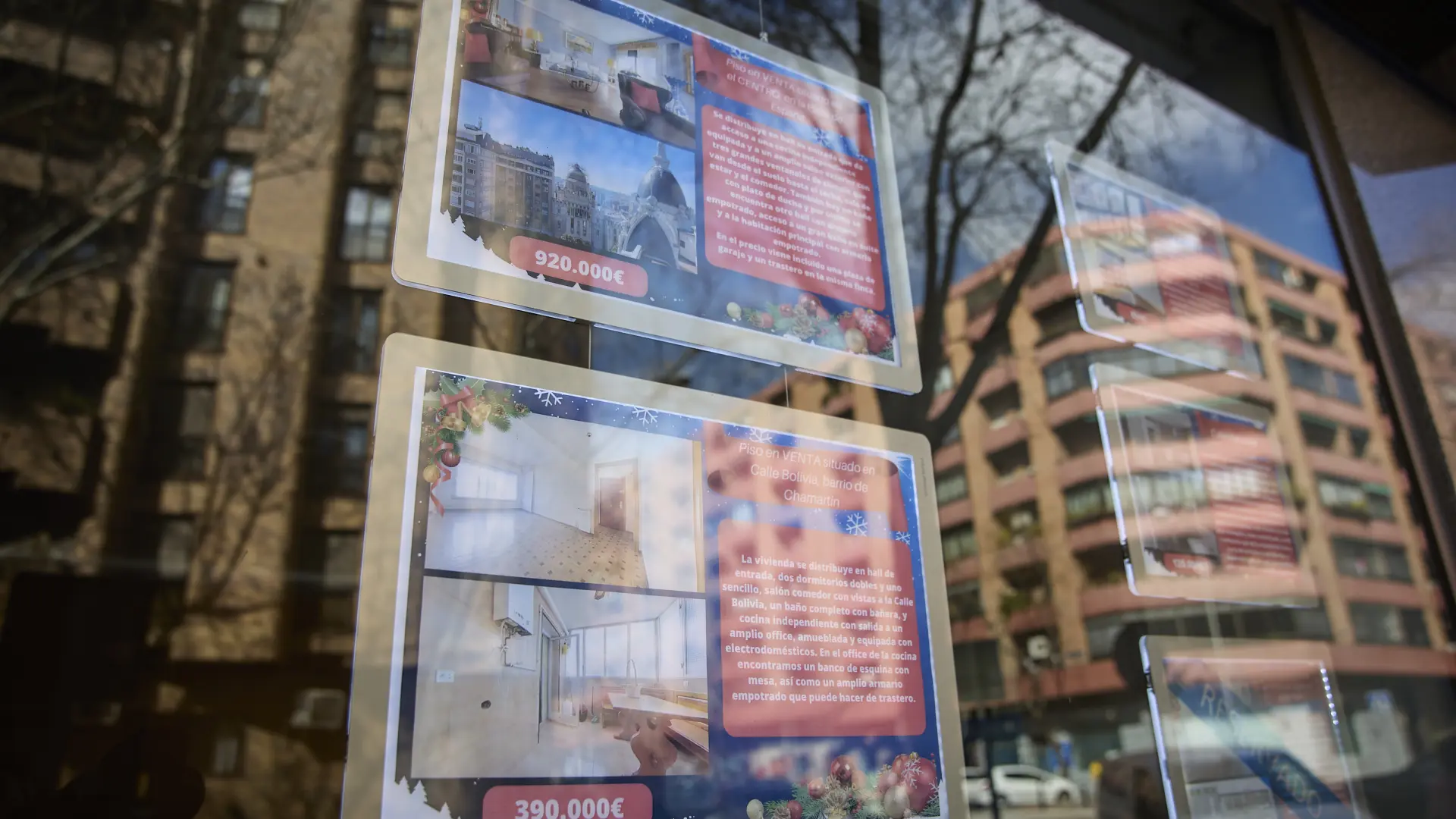
Since the beginning of the year, the volume of houses sold each month in Spain has reached levels not seen since 2007. At the same time, the signing of mortgages continues to increase month after month, despite the fact that, at the same time, so do the prices and the difficulties in accessing housing for a growing part of the population. According to the Quarterly Housing Barometer recently published by the Association of Financial Users (Asufin), the average installment of a loan for the purchase of a house is equivalent to more than 30% of the average salary and exceeds 40% among young people. The study points out that the perception of housing as an investment vehicle is fueling the market, since 47.7% of consumers who request a mortgage acknowledge acquiring the property for the purpose of investing.
The Asufin survey indicates that the proportion of this type of buyers is much higher than that of consumers who take out a mortgage to access a first purchase (15.9%), to change their primary residence (17.9%) or even to acquire a second residence for personal use (18.5%). From the association they clarify that it is about the “intentionality” of the buyer. “It is a home that is bought as an economic asset, but it is not so much to rent out as was the case before, but now people think more about living in it for a while and selling it after a few months or years,” he explains to 20 minutes Antonio Gallardo, head of studies at Asufin. The report warns that this dynamic generates “a cycle of buying to rent or saving value to sell more expensive” that stresses “in an important way” the market.
“The idea of housing as a refuge asset prevails over housing as a home,” states Asufin’s analysis, which states that two out of three consumers believe that there is currently a “good opportunity” to invest in housing. It is the main motivation behind the decision to take out a mortgage, far ahead of the thought that now they will find better prices than in the future (5.4%) and that financing conditions in the market have improved (22.6%). Despite this perception, the truth is that interest rates have indeed fallen in recent months. Asufin’s analysis indicates that the current offer of mortgages by financial institutions focuses mainly on fixed mortgages, with an average rate of 2.87%. A year ago it exceeded 3%.
From the Trioteca mortgage platform they agree that the vast majority of loans that are currently being signed are at a fixed rate. On the other hand, they do not detect that the purchase of housing as an investment has such a majority weight in the market, although they do remember that in Spain there has always been a strong culture of investing in brick. “There are many families who, instead of investing in pension plans or investment funds, They put their savings into a home. This has been done all our lives, even though the yield is not very high,” says the general director of Trioteca, Ricard Garriga. “Putting money into bricks does not have to be bad, because if that home is rented there will be more rental supply, but that is not happening either,” he points out, while emphasizing the shortage of apartments available for rent and the majority weight of small owners in the Spanish real estate stock.
In any case, Asufin believes that the rebound in investment purchase intention is temporary and is motivated by the strong price increases, due to the mismatch between the shortage of supply and the high demand. They expect it to deflate as the situation gets under control. In fact, if the results of its latest barometer are compared with those of February, the intention to buy as an investment has fallen, going from being indicated by 56.2% of consumers to being recognized by 47.7%. Buyers looking for a second home have also decreased from 19.1% to 18.5%. On the other hand, the purchase of first homes has increased from 14.4% to 15.9% and, to a greater extent, the proportion of consumers who already had a home but took out a mortgage to change floor —from 10.3% to 17.9%—.
More mortgages granted
According to data from the INE, so far this year – until September – 533,754 homes have been purchased in Spain and 367,715 mortgages have been signed. This is the largest volume of loans for the acquisition of a property granted in the first nine months of the year since 2010, although there are still around 31% of acquisitions paid in cash. A year ago they reached 35%. “When interest rates fall, there are fewer purchases in cash, because it is much more expensive to mortgage than to decapitalize,” explains Garriga, who points out that many of these operations are families who sell a house to buy another. “They are very expensive homes bought by people with a lot of money who do not need financing or, on the contrary, very affordable homes in small provincial capitals,” says Gallardo.
The dynamism of sales and mortgage signing contrasts with increasingly higher prices. “Not everyone can access financing, because you also have to make a significant initial outlay. “A lot of people are being left out of the loop.”acknowledges the head of studies at Asufin, who warns that this profile that is falling behind is precisely the one who is looking to buy for the first time. According to its latest analysis, the average amount of a mortgage is currently around 169,560 euros, with a average monthly payment of 815 euros. They calculate that this amount is equivalent to 35.9% of the average salary in Spain, a percentage that shoots up to 40.5% and 58.8% when compared to the average salary among young people aged 25 to 34 and 16 to 24 respectively. “Mortgage accessibility has become a generational problem, not just a financial one,” warns the Asufin report, which urges the adoption of specific policies for these age groups.
To improve access to housing, Asufin sees it as key to increase the supply of apartments on the market by promoting the construction of new homes, both free and protected. According to INE data, only one in every five apartments sold so far this year have been new properties. “There is a market for the sale and purchase of second-hand housing that greatly fuels this spiral of purchase for investmentbecause in the end the market is being fed by people who have a house and sell it to buy another,” explains Gallardo. “If nothing changes in the supply, the stabilization of rates will not make access cheaper. With strong investment expectations and scarce new construction, good mortgage conditions only benefit a part of the population and put more pressure on prices,” the report concludes.