What will happen to Bitcoin before the escalation of the conflict between Iran and Israel?
The escalation in the conflict between Israel and Iran has once again put the influence of global geopolitics on Bitcoin. Several analysts have exposed their opinions about what could expect the digital currency and its ecosystem in the context of tension.
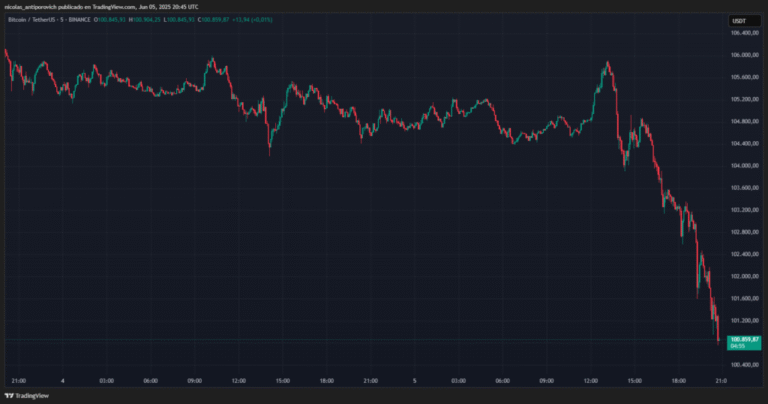
In market, last Thursday, June 12, the price of Bitcoin (BTC) fell almost 4%, going from USD 108,500 to USD 103,500 after the massive air attack that Israel launched against Iran. This aroused a series of retaliation between both nations that continue to be reported in media around the world.
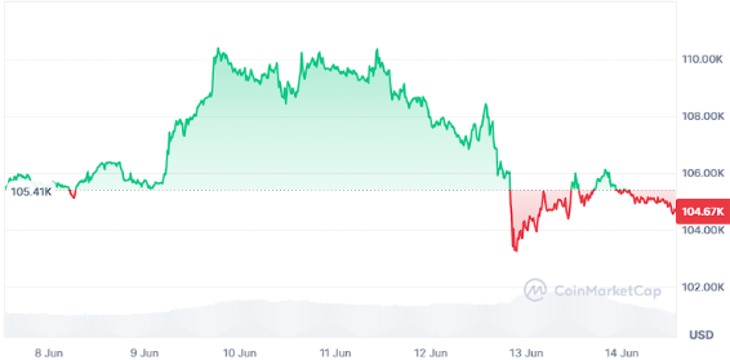
According to analysts such as Markus Thielen, 10x Research, the fall of BTC below USD 106,000 could return it to a consolidation stage, with support in the USD 100,000. John Glover, cio de ledn, sees rather the entrance to A corrective phase that could take BTC near the USD 88,000.
On the optimistic side, several analysts expect a prompt recovery of the upward trend based especially on historical precedents. Anthony Pompliano, Bitcoin enthusiastic investor and entrepreneur, explained that BTC’s immediate reaction to this escalation was similar to the one in October 2024, when the price fell 3% after the launch of hundreds of missiles from Iran to Israel. Nevertheless, In a matter of 48 hours, BTC’s performance was higher than gold and oilRecognized assets as a value refuge. This background opens the possibility of repeating the story.
André Dragosch, head of research for Europe in Bitwise, published a study in which he shows that Bitcoin usually reacts with falls to geopolitical conflicts. However, in a period of 50 days, its price recovers and even exceeds the level at which it was before the climb.
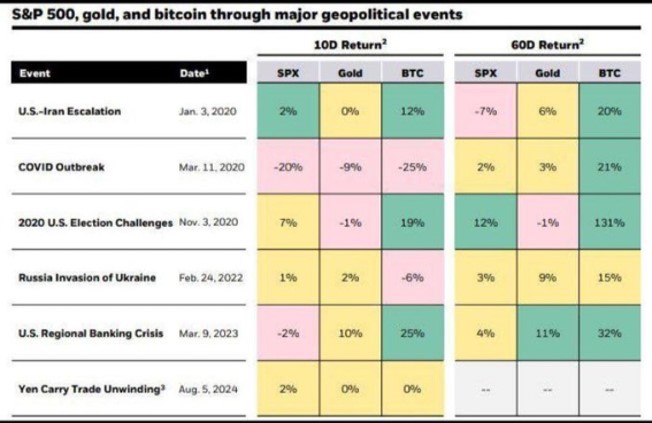
For his part, Adam Back, Cypherpunk and CEO of Blockstream, published in his account in X an image that compares the performance of BTC, gold and S&P 500 between 10 and 60 days after global impact events, such as climbs of war conflicts. Bitcoin was the one that offered better results in most cases.
Bitcoin mining could also be affected
According to reports from the Iraní Irinn news agency, citing the legislator and member of the Iranian Parliament Security Commission, Esmail Kosari, Iran is seriously considering the possibility of closing the Ormuz Strait As the conflict with Israel intensifies.
The Ormuz Strait has historically been a geopolitical pressure point due to its vital importance for global oil transport. The relationship of this threat to Bitcoin mining is that mine is an intensive energy activity. An increase in the cost of energy, driven by the increase in oil and gas (which directly influence the generation of electricity in many regions), would result directly into Greater operational costs for Bitcoin miners.
If the profitability of Bitcoin mining decreases, the miners could be forced to diminish or even completely stop their operations and, consequently, the hashrate would fall from the network. A low hashrate can affect the processing of transactions in the Bitcoin Network and in an extremely critical situation, it would also put its safety at risk.
According to the April of this year of the Cambridge Digital Mining Industry Report, 52.4% of Bitcoin mining today uses renewable energy. However, 38% is still sustained in natural gas generated. So that the shortage of this resource can significantly affect many miners.