factors that influence the price
The drought has a direct impact on our economy. It does so because, with the most basic logic of the free market: The less water there is, the more expensive it becomes. Although, of course, this increase depends on the city and factors such as the availability of the resource, the costs of treatment and distribution, and water management policies.
The five cities with the most expensive water in Spain
With the aim of determining which are the Spanish cities that pay the most for water, the Organization of Consumers and Users (OCU) has carried out a study in which it shows that the differences can triple between localities.
To do this, they have analyzed the rates of the provincial capitals and other important cities, estimating the annual bill for the average consumption of a household of 3 or 4 people.

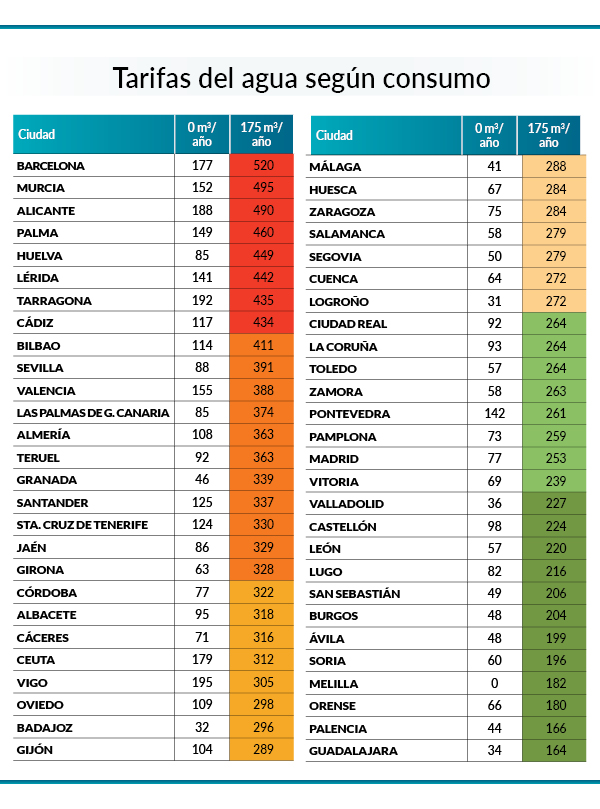
In it First place is Barcelona, with an average annual consumption of 175 cubic meters. Here, the bill can exceed 520 euros. Murcia follows, with an annual bill, for the same average consumption, of 495 euros.
In third position is Alicante, with a bill of 450, and very close behind Palma where they can pay up to 440 euros a year for a consumption of 175 cubic meters. Finally, Huelva, in fifth position, with bills of more than 420 euros.
And the cities that spend the least?
For their part, the cities that assume the lowest cost in their water bill are Guadalajara, with 164 euros for a consumption of 175 cubic meters; Palencia, with 166 euros for the same consumption; Ourense, with 180 euros and Melilla, with 182 euros.
This is explained by the costs of collection, treatment and distribution of water, as well as infrastructure maintenance costs and investment in new facilities.
Caliber, consumption, drought and demand: this is how they influence the price of water
Two elements that can decisively affect the water bill are the caliber and water consumption. This is the \ It \ him meter gauge or pipe diameterwhich can be consulted on the water bill itself, and for a normal home it is usually between 13 or 15 millimeters, although it may be higher depending on the municipality, the home and the necessary supply.
On the other hand, water consumption, which is usually, per person, about 3.8 cubic meters per month. Thus, for a family of 4 residents, consumption can rise to 15.4 cubic meters of water.
Additionally, there are other changing factors that influence the price of water. One of them is drought. Currently, in Spain, this situation mainly impacts the southern and eastern regions of the country. In this sense, Andalusia, the Region of Murcia, the Balearic Islands, Catalonia, Ceuta and Melilla are identified as areas at high risk of drought.
Finally, the demand for water is a determining factor in its price. In areas with high demand, either due to population density, intensive agriculture or industry, The price may increase due to pressure on available resources. Likewise, inefficient water management and waste also contribute to higher costs.