Olive oil consumption plummets to historic low due to rising prices
He olive oil It has always been the undisputed king on Spanish tables when it comes to dressing. However, the reign of the so-called (with increasing reason) ‘liquid gold’ is faltering after the huge increase in its price, which has shot up 177% in three years. Households in the country have not been immune to the rise in costs and have significantly reduced their consumption. To the point that In 2023, households bought the smallest amount of olive oil since records beganThis is confirmed by the Household Budget Survey (EPF) published by the INE on Thursday.
Last year Spanish households consumed 376,542 liters of olive juice, 43,513 less than in 2022 and the lowest since INE statistics began to be published in 2006. We are talking about a 10.4% drop in consumption in a single year, the largest year-on-year drop in consumption of this product since records began.
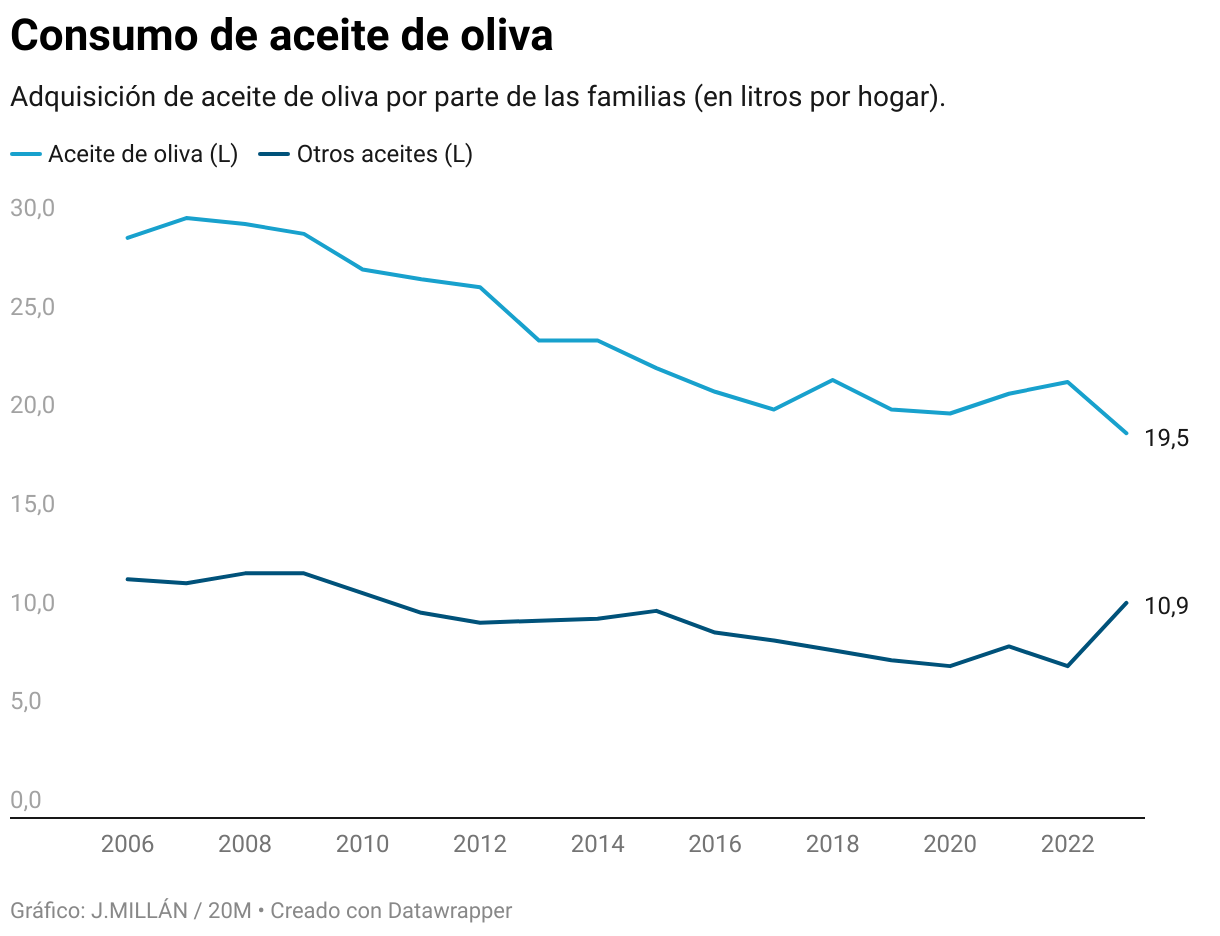
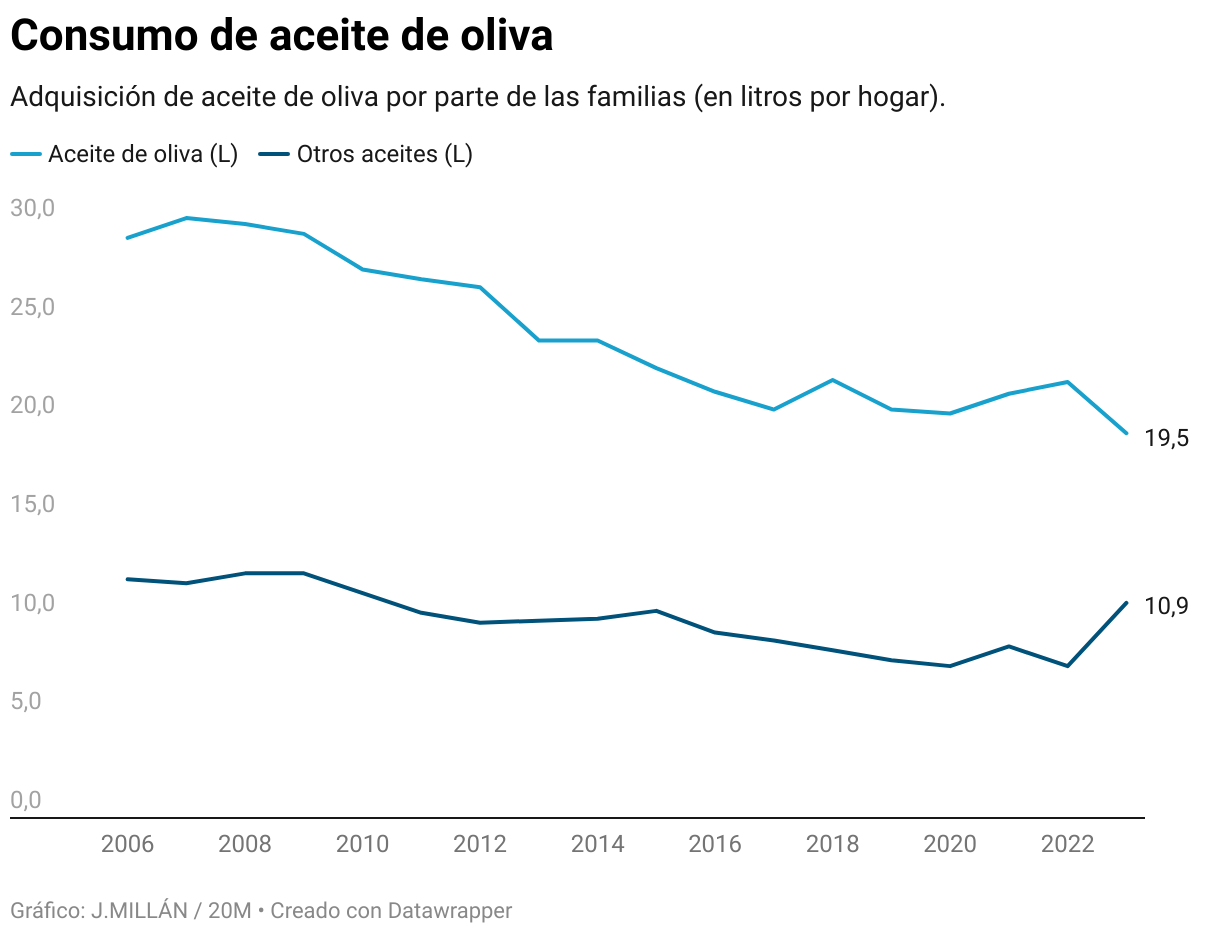
At home level, Each family has gone from consuming an average of 22.1 liters per year in 2022 to 19.5 in 2023In other words, in 2023, 2.6 fewer bottles of olive oil entered every Spanish household than in 2022. A collapse that risks becoming more consolidated in the future, because the money that families have stopped spending on consuming olive oil has not only stayed in their pockets. A significant part has been replaced by other types of oil, particularly sunflower oil.
Olive oil loses market share
All you have to do is take a look at the numbers. Consumption of other types of oils has skyrocketed by 42.6% between 2022 and 2023. Households have gone from consuming 7.7 litres of other oils two years ago to 10.9 last year. We are talking about an increase in consumption per family of more than three litres in a single year, which is unprecedented.

However, it should be noted that In 2022, households reduced their consumption of other oils after prices skyrocketed due to the Russian invasion of Ukraine, which played in favour of olive oil. However, in 2023 there was a significant drop in the prices of other oils, already cheaper than olive juice. Something that, added to the brutal rise in olive oil, helps to understand why so many families have decided to change.
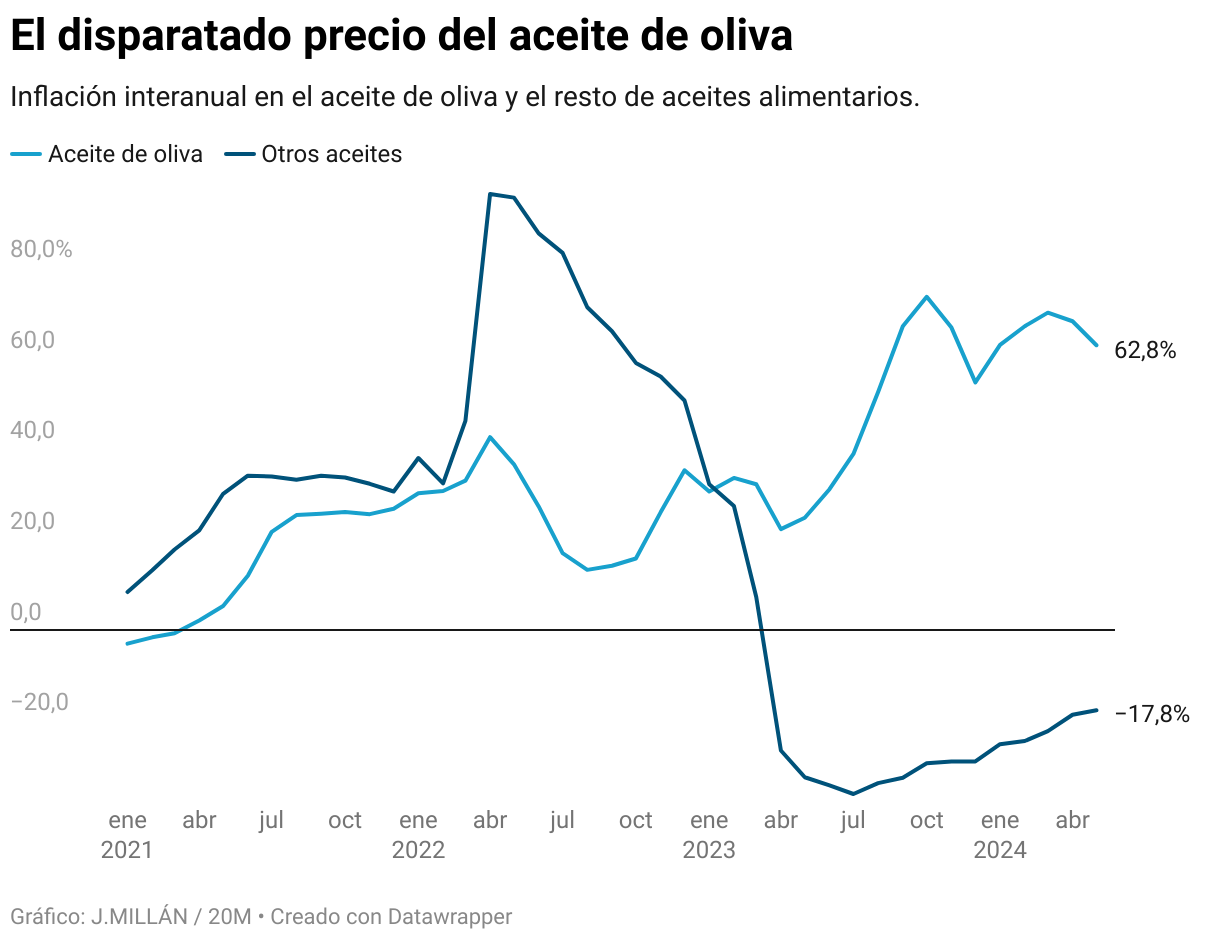
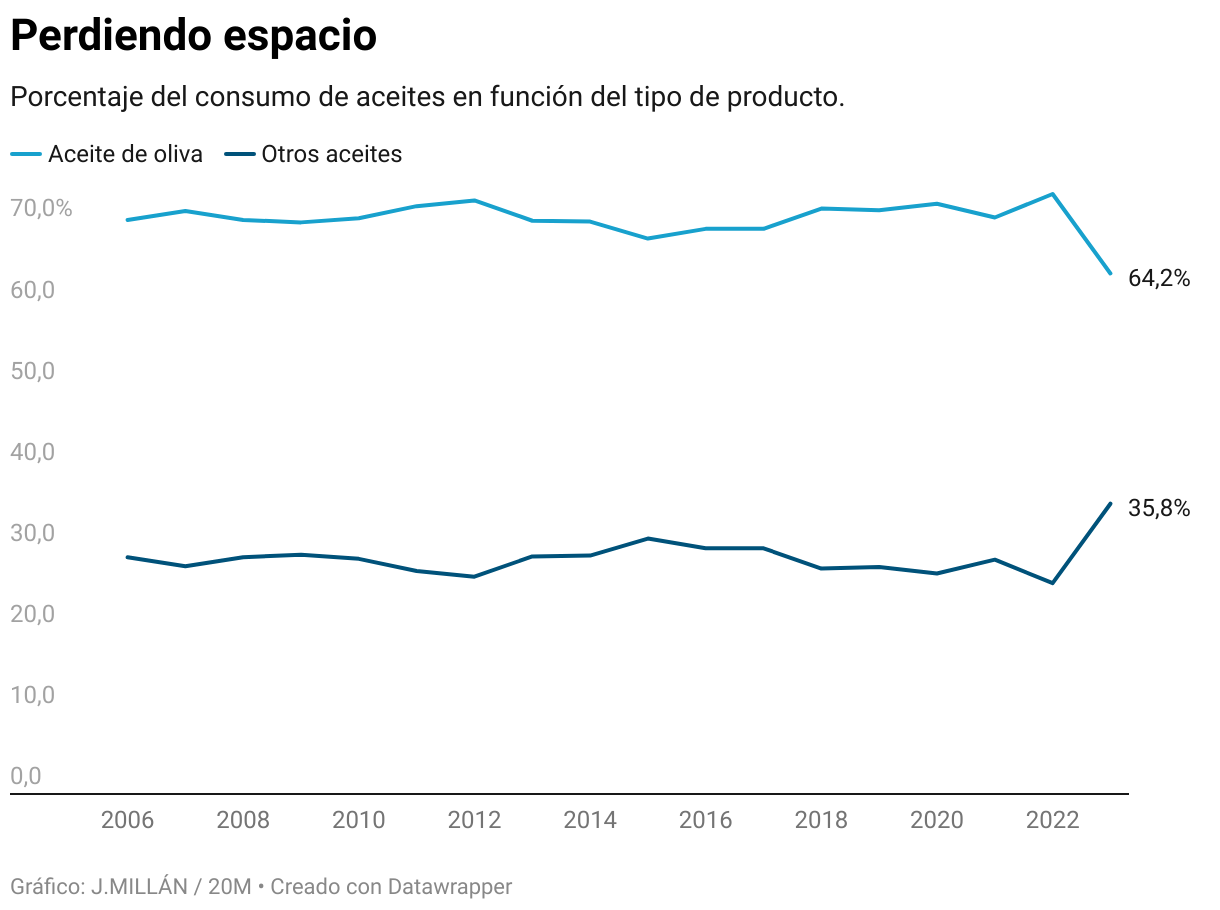
The change in consumption patterns has meant that Olive oil has lost a significant market share in just one year. If in 2022 74% of the oil consumed in Spain was olive oil, last year that percentage fell to just 64.2%. A figure that could have continued to fall this year. The latest available data indicate that the price of olive juice was still 63% more expensive in May than in 2023. While the rest of edible oils now cost 17.8% less than the previous year.
To try to alleviate the impact of the sharp increases in this basic product, the Government has decided reduce VAT on olive oil to 0% for the next three months. The reduction has a catch, as from 1 October VAT will be set at 2% until the end of 2024. Afterwards, the tax rate will rise to 4%, where it will remain permanently, compared to 8% before the crisis.
The effect of this new VAT reduction will have a very small impact. For a one-litre bottle of olive oil costing eight euros, we would be talking about a saving of 31 cents. In the case of a five-litre bottle costing 40 euros, the saving is barely 1.50.

A disastrous harvest
The reasons why the price of olive oil has skyrocketed can be summed up in a cocktail of adverse circumstances that have occurred in the midst of an inflationary epidemic. The last two harvests have resulted in a production well below one million tons of oilwhen the usual thing is to greatly exceed that figure.
Drought and high temperatures have reduced productionwhich has also been more expensive due to the sharp rise in the price of inputs such as electricity or fertilizers due to the war in Ukraine. All this has occurred in an inflationary environment in which raising prices is easier because it goes more unnoticed.
However, the brutal rise in the price of ‘liquid gold’ should be mitigated in the coming months. Prices at the source are already falling and this should eventually be passed on to the supermarkets at some point. In addition, expectations for the next harvest, which will begin to be collected in the autumn, are good due to the abundant spring rains. However, as is often the case when there is an outbreak of inflation, even if prices do fall, they will hardly return to values similar to those seen in 2021.