“People come in who didn’t even know what a haberdashery was”

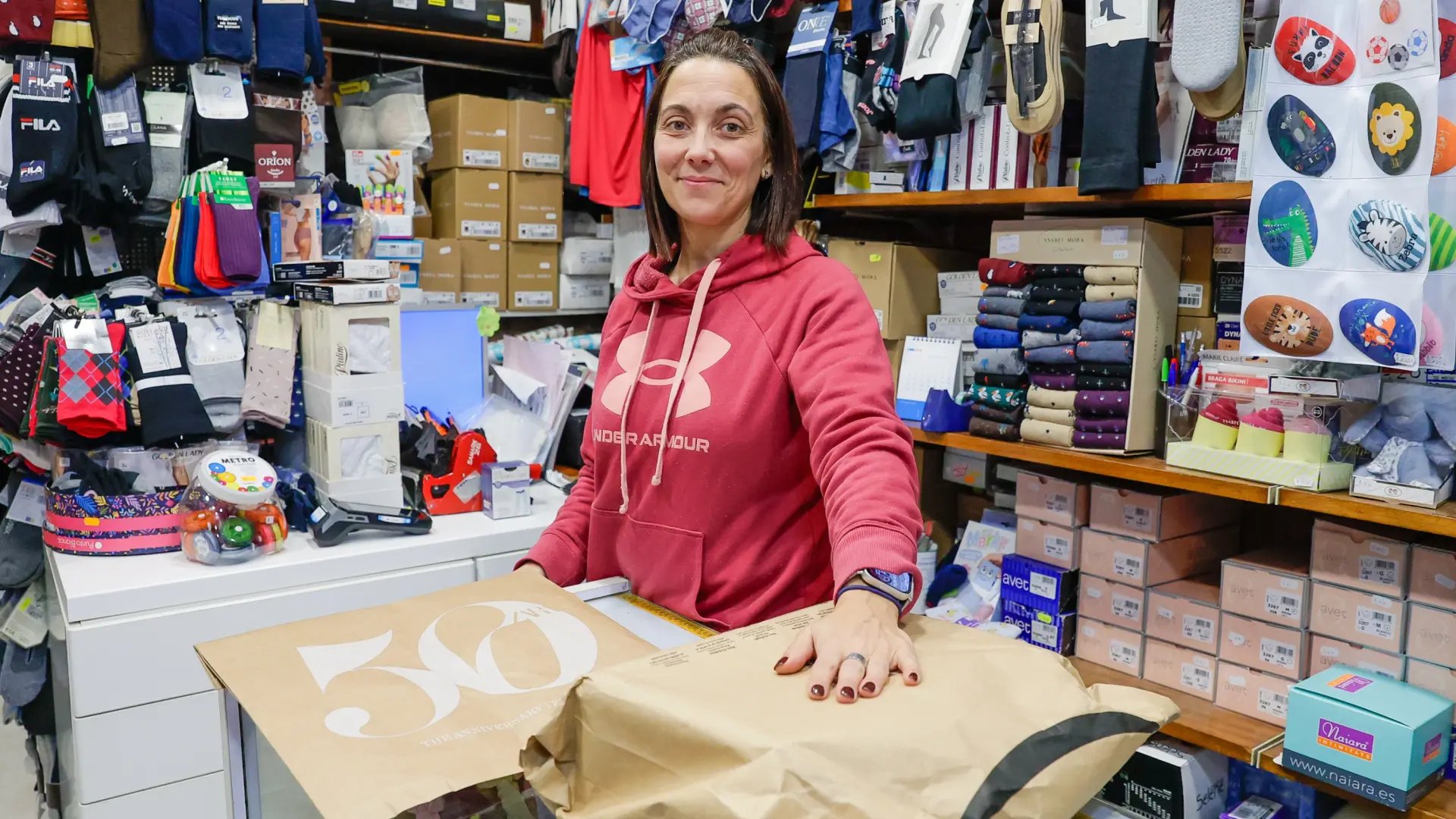
The Baby haberdashery is a narrow store with all the walls full of the most classic products of this type of business in danger of extinction: underwear, pajamas, school uniforms, sewing patterns… Natividad Gómez, the owner of the store that she inherited from her mother-in-law 17 years ago, has just opened after the midday break and It doesn’t take five minutes until the first customer comes in.: “Good afternoon, I’m here to pick up a package.”
“My mother-in-law had a line waiting and now it’s a strange day that passes,” admits Gómez, whose haberdashery is located in the Madrid district of Arganzuela. “But now, thanks to the packages, the people who live on the back street who come in and who didn’t even know it existed or what a haberdashery is, are getting to know you.”
The fortunes of thousands of small neighborhood businesses changed approximately four years ago when large parcel companies began to offer them a deal: they received the packages and delivered them to the neighbors and in exchange, they obtained a small financial compensation and, most importantly, they recovered a continuous flow of people entering and leaving the premises.
“It’s not because of the money the package gives you, which is nothing. But it’s true that people bring you who don’t know you, who already see the socks, who see the quality, who see the friendliness and they come back,” explains the owner, who estimates the money she earns by acting as a collection point at around 300 euros per month. “There is always someone who comes and takes some socks, tights, a robe: ‘Wow, I like this for my mother.’ For 10 customers who come for a package, one buys something, then it’s worth it, one is enough.”
Small businesses have been gradually losing presence on Spanish streets since the 2008 crisis, a process that the pandemic only accelerated. Between 2019 and 2024, 49,970 commercial premises have been closed on the streets throughout the country. In that same period, the growth of electronic commerce has been dizzying, with a increase in sales on-line of 95%.
With these two processes walking inevitably in parallel, the formula of association between parcel delivery companies and neighborhood businesses seems to be, at least, stopping the bleeding in the latter. A survey carried out a year ago by the parcel delivery company InPost concluded that 60% of local businesses that functioned as collection points increased their sales.
Of course, it’s not all good news. Parcel delivery involves extra work completely unrelated to the traditional activity of businesses such as the Natividad haberdashery. “You spend all day with it, from the morning they are delivered, you have to chop them, you have to place them, you also have to put up with people who have not been sent the code or who have been sent it when they shouldn’t… the brown ones are also for you who are the one who shows your face,” laments Gómez, who, however, is happy with having started acting as a collection point three years ago. “It compensates me because I like that, the movement and not sitting around waiting for them to come.”
A sector in slow decline
The small business sector is seeing its activity severely affected not only by the cultural change of some customers who now buy products of all kinds online and no longer go to stores proximity stores such as hardware stores, stationery stores, shoe stores or haberdashery stores, but by their own labor. The self-employed workers who have historically nourished the sector do not find generational relief and only a part of the migrant population is taking their position when they retire.
“The children of the owners, of the self-employed, of the SMEs, do not want to keep the business, even if it is profitable, it happened quite a few years ago in the United States and there immigration has kept many of those businesses that the nationals did not want and not only were they not lost, but they have been consolidated,” explains José Manuel Fernández, Commerce coordinator of the Madrid Business Forum.
In his opinion, formulas such as conversion into collection points are positive, although They will not be enough to break the downward trend of small businesses. “The margin that the store receives is small, that is, it is not a lifeline. We will have to talk about many other more important issues, such as generational change, the ability to hire people, aid from the Administration for entrepreneurship, so that there is continuity in the business, but hey, it can be just one more thing that helps among other things that can help the stores.”
For parcel delivery companies, the formula is undoubtedly beneficial, with a greater efficiency in the distribution of the most expensive part in the logistics chain: the last mile. “It allows us to better adapt to how consumers buy today on-line. More and more buyers prefer flexible delivery options,” declares a spokesperson for Seur, one of the largest companies in the sector that has 8,000 small businesses that act as collection centers throughout Spain. “It is a key lever because it reduces failed delivery attempts, improves operational efficiency, and, in addition, speeds up returns, one of the most sensitive moments of the experience. e-commerce“.
Correos, for its part, has 15,000 collection points, with significant growth in the last three years, which has allowed it to complement its own office networks and “extend the current networks with a greater number of points, expanding coverage and proximity to users,” according to a spokesperson for the public company. The American giant of commerce on-line Amazon is also relying on small businesses to strengthen its distribution network and has some 16,000 collection points in these locations after having expanded its network by 20% in the last year (also including ticket offices) “with the aim of offering customers comfortable and accessible delivery options, while boosting the visibility of small businesses,” company sources indicate.
As a general rule, companies look for premises located in high-traffic areas, with sufficient shop windows and storage space and that carry out an activity compatible with the delivery of parcels, for example, bookstores, tobacconists, bars, neighborhood stores, florists or stationery stores. In exchange for serving as collection points, The companies offer them a small financial reward for each shipment managed and, above all, visibility and increased flow of people entering the premises.
Different models
The bells of the wall clocks begin to ring in unison when six in the afternoon arrives at the Gayo Díez watch shop, located on Jacinto Verdaguer Street, in the Madrid district of Carabanchel. The store opened to the public in 1978 and is run by two brothers, sons of the original owner and both veteran watchmakers and, now, also receivers and deliverers of packages.
“Before this business was something more essential because everyone wore a watch and they were all very expensive and had to be fixed, but in terms of the number of people who come, it is more or less the same people as before,” says Isaac Gayo, one of the two brothers who runs the watch shop. His business, he says, was not in danger, but when a Seur’s commercial appeared one day at the premises proposing it to become a collection centerthought the formula could be interesting.
“They came and told us: ‘Hey, we’ve seen your schedule, if you’re interested, they leave you a package here and then the customer comes to pick it up. You get a little for each package, but it can be good for you.’ We said: ‘It’s not our business.’ to “for a battery or to bring the grandfather clock that didn’t work.”
These watchmakers found themselves in some peak moments such as the Black Friday or Christmas a little overwhelmed, but they ended up agreeing with the company on a limit of between 10 and 15 packages dailyjust enough to attract new customers without having to sacrifice any of its main activity. “Many people come for the package and say: ‘Come on, I didn’t know there was a watch shop here’. They are people from the neighborhood too and I’ll tell you how long this has been open, I grew up in this neighborhood, I’m linked to this neighborhood as always, but there are people who say: ‘Oh, I live down there and I didn’t know it was there.'”
Not far from there, on Antonio López Street, one of the main arteries of the lower part of Carabanchel and, therefore, a privileged location for both a store and a collection center, is the Essenzia equivalence perfume store. Mónica Fernández has run the perfumery for nine years, but in front of the shelves full of jars rise towers of boxes, his other business.
“As a result of the pandemic, sales fell a lot and, while we were getting back on our feet, we needed a push, for people to see us, to attract people to the store again,” says Fernández, who picks up and delivers for several parcel companies. In times of high demand, such as Black Fridayadmits that its main activity has become parcel delivery. “In August it is practically non-existent, but now, these months of November and December, it increases and, now, more people come in by packages than by colonies.”
Although in your case both activities do not usually generate too many cross-sales, The effect has been so good that, according to Fernández, income has already exceeded pre-pandemic figures. After four years, however, the parcel service is taking its toll on its fatigue and also on the state of the store.
“The floor is deteriorating, because the carts come, those who bring the packages come, those who take the packages, people drag, I myself drag the packages. So, of course, there is certain, you see, deterioration in the store,” declares Fernández, who, although for the moment he will continue with the activity, is not so clear about it in the medium or long term. “There comes a time when it gets tiring to be lifting packages, put them in the back, take them out of the storage room to send… So, it’s tiring, but hey, in general I still feel capable of continuing for a while longer. But I can’t say for how long.”
If you want to contact 20 minutesmake a complaint or have a story that you want us to tell, write to pablo.rodero@20minutos.es. You can also subscribe to the 20-minute newsletters to receive the most outstanding news or the printed edition every day.