Spain, the country where housing prices grew the most in 2024 among the big four in the EU and the seventh on the entire continent

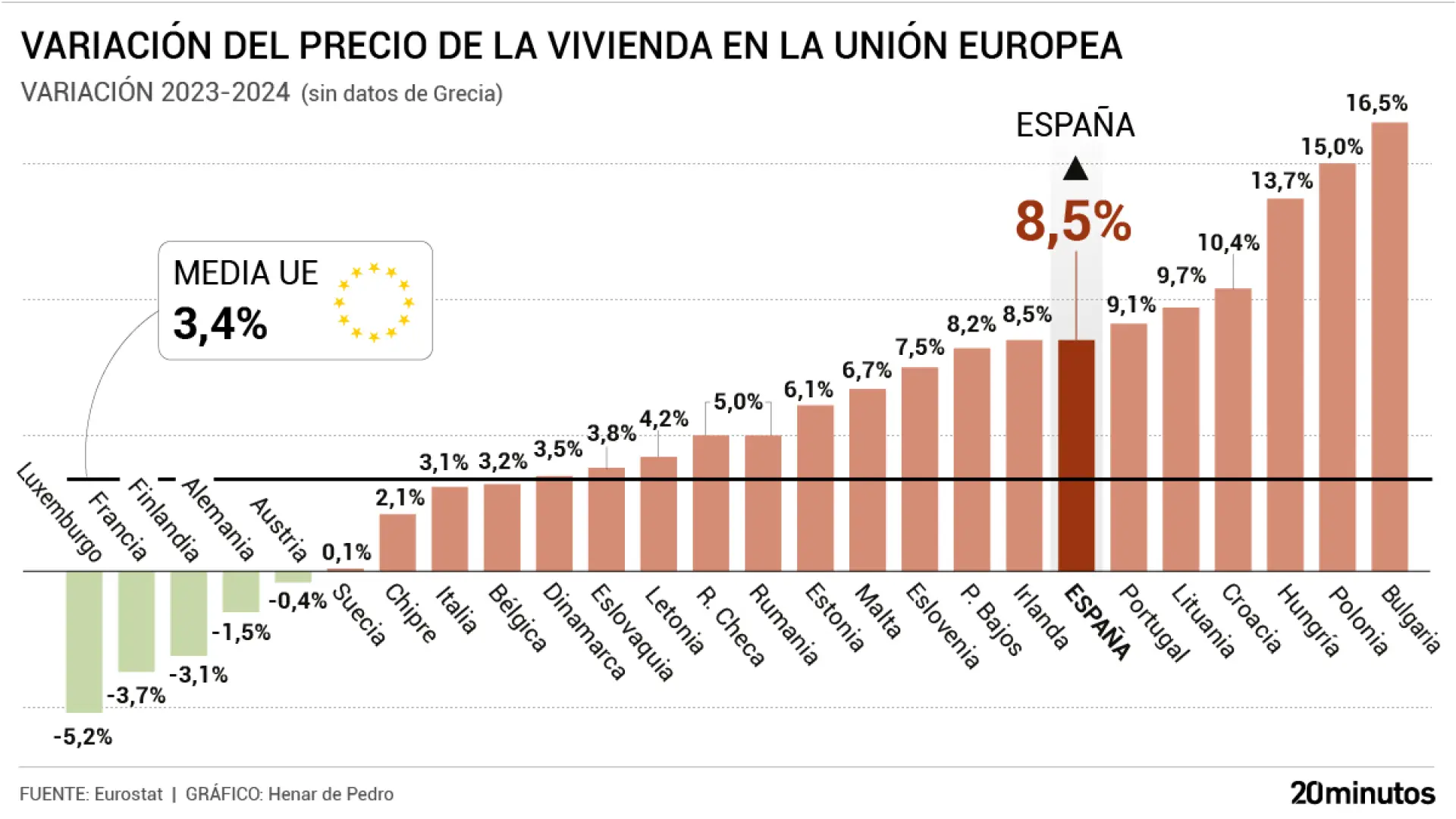
Housing is a problem shared in many corners of Europe, although the situation is not exactly the same everywhere. Spain is the country of the big four where housing prices grew the most in 2024, very far from the brands of Italy, Germany and France. In fact, in these last two the increases subsided. According to the x-ray Housing in Europe published this Thursday by Eurostat, real estate in Spain They became more expensive on average by 8.5% last year compared to 2023, the seventh steepest rise on the continent.
The rise in prices in the Iberian country far exceeded the average increase of 3.4% registered in the EU as a whole. It was the only country of the big four that exceeded the community average. In Italy, housing became more expensive by 3.1%, while in France and Germany it became cheaper by 3.7% and 1.5%continuing the declines after having peaked in 2022. Despite evolving more favorably in the last two years, these two countries have not been exempt from increases. In the last decade, real estate has become more expensive by 48% in Germany and 26.4% in France, while in Spain – which started from lower levels due to the collapse after the bubble burst – the increase reaches 60.3%. The behavior of prices in Italy has been more stable: since 2015 they have increased by just 11.7%.
France and Germany were not the only countries that recorded falls in 2024, also in Luxembourg, Finland and Austria prices fell by 5.2%, 3.1% and 0.4% respectively. On the continent as a whole, the situation has begun to stabilize after accumulating strong increases between 2013 and 2022, although in some countries the climbs remain very steep, especially in the eastern part of the continent, but also in the Iberian Peninsula. Bulgaria (16.5%), Poland (15%), Hungary (13.7%) and Croatia (10.4%) were where prices grew the most last year, with increases of over 10%. They were followed by Lithuania (9.7%) and Portugal (9.1%), just ahead of Spain and Ireland, both in seventh position.
These price increases are increasing access to a roof in much of the Old Continent, although in Spain the general picture is more optimistic than in other neighboring countries because a significant part of the population lives in a home that has already been paid for, which alleviates the average level of effort. In the country as a whole, each citizen spends on average 16.7% of their income to pay for a roof, a percentage that rises to 34% among the least well-off households —the EU average is 19.2% and 36.9% respectively—. In Greece and Denmark, families with the lowest income spend more than half of their monthly income on housing. At the opposite extreme, in Cyprus, Romania, Italy and Croatia they dedicate between 19% and 27.5%.
Those who live in rent are those who are in a worse situation. 28.1% of tenants spend more than 40% of their income to pay for housing, while on the continent as a whole the average is 19.2%. Germany is the EU country with the lowest level of overexertion among renters – 13.8% allocate more than 40% of their income – although it is also the country in which a higher proportion of inhabitants live in rent (52.8%, compared to 26.3% in Spain). In France and Italy the proportion of renters who make an effort above what is recommended each month is around 20%. The Member State in the worst situation in this regard is the Netherlands, where 43.9% of tenants overexert themselves, even more than in Hungary (43.8%) and Greece (37.4%).
According to Eurostat data, in Spain one in seven households accumulates arrears on mortgage payments, rent or basic invoices. It is 14.2% of the population – compared to the 9.2% average in the EU -, which makes the Mediterranean country the fourth Community State with the highest proportion of inhabitants in this situation, behind Greece (42.8%), Bulgaria (18.7%) and Romania (15.3%). In Spain, the figure has been above 13% since 2020, despite the fact that before the pandemic it coincided with the European average at around 8%. At the opposite extreme, in Poland, the Netherlands and the Czech Republic less than 5% of families live in households with late payments.
Besides, 17.5% of the Spanish population cannot keep their home at an adequate temperature. Although the proportion of households that are in this situation has decreased compared to 20.8% in 2023, it still far exceeds the European average, which stands at 9.2%. In fact, Spain is the fourth country with the most inhabitants in these conditions, only behind Bulgaria (19%), Greece (19%) and Lithuania (18%). The countries in the south of the continent and with warmer climates are the ones that face this problem the most. On the other hand, less than 3% of the Finnish population is unable to keep their home at an adequate temperature. Poland, Luxembourg, Austria and Sweden are also at the bottom of the table – the proportion is around 4%.