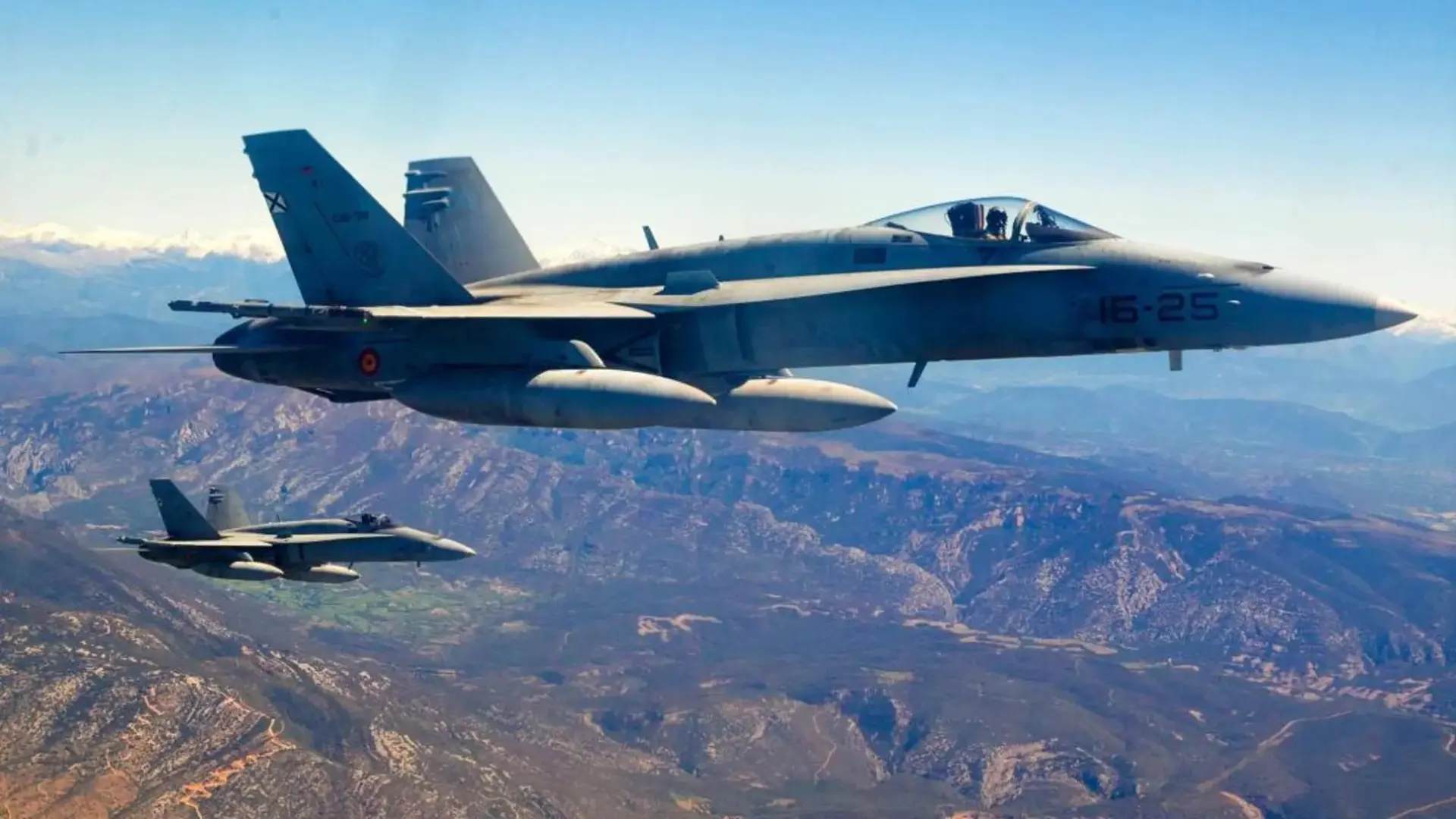
The Spanish defense and aerospace industry makes the most of the military boom with a record of 16,153 million in revenue

“There were decades in which practically nothing happened, while now there are weeks that seem like decades”. The words of Ricardo Martí, president of the Spanish Association of Defense, Security, Aeronautics and Space Technology Companies (TEDAE) stage the momentum that lives a sector that has dominated the narrative of administrations and companies in the last year in the heat of the escalation of geopolitical tensions and its pressing demand to increase military spending.
The association that encompasses the four legs that make up the Spanish technology industry has wanted to capture in figures the growth of the business of these strategic sectors in the last year. According to the report ‘Economic and Social Impact of the Defense, Security, Aeronautics and Space Industry’ prepared together with PwC, the industries that TEDAE groups together They invoiced 16,153 million, which is 16% more than the previous year and 2.3% of the income recorded by the entire Spanish industry.
Propelled by the rise of aeronautical and defense and security companies, and relaunched by increased space activity, the consolidated turnover of these industries achieved surpass for the first time the results prior to the Covid health crisiswhen the figure was around 14 billion (in 2019, the year before the pandemic). According to the authors of the report, five factors contribute to this: climate change, technological disruption, the fragmentation of the world order, demographic changes and the increase in social, economic and cultural inequalities.
The report represents the origin of these billing levels on the national map to conclude that three autonomies -Madrid, Andalusia and the Basque Country- concentrate close to 80% of the turnover of the industry with 8,548 (53%), 3,044, (19%) and 1,324 (8%) million, respectively, in contrast to communities like Catalonia where income is limited to 189 million (1%). From another angle, according to PwC, The sector generated 21,919 million euros of GDP (1.4% of the national total), 260,049 jobs and exports worth 9,931 millionequivalent to 61% of its consolidated turnover. Furthermore, he invested 2,614 million in R&D&i (almost 30% of Spanish industrial innovation) and contributed 7,399 million in tax collection.
“Global threats, the Russian invasion of Ukraine, the rise of China and political unpredictability in the United States have made it clear that globalization is no longer synonymous with stability and much less with security. They are forces that we cannot ignore and that place our industries at the center of the strategic debate in Spain and Europe. And from here we must necessarily refer to the essential need for strategic autonomy“Martí stated before the eyes of the Secretaries of State for Industry and Defense, Jordi García and María Amparo Valcarce, before highlighting that the Government has committed to reaching levels of investment “that had never been seen in Spain.”
For his part, García has emphasized the need to move towards an industrial ecosystem that grows “healthily”, and not “like a bubble that later explodes.” During his speech at the event held this Monday in Madrid, he highlighted that Spain is called to be one of the European powers in industry and defenseand recalled that the objective is to increase the number of companies that access the catalog of industrial capabilities for defense. “Where there were 500 (SMEs involved) at the beginning of 2025, we are going to end up with about 800, and (we want) next year there will be more than 1,200,” he stated.