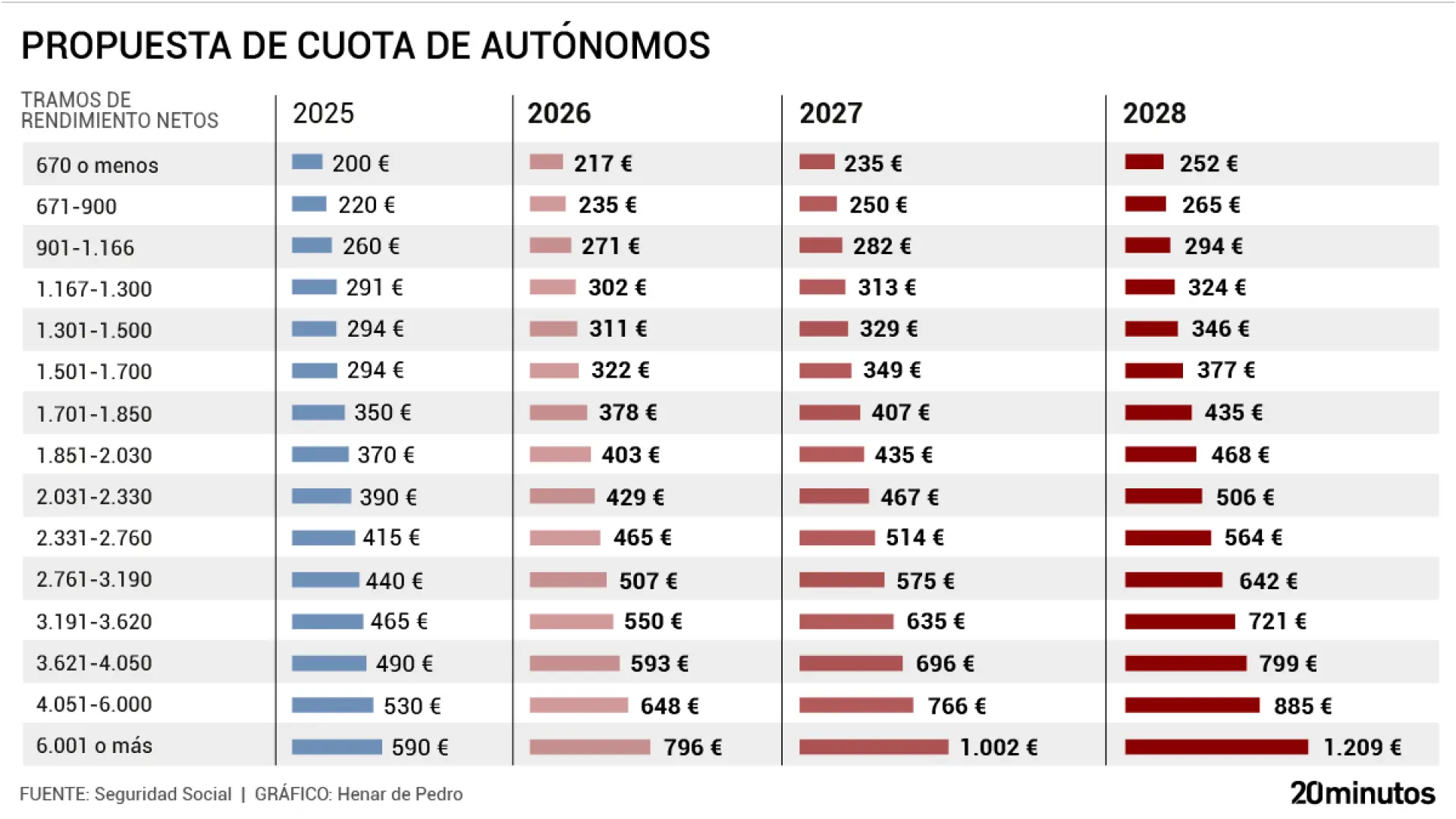
This is how the fees for the self-employed will increase from 2026
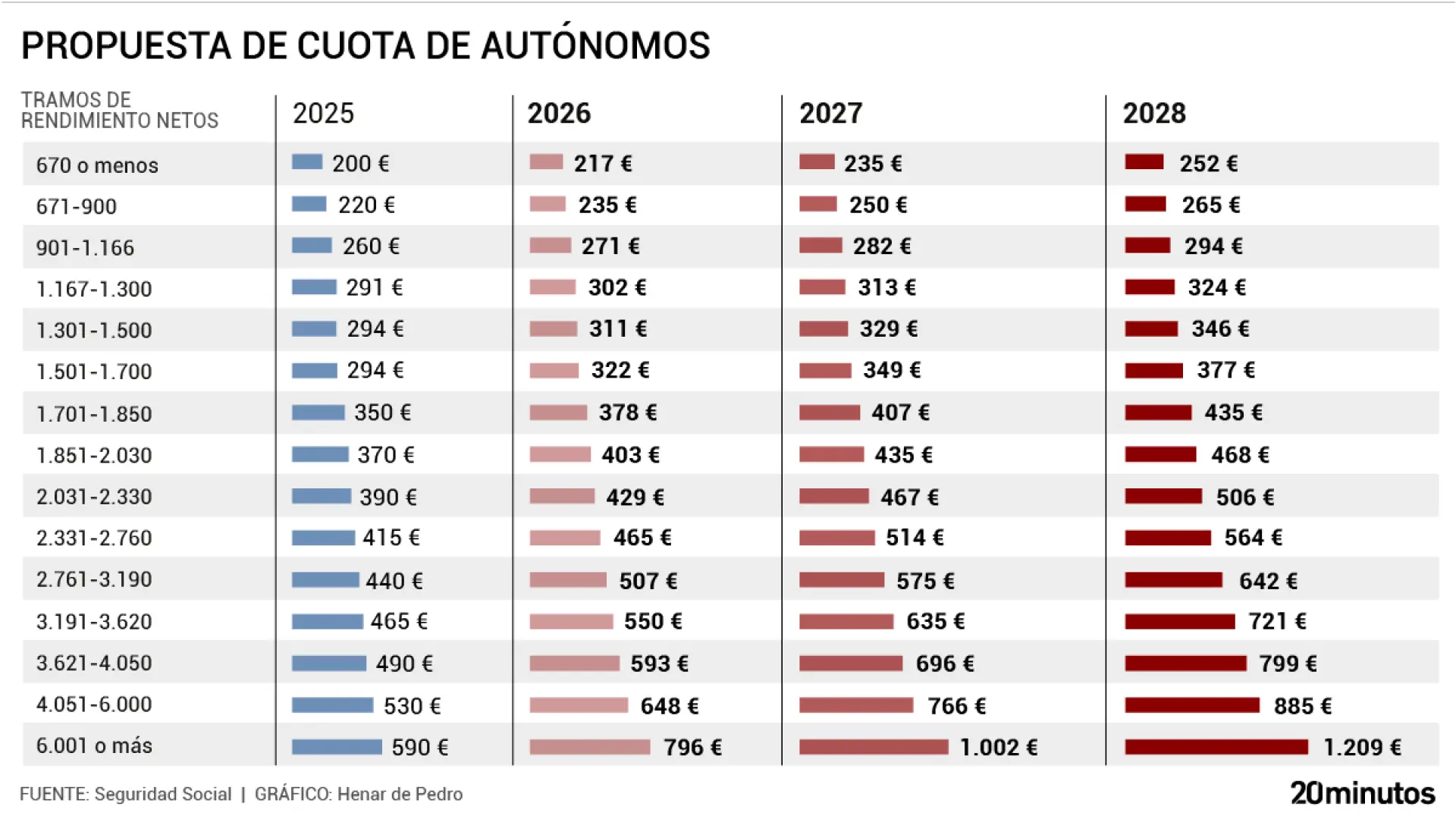
The self-employed will pay more from 2026. That is, at least, the proposal that the Ministry of Social Security has made with the agents and associations of self-employed workers for the years 2026, 2027 and 2028.
In practice, the Government proposes a new table of fees that will be calculated according to the real income of each self-employed person. This means that, depending on how much you earn, the monthly contribution to Social Security will be different. If the proposal goes ahead, the fees will rise between 11 and 206 euros per month starting in 2026.
Specifically, the Executive establishes 15 contribution brackets based on annual net income of each self-employed worker, and all sections increase, although in different proportions: the increases range from 3.8% to 35%. In general, the increase is progressive – self-employed workers with higher income will pay more – although there is also a slight inverse progressivity in the lower brackets, below the interprofessional minimum wage.
In this way, for example, self-employed people with lower incomeup to 670 euros per month, They would pay 17 euros more, leaving their fee at 217 euros per month. On the other hand, those who earn between 1,166 and 1,300 euros would see an increase of 11 euros, up to 302 euros per month.
For their part, the self-employed with higher incomeof more than 6,000 euros per month, would be the ones who notice the increase the most: Your fee would increase by 206 eurosreaching 796.24 euros per month.
The new system would affect both the reduced table (that is, those who earn less than 1,166.70 euros per month) and the general table, which includes another twelve income brackets. For example, a self-employed person with returns similar to an average salary—between 2,030 and 2,330 euros per month— It would go from paying 390 euros in 2025 to 428.53 euros next year.
In the proposal, the Ministry states that these increases be repeated linearly not only until 2028, as the table shows, but until 2031 includedcomplying with the agreement signed between the Government and the self-employed associations in 2022, which included a progressive deployment of the contribution model based on real income until 2032.
The complete rise table
- Income of up to 670 euros per month: The fee will be 217.4 euros per month in 2026, with an increase of 17 euros.
- Income between 670 and 900 euros per month: The fee will be 234.85 euros per month, with an increase of 15 euros.
- Income between 900 and 1,166 euros per month: The fee will be 271.24 euros per month, with an increase of 11 euros.
- Income between 1,166.7 and 1,300 euros per month: The fee will be 302 euros per month, with an increase of 11 euros.
- Income between 1,300 and 1,500 euros per month: The fee will be 311 euros per month, with an increase of 17 euros.
- Income between 1,500 and 1,700 euros per month: The fee will be 322 euros per month, with an increase of 28 euros.
- Income between 1,700 and 1,850 euros per month: The fee will be 378 euros per month, with an increase of 28 euros.
- Income between 1,850 and 2,030 euros per month: The fee will be 403 euros per month, with an increase of 33 euros.
- Income between 2,030 and 2,330 euros per month: The fee will be 439 euros per month, with an increase of 39 euros.
- Income between 2,330 and 2,760 euros per month: The fee will be 465 euros per month, with an increase of 50 euros.
- Income between 2,760 and 3,190 euros per month: The fee will be 507 euros per month, with an increase of 67 euros.
- Income between 3,190 and 3,620 euros per month: The fee will be 550 euros per month, with an increase of 85 euros.
- Income between 3,620 and 4,050 euros per month: The fee will be 593 euros per month, with an increase of 103 euros.
- Income between 4,050 and 6,000 euros per month: The fee will be 648 euros per month, with an increase of 118 euros.
- Income greater than 6,000 euros per month: The fee will be 796 euros per month, with an increase of 206 euros.
The response to the Government’s proposal
The rejection of this proposal has been frontal by the main association of self-employed workers, ATA, whose president, Lorenzo Amor, has considered the proposed increases for the minimum bases and monthly fees paid by these professionals to be excessive. “We are not willing to take a new swipe at the self-employed and it will not have the endorsement of ATA, they can now prepare the decree and take it to Congress and let the political parties be the ones to deal with it, but with ATA they do not count,” he complained in statements to the media.
For its part, the Union of Self-Employed Professionals (UPTA) has positively valued the Social Security proposal and has reminded ATA, which rejected it, that it is a very similar model to the one approved by all associations in 2022, including the one chaired by Amor.
However, Eduardo Abad, president of UPTA, has pointed out the need to introduce some adjustments, such as the creation of an even lower bracket for freelancers in the artistic and content creation field. This section would allow those who are already affiliated with other schemes and whose income from these activities does not exceed 4,000 euros per year to contribute with very reduced contributions.