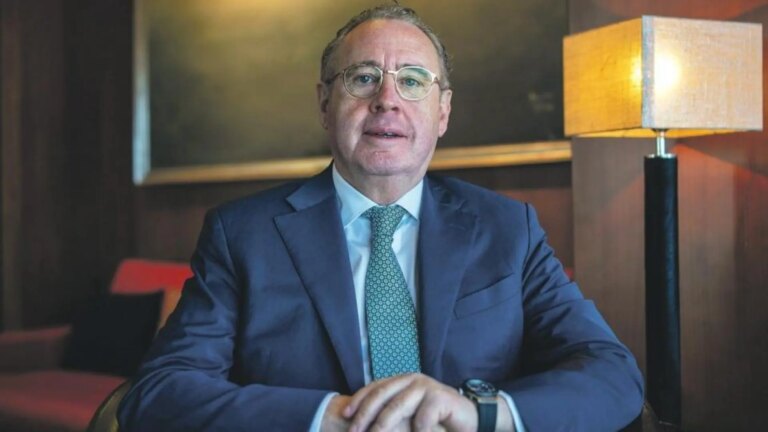
“50,000 million more could be granted in mortgages”
He “excess” regulation in Europe It is weighing down credit for SMEs and mortgages. The president of the Spanish Banking Association (AEB) has challenged the requirements of countercyclical capital buffers, beyond Basel IVwhich in practice imply less financing from the sector. “The exceptional decisions of European regulators and supervisors represent 270 billion in capital, with a growth in the last four years of 100,000 million, that if it had been half, the entities would have had an additional 50,000 million to grant loans for housing,” he noted.
During the presentation of number 190 of the Economistas magazineentitled ‘Banking: transformation and competitiveness’, a monograph that analyzes the key challenges facing the European financial sector in a context of profound technological, regulatory and strategic transformation, Kindelán has done a call for “simplification” regulatory as a “social” issue with practical application to families and companies. “That is why we say that this is a matter of political responsibility,” he pointed out.
In this line, the president of the banking association in Spain has been critical of the number of laws that are passed at the community level. “For our sector alone, the European Union published 13,000 new regulations in 2019. In the same period, in the United States there were barely 5,000. The banking is a paradigmatic case of this regulatory overproduction,” he maintains, adding that this situation entails the daily application of one and a half regulations, counting weekends. Kindelán considers that in this context the adoption of the prudential framework – the one in charge of ensuring banking solvency – becomes “unaffordable”.
This complexity, according to the head of the AEBalso extends to the area of supervision, where the pressure has increased. If six years ago they faced three supervised performances per year, in 2023 was raised to eight, which also entails an increase in costs by 160%, “giving more and more resources to supervisors.” Kindelán has also taken the opportunity to address the project to create the European Deposit Guarantee Fund (EFDG), an “essential” initiative to ensure homogeneous coverage of those deposited, but also so that entities are assessed for their solvency.