civil servants lost purchasing power again, while employees gained and pensioners maintained it
There are only a few hours left for the Puerta del Sol clock to end 2025 that, as far as the pockets of Spanish workers are concerned, has been marked by a slowdown in salary increases. The majority of the country’s income groups (private employees, pensioners, recipients of subsidies…), except for civil servants, have been saved from losing purchasing power, although this will be little consolation after 2022 (when inflation rose 8.5%) from which few have recovered.
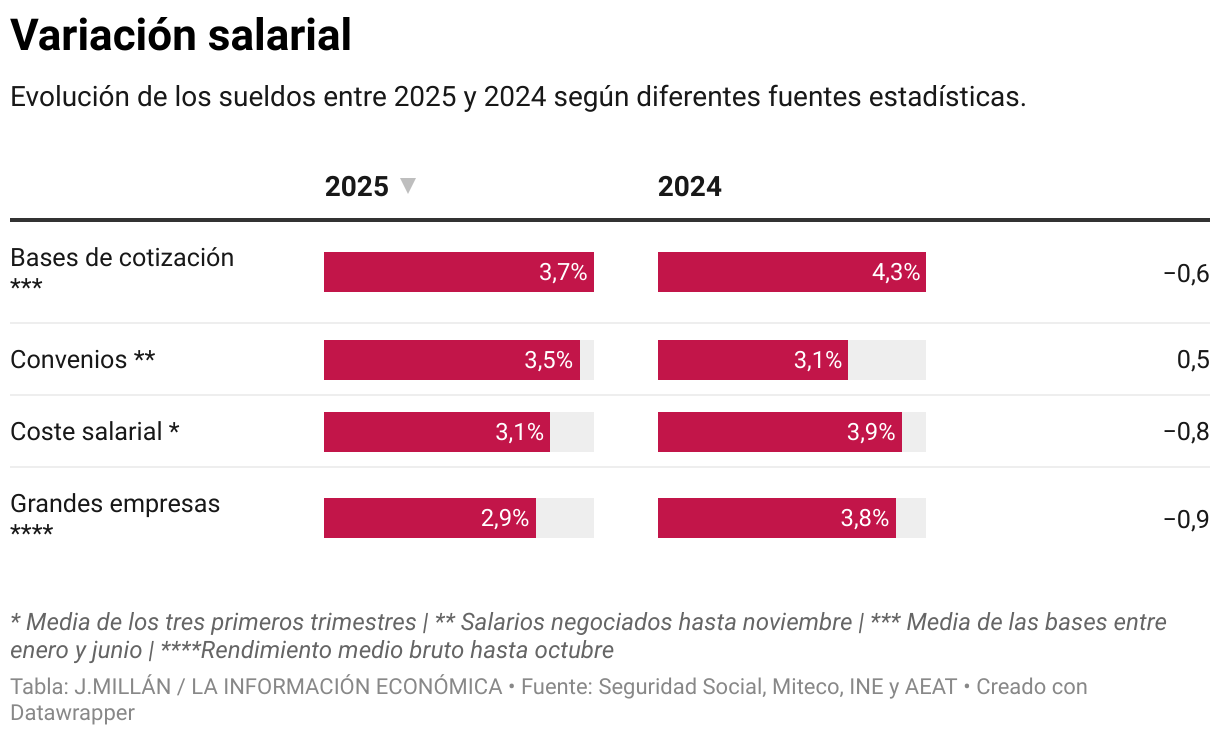
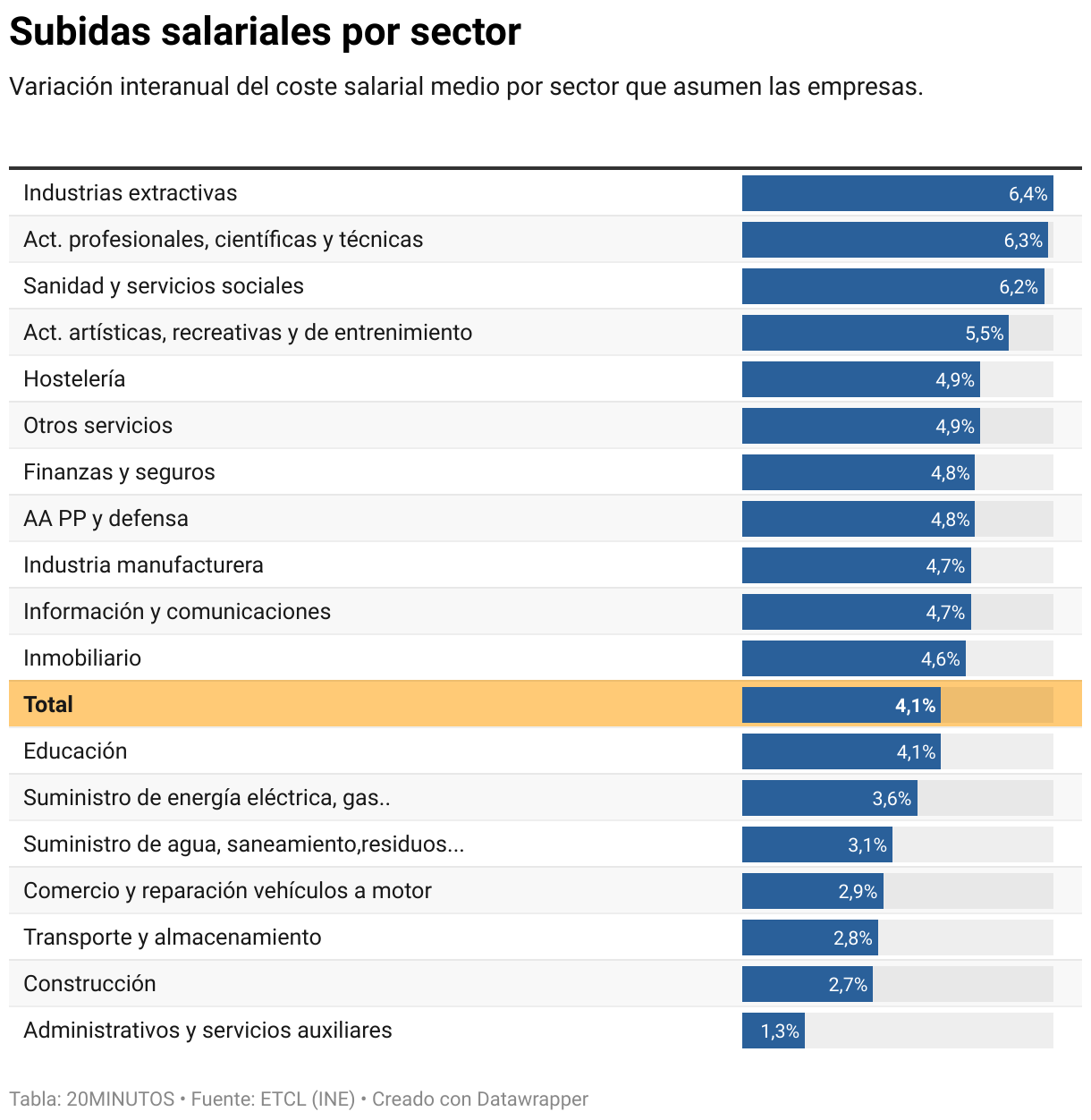
The data that is available at this date – the final figures will take months to be published – indicate that gross salaries have increased by around 3.1% in 2025. This is reflected by the average of the first three quarters of the year of the Quarterly Labor Cost Survey (ETCL) of the INE, the most updated salary statistics of those prepared by the organization.
That 3.1% average would be enough to beat the rise in consumer prices, which closed the year at 2.7%. However, the trend of the year has been an increasingly pronounced slowdown in payrolls. If we only take the data for the third quarter (last available), the increase would remain at 2.8%, practically the same as the cost of living has increased. These figures contrast with the 3.9% salary increase seen in the first three quarters of 2024.
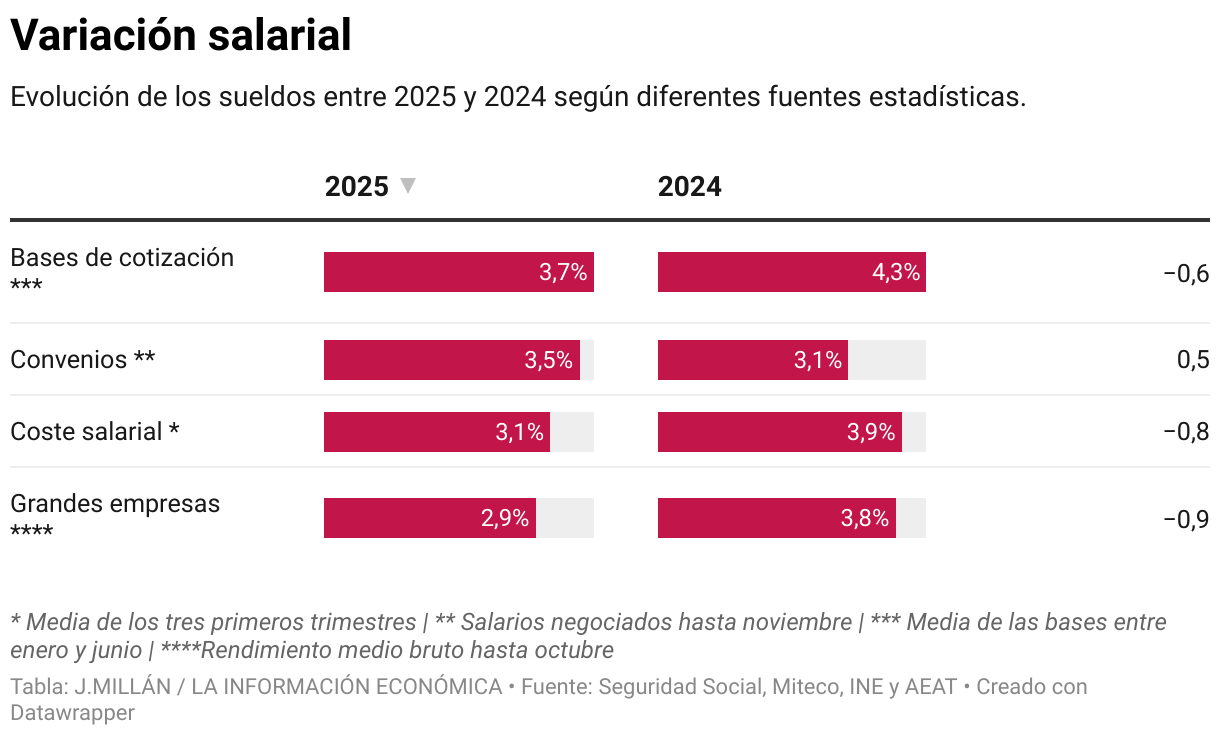
Other salary references point in a similar direction. For example, the Tax Agency’s sales, employment and salary statistics in large companies reflect that the average gross return (a concept similar to the average salary) increased by 2.8% until October. A notable slowdown compared to the 3.8% experienced in 2024.
The only salary reference that shows a different picture is that of collective agreements. The agreements agreed until November included salary increases of 3.5% on average, compared to the 3.1% that was registered at this point in 2024. However, it must be taken into account that a non-negligible part of the agreements agree on salary increases for a given year, but they are approved later, so not all the information is available yet.
Officials lose again
Within the vast group of 18.9 million employees in the Spanish economy, there is a subgroup that has lost purchasing power. These are the 3.5 million public employees in the country, for whom the 2.5% increase that the Government approved in extremis does not compensate for the rise in consumer prices. This is the fourth consecutive year in which civil servants, who have an average salary considerably higher than that of the private sector, lose purchasing power. However, the situation could be reversed in 2027, the year in which a salary increase of 4.5% has been agreed for the group.
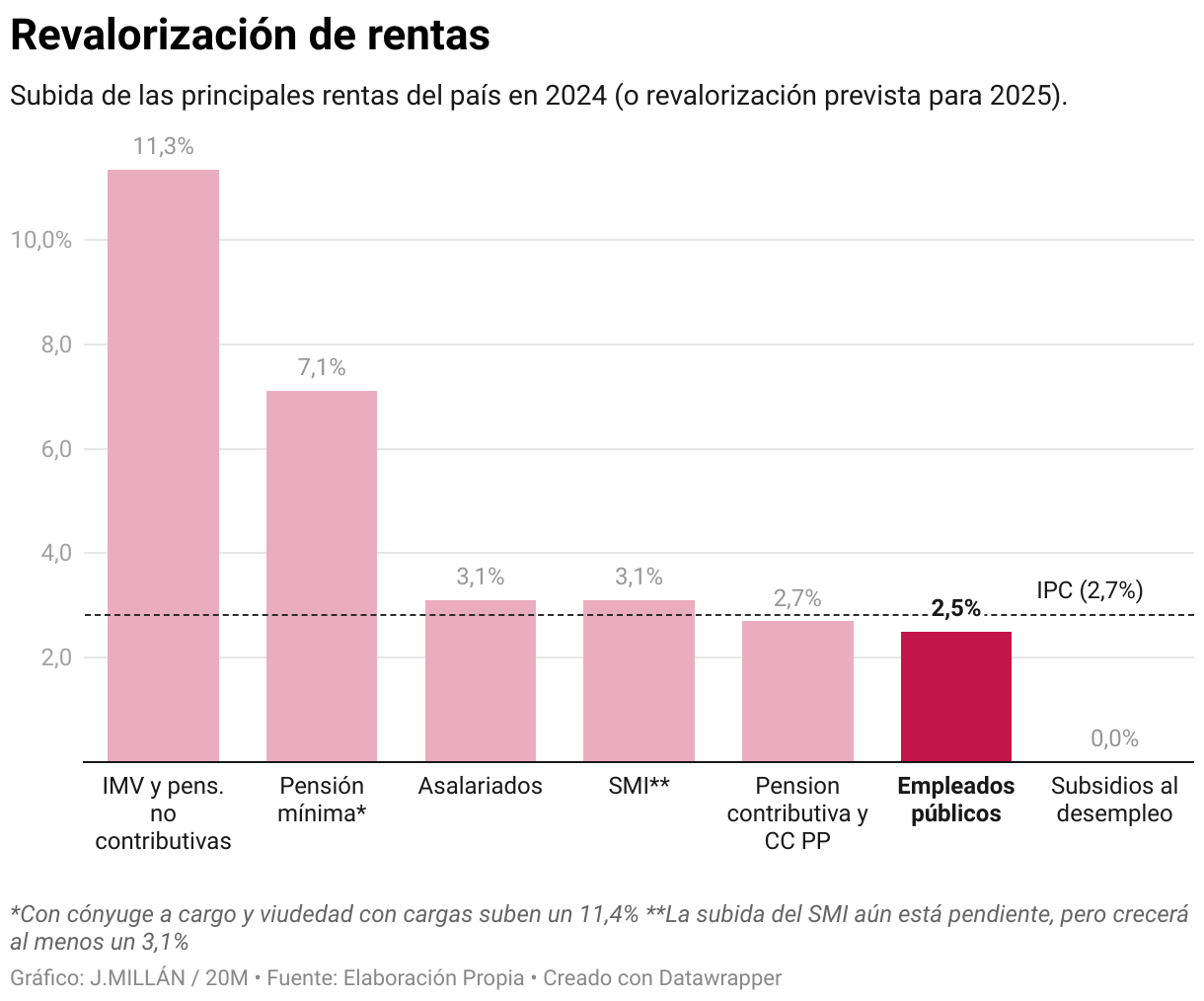
On the other hand, everything indicates that minimum wage recipients will once again gain ground on inflation. The increase that the Ministry of Labor is finalizing with a view to approving it at the end of January, will be at least 3.1%, a range sufficient to beat consumer prices. In fact, it cannot be ruled out that the Ministry of Labor will finally lean towards a larger increase, such as the 4.7% that sets the maximum range proposed by the experts who have been in charge of calculating the increase.
Armored pensioners
Outside the universe of employees, Pensioners have seen their income guaranteed once again. From 2022, public pensions are revalued in line with the Consumer Price Index (CPI) so their purchasing power is protected against inflation. In fact, the most humble benefits (minimum and non-contributory pensions) will once again gain purchasing power when they are revalued in 2026.
So, The minimum pension will increase by 7% in the event that the pensioner does not have family responsibilities and 11.4% when they do exist. In addition, non-contributory pensions will be revalued by 11.4%, the same figure that will be applied to the minimum vital income (IMV), the amount of which is linked to this benefit. On the other hand, the system’s maximum pension will rise by 2.8%, practically the same as consumer prices, but less than the maximum contribution base, which will rise by 3.9%.
Finally, there are a series of income groups that have seen their income frozen. It’s about the people whose income is linked to the Multiple Effects Public Income Indicator (Iprem)such as those receiving unemployment benefits. The Iprem has not been updated since 2023, the year in which it was set at 600 euros per month.