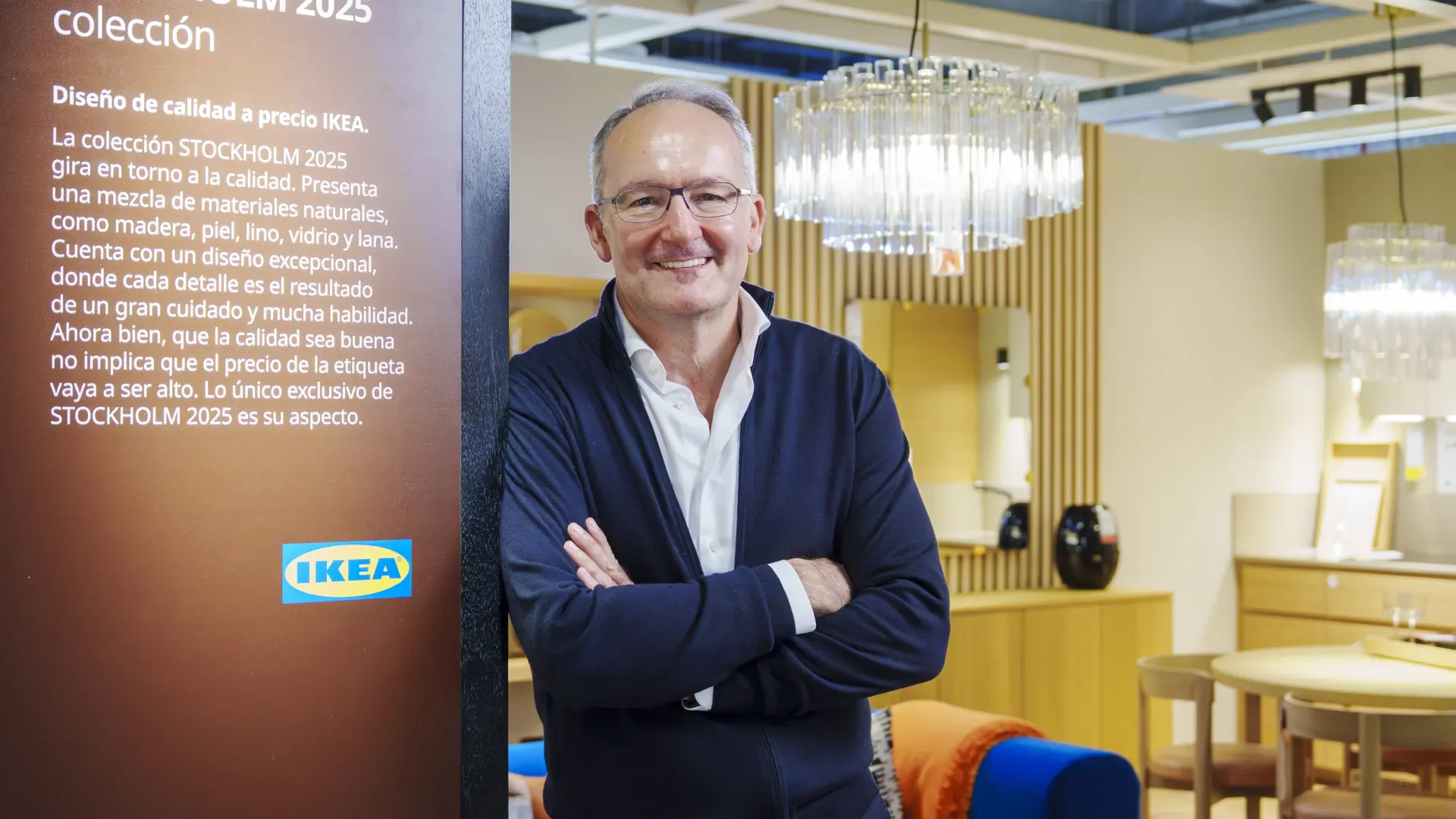
“My priority, in the coming years, is to grow and grow in both mature and new markets”

Since last week, the Spanish Juvencio Maeztuis at the helm of IKEA as its global CEO. The first not Swedish. He does so after a long career in the ‘house’ that dates back to 2001. Maeztu has been store director in Alcorcón, Seville and Wembley (United Kingdom) between 2001-2012, as well as head of Human Resources for Spain and Portugal between 2006 and 2009. He has also directed the implementation of IKEA in India between 2012 and 2018. He has been a director for 7 years deputy delegate and financial director of IKEA. “I started at IKEA 25 years ago, because my wife worked at IKEA “and it attracted me a lot,” summarizes Maeztu as a greeting before the interview given to a group of Spanish journalists. This Tuesday the company reported that its net profit rose 35% in fiscal year 2025 – which closed on August 31 – up to 1,411 million euros. Along these lines, it closed with a greater number of clients and formats, although revenues fell a slight 0.9% to 41,451 million. Which he attributes to economic uncertainty and the cost of living, which impacted the consumer.
After a long career at IKEA, you take charge of the Swedish group, the first Spaniard to do so. What are your priorities for the future?
I would like to start with what is not going to change: the company’s great strategic framework. It will not change our vision: creating a better everyday life for the most people, the founder’s greatest gift. Second, the business idea will not change, which is to offer magnificent home decoration products at affordable prices, so that the majority can purchase them, and the third thing that will not change are the three strategic pillars: that IKEA is more affordable, that is, at a lower price; that IKEA is more accessible by being closer to customers; and, thirdly, that IKEA is more sustainable. Then my closest priority in the coming years ands grow and grow in both mature and new markets, or that they are just starting out, and where we are still small, because there is a good chance that IKEA will grow. I will also focus on being more efficient as a company, more resilient because the world we live in will continue to be complex and, thirdly, for me it is an even more critical issue from the point of view of the company’s leadership.: to be a company that is much more agile and simpler. The more companies grow, the more bureaucratic they become and they have to be much more agile and simpler. Complexity must be transformed into simplicity.
IKEA in Spain has record revenues, but global sales have slowed slightly. Is there still room for IKEA to continue lowering prices?
At Ikea we do not seek to maximize profit because the owner of the company is Ingka, a foundation. After paying 30 or 32% in taxes, 85% of the profit remains in the company, to continue investing, and the remaining 15% is a ‘dividend’ that goes to the IKEA Foundation to support charitable, social activities… With which, Our long-term vision is to help people have a better life at home and this is the pillar of who we are. Which leads us to make very long-term decisions such as lowering prices. Last year what we wanted happened: We have lowered the billing figure a little, but We have turned up the volume, which is what we wanted. We have increased the number of physical visitors to stores: There are 736 million people, while physical sales have grown by more than 1%. Online sales have increased by more than 4%, with more than 4,000 million visits. This means that IKEA is becoming more necessary and relevant. There is still a lot of potential, because IKEA is still small, we have to continue furnishing many homes. There is a lot of potential to lower prices and to grow we have to continue lowering them. In the long term we are focused on lowering prices.
Where IKEA wants to grow
What are the new markets where you want to grow?
When I talk about a new market, I mean those where we are still relatively small. I’m talking about India, China, the United States… These are markets where we are present but we are still small and we will continue to grow. But also There is a lot of potential within Europe. Because it is increasingly difficult to make ends meet, more difficult to have a home, and, we confirm, that it is increasingly necessary to have a life at home at affordable prices. Since the answer to all of the above is yes, this is confirmation that IKEA is still very relevant in Europe.
You are also happy with online sales, can you expand on this point?
Now it is at 30% or so of total sales and remains relatively stable after Covid. They rose, but have remained relatively stable.
So, do you have any prediction that they will increase or remain the same in the coming years?
The important thing is that there are cities like London that are at 50% and there are other smaller cities or towns that are at a lower figure. In the end, The important thing is the combination that today you visit a store but buy online. Or tomorrow you buy online and end up picking it up in the store. What is relevant is the combination for the customer, and throughout this process, the physical store will continue to be at the backbone of what IKEA is.
Openings and the future of IKEA Food
How many openings are you doing, on average, per year?
More or less 50 stores of all types of formats may be opening, depending on the years, but more or less 50 a year. There aren’t many closures, but there have to be. We are in a company that is growing and that is increasingly adjusting and closures are a natural part of expansion. In the end, IKEA will always continue to grow. In Spain, openings have been announced in Vitora and Gerona – the first opened shortly after this conversation – and in Girona, work has already begun on the store, which will surely be ready after Christmas.
IKEA Foods was a refuge during the last economic crisis, now that customers are saving again. Do you notice an increase in consumption in your cafeterias?
IKEA Food many years ago began as a way to feed a clientele, a hungry or thirsty customer, when they came to an IKEA store. Nowadays It’s starting to be a movement for people to come to IKEA. and makes the visit more pleasant. Our goal, as with furniture, is to offer our products at affordable prices. That is why it is so successful, we are also offering a menu that is also sustainable and where there is more and more variety but also more ‘plant based’ production of vegetable proteins. Besides, we have managed to reduce more than 50% of food waste in recent years applying artificial intelligence. IKEA Food is becoming a way to get much closer to customers. The idea is that it is always integrated with a store or with an IKEA format, not a totally independent business unit.
Spain’s contribution to IKEA
We have talked in this interview about how much IKEA contributes to Spain, but what is Spain contributing to Ikea on a global level?
Spain has been and is very important in the IKEA world. I say this because of how IKEA, from the beginning, connected with Spanish society and the IKEA brand was part of the brand positioning. Secondly, also because of the amount of innovations that have occurred in Spain. Many of the formats that we are opening in Tokyo, Shanghai, London or Manhattan (New York), in their day They left Spain. Thirdly, because of the talent pool. There are many Spaniards who are in the global world at IKEA. I am one of them, but there are many more.