The Canary Islands, Balearic Islands and Andalusia lead economic growth in Spain in 2025
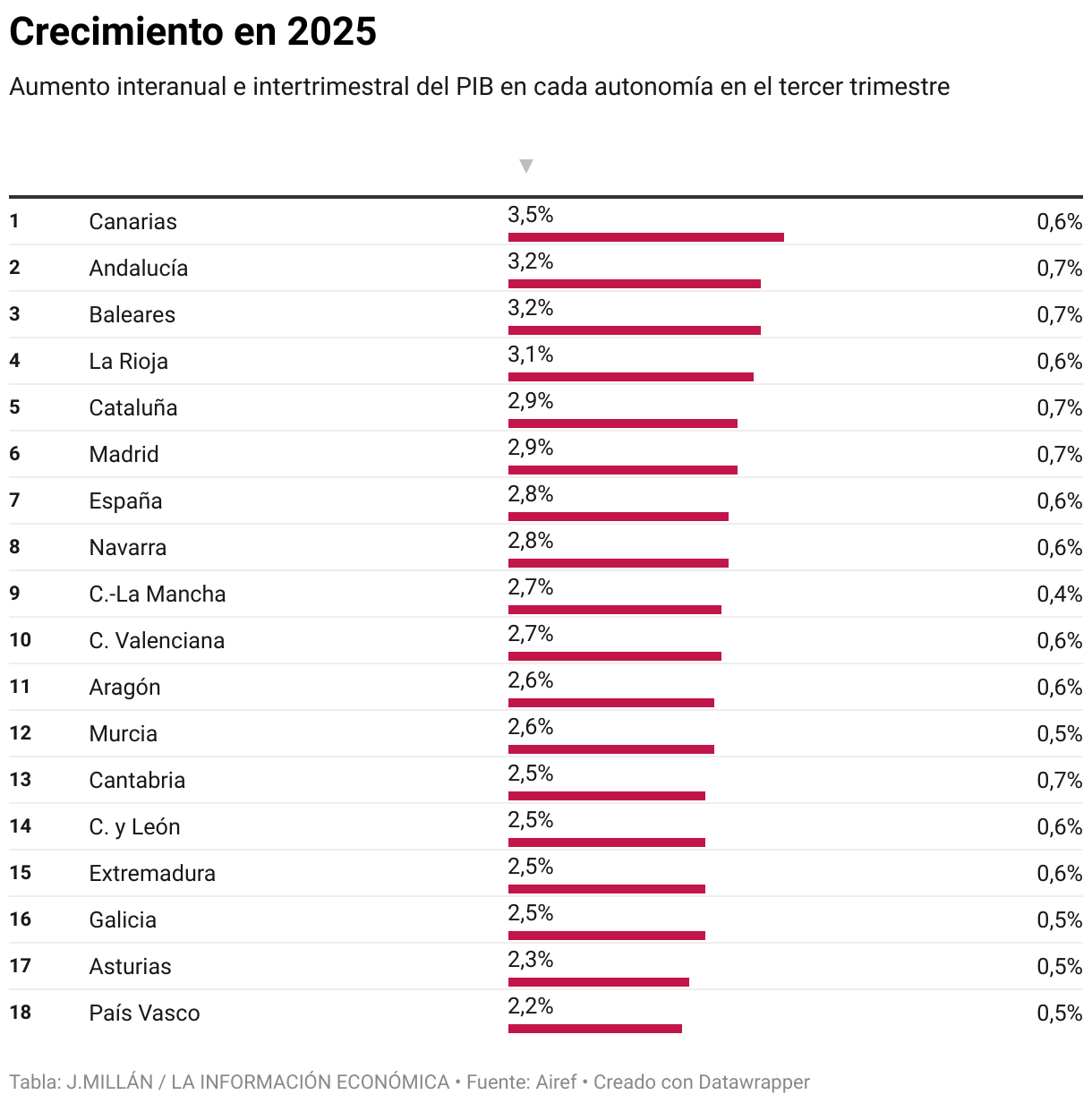
The Canary Islands, Andalusia, the Balearic Islands and La Rioja are the autonomous communities that are pulling the most on the national economy so far this year. These four territories grew at a rate of more than 3% year-on-year in the third quarteraccording to the regionalized estimates of GDP in the third quarter published by the Independent Authority for Fiscal Responsibility (Airef) this Monday.
According to Airef calculations, The Canary Islands recorded year-on-year growth of 3.5%closely followed by Andalusia and Balearicswhich reported a GDP increase of 3.2% and also for La Rioja, where the economy advanced 3.1% in the third quarter compared to the previous year. Madrid (2.9%) and Catalonia (2.9%) close the list of communities that grew above the national average (2.8%) in said period.
The increase in economic activity was also notable in Castile-La Mancha and Valencian Community (2.7% each); in Aragon and Murcia (2.6%) and in Cantabria, Castile and León, Estremadura and Galicia (2.5%). The two communities that have grown the least so far this year are Asturias (2.3%) and the Basque Country (2.2%) which, despite closing the list, are advancing at a rate greater than 2% year-on-year.
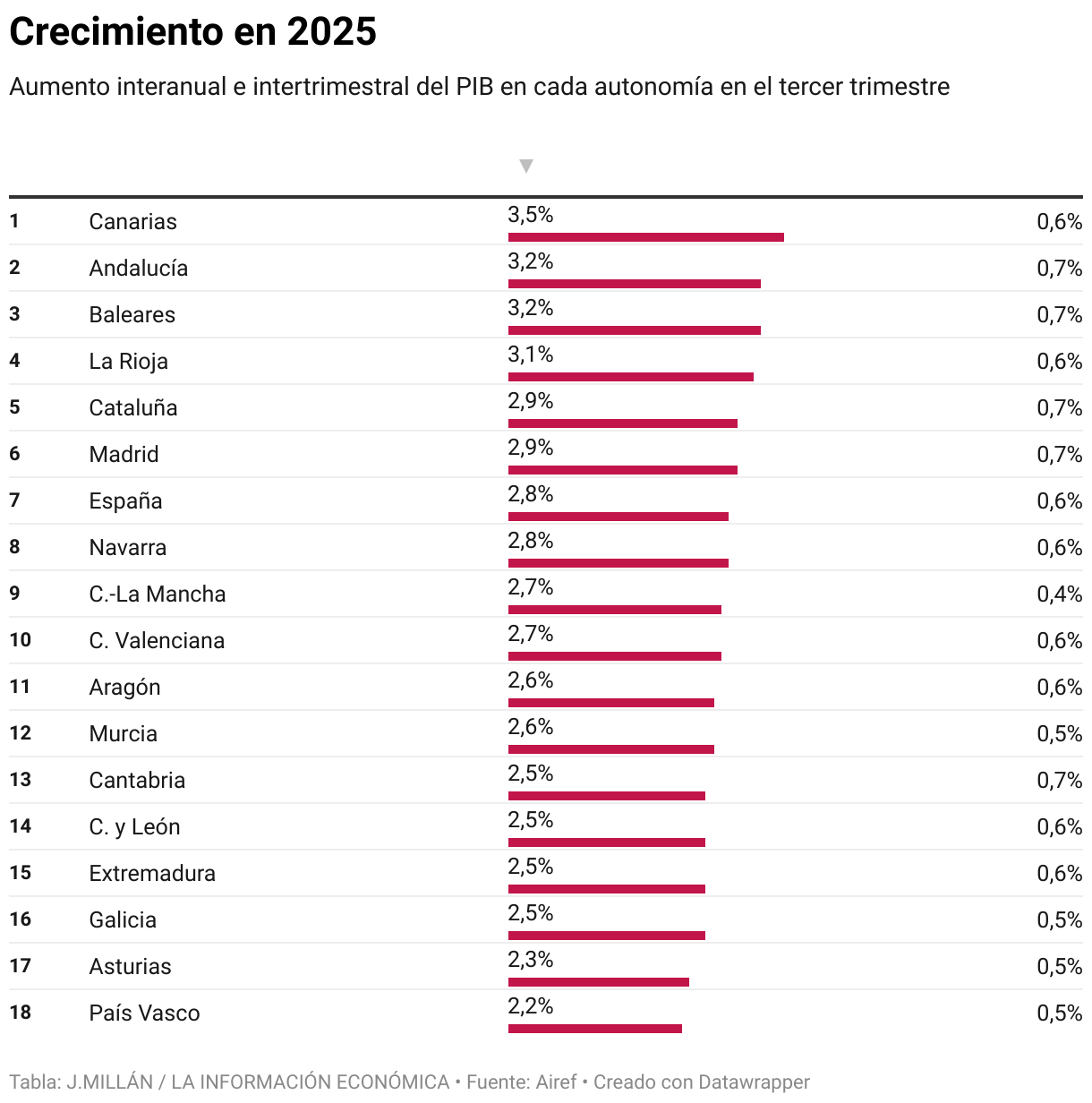
If the focus is placed on the advance of GDP between quarters, instead of comparing with the previous year, The most dynamic territories were Andalusia, the Balearic Islands, Cantabria, Catalonia and Madrid. These five autonomous communities grew at a rate of 0.7% quarter-on-quarter, one tenth faster than the country as a whole.
Behind them, appears a block of territories that grew at a rate of 0.6%. These are Aragon, the Canary Islands, Castilla y León, the Valencian Community, Extremadura, Navarra and La Rioja. They close the ranking Asturias, Galicia, Murcia and the Basque Country (which advanced 0.5%, one tenth less than the national average) and Castile-La Manchawhich grew by 0.4%.
At the national level, the economy lost some steam in the third quarterafter registering a 0.6% increase in GDP. The fall in foreign demand hindered growth, but was offset by a greater boost in household consumption and business investment. Most analysts place the expected GDP growth for this year at around 3%, pending the reading of the fourth quarter data.
Madrid leads in growth since the pandemic
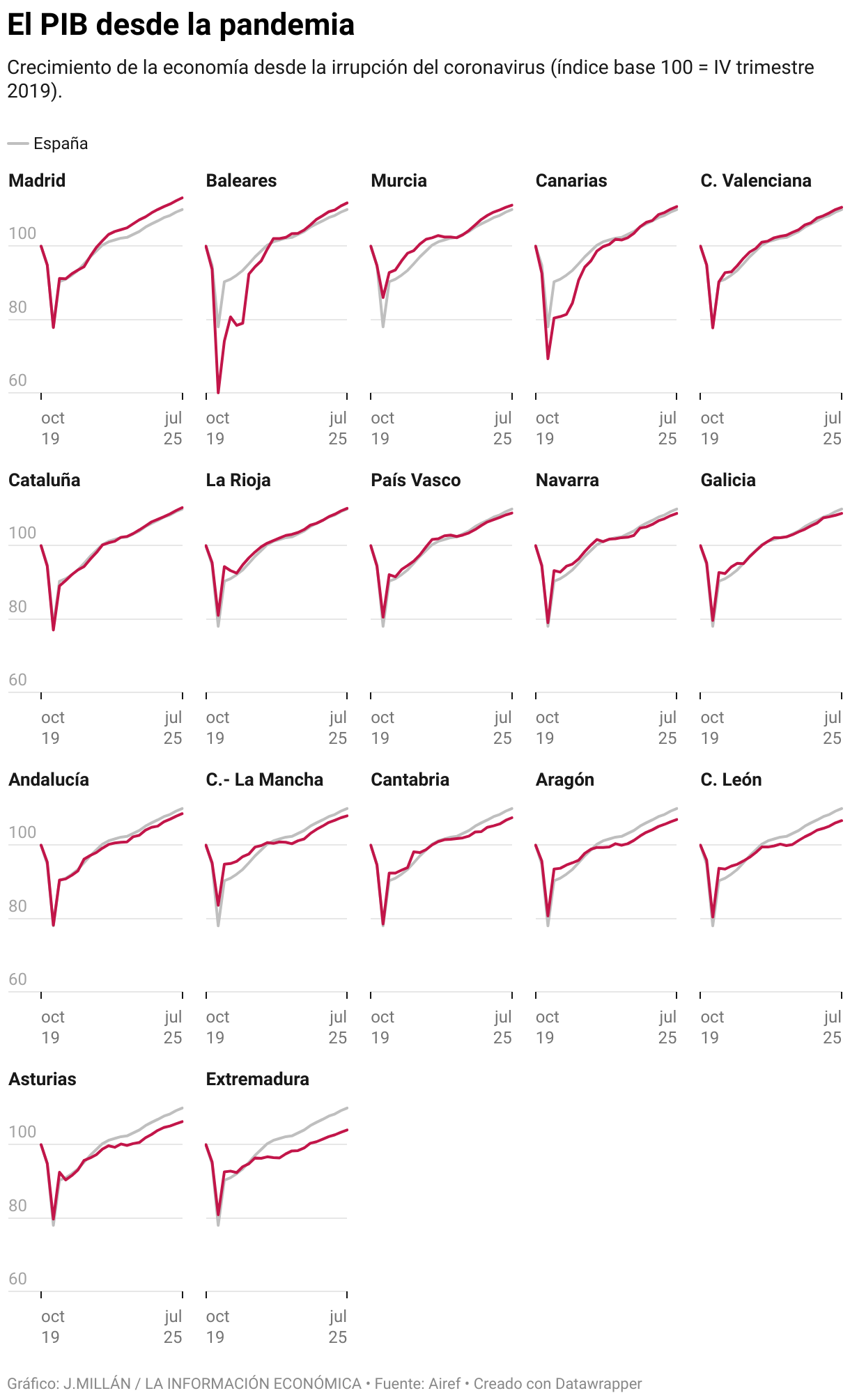
More than five years after the coronavirus, all regional economies have clearly exceeded their production level prior to the coronavirus. shock pandemic. However, heThe path that some have followed is quite disparate.
The community that has grown the most since the fourth quarter of 2019 (the last one not contaminated by the virus) is Madridwhose GDP level is now a 13.2% higher than then. They follow him Balearics (11.8%); Murcia (11.2%); Canary Islands (10.8%); Valencian Community (10.6%); Catalonia (10.4%) and Rioja (10.2%). All of them above the national average of 10%.
Already below the average they appear the Basque Country (8.9%); Navarre and Galicia (8.8%); Andalusia (8.6%); Castile-La Mancha (8%); Cantabria (7.5%) and Aragon (7%). The three most lagging territories are Castile and León (6.7%), Asturias (6.3%) and Estremadurawhich closes the list with a GDP increase of just 4%, three times less than Madrid.