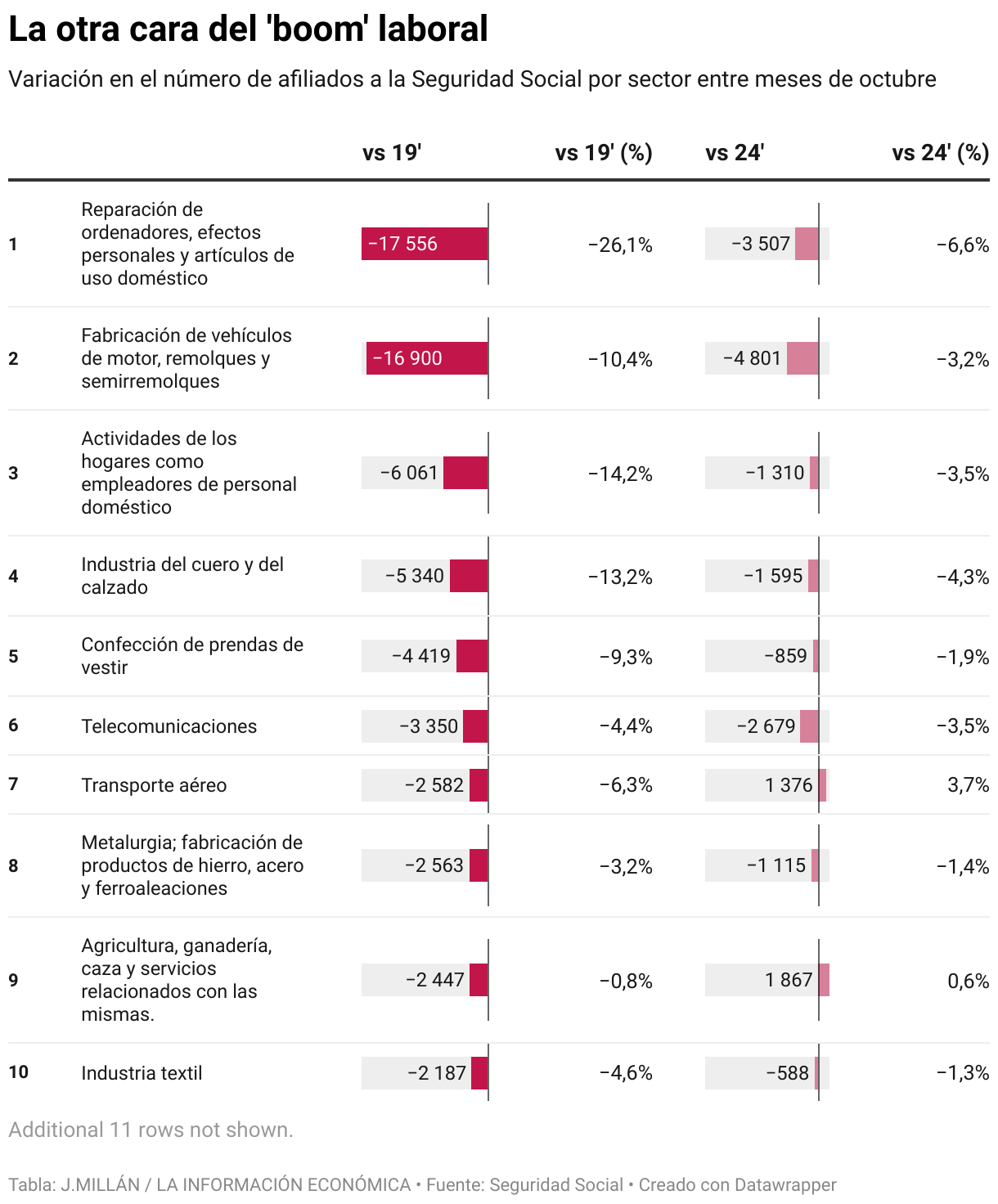
the automobile industry and 20 other sectors have lost workers since 2019
Spain is surfing a wave of employment since the pandemic that is boosting its economy to place it at the head of growth in a stagnant Europe. Even with its own seasonal fluctuations, the Spanish labor market has a streak of 55 months of growth in year-on-year terms. Employment is growing at a rate of half a million jobs a year, spurred by the strong pull of services.
However, this upward employment cycle also has a bitter side. There are sectors where Social Security affiliation has not recovered since the pandemic for various reasons. These are 21 activities in which employment was still, still in October of this year, below the level recorded in the same month of 2019.
We are talking about sectors as sensitive to the national productive fabric as the automobile industry, the repair of computers and other household items, employment at home, the textile industry, telecommunications, air transport or the agricultural sector.
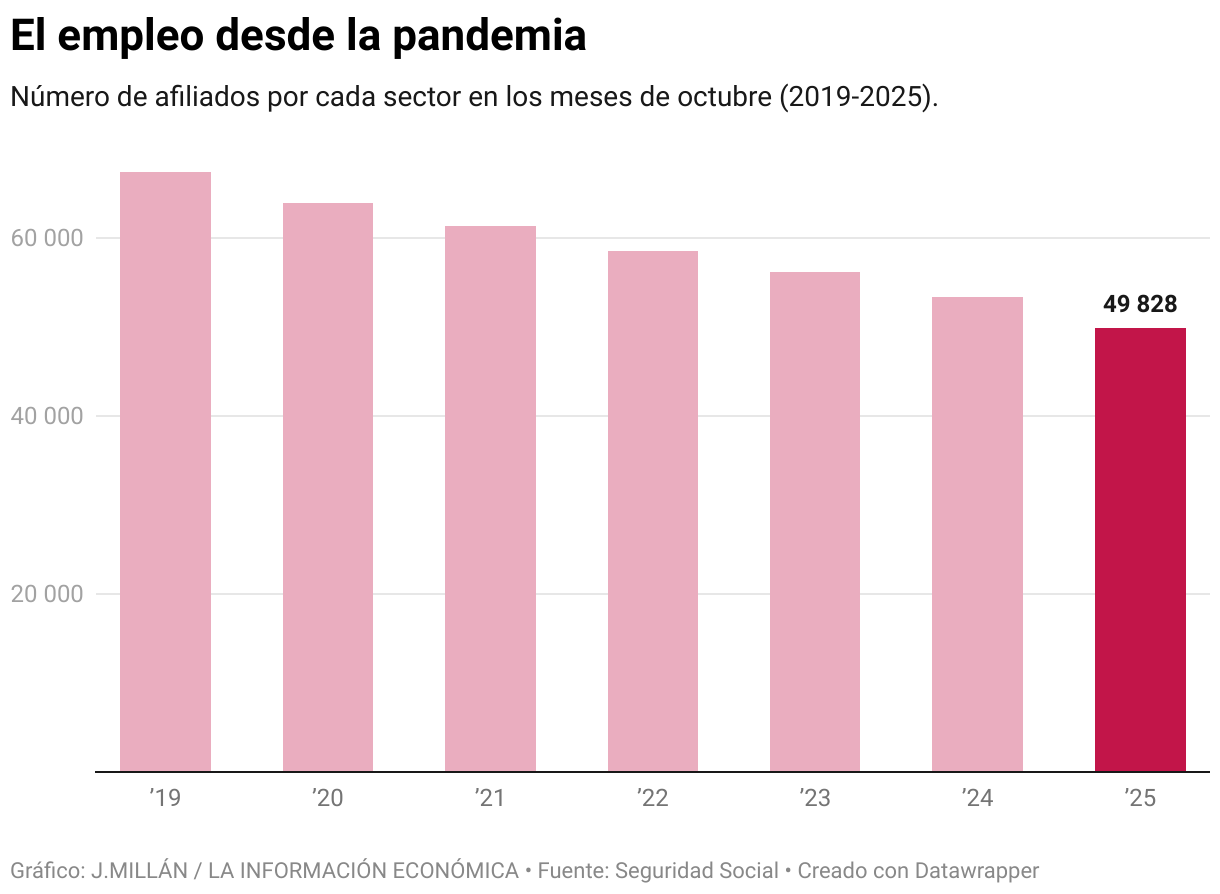
Within this ‘B side’ of the labor boom that Spain is experiencing, the situation of the automobile industry stands out above all. A sector, the automobile, which together represents 10% of the national GDP and contributes around 9% of the country’s employment, according to the employers’ association Anfac. Social Security affiliates in this section have fallen by 16,900 since October 2019, 4,800 of them in the last year. The 162,300 members registered in October 2019 have fallen by 10.4% in six years.
For María Jesús Fernández, senior economist at Funcas, this job decline is due to a “very deep European crisis” in the automobile industry. Regulatory changes and the transition from the combustion engine to the electric engine are discouraging the consumer, he explains. Similarly, the emergence of the Chinese electric vehicle is beginning to show effects.
Fernández warns of the risk that this job decline will worsen if European industry does not manage to regain competitiveness. “We are in a moment of transition, where industries do not know very well what to do, there is a lot of investment in electricity and it is not going well. Combustion has an expiration date, prices have risen a lot due to the effect of electrification…”, he points out.
The evolution of the automobile sector is key for the country as a whole, but it is crucial in certain areas of the national geography. Ford manufacturing plants in Valencia; those of Iveco in Madrid and Valladolid; those of Stelantis in Vigo, Zaragoza and Madrid; those of Seat and Ebro in Barcelona or those of Nissan in Santander and Ávila (to name some of the most important) are very relevant employment vectors.
Change in consumption patterns
In other sectors experiencing declines in employment, the factors behind them are harder to explain. One of the sectors that attracts the most attention is the repair of computers, personal effects and household items, which has experienced a decline in employment of 17,556 affiliates (a drop of 26.1% in six years), the most pronounced in the entire labor market.
One hypothesis that could explain the collapse in employment is the change in consumption patterns that has been seen since the pandemic broke out in 2019. However, the heterogeneity of the jobs included in this section (from mobile phone repairs to piano repair, garden machinery or clothing) makes it difficult to draw conclusions.
The third sector where the most jobs have been destroyed since 2019 is that of domestic workers. Today Social Security counts 6,061 fewer jobs in this activity than six years ago. In this case, the effect of the strong increases in the minimum wage since 2019 (it has grown by 31%) have been a determining factor for the decline, explains Fernández, who sees it likely that a portion of those jobs have gone to the underground economy.
Another sector in decline is the manufacturing of clothing products. Thus, the leather and footwear industry (5,340 fewer jobs); clothing manufacturing (4,419) or the textile industry (2,187). In this case, strong competition from Asia, added to changes in consumption patterns, may be behind it.